Controversy Over Groups Claiming to Monitor for "Election Fraud"
Targeting Voters at Polling Stations
Controversy has arisen as individuals claiming to monitor for "election fraud" have engaged in activities at some polling stations during the early voting for the 21st presidential election, attempting to find evidence of "Chinese interference" in the election. These individuals attempted to identify Chinese nationals by checking voters' Korean language proficiency.
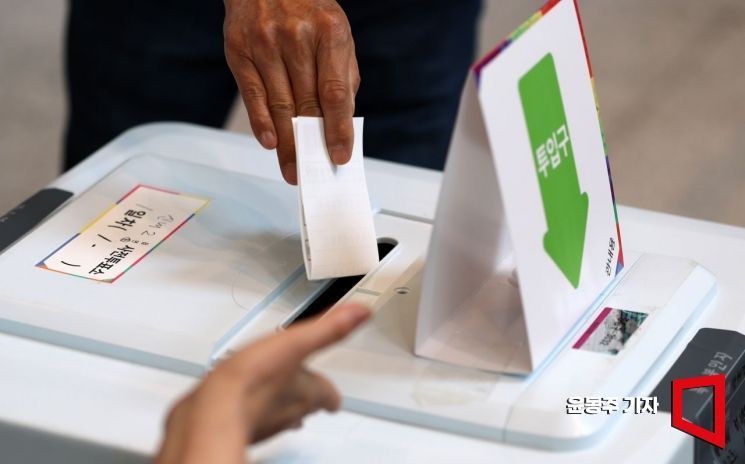 On the first day of early voting for the 21st presidential election, on the 29th, voters are casting their ballots at the Sinnae 2-dong early voting station set up at Jungnang District Office in Jungnang-gu, Seoul. Photo by Yoon Dongju
On the 29th, Yonhap News reported that at around 1 p.m. that day, five to six young people and YouTubers gathered in front of the Daerim 2-dong early voting station in Yeongdeungpo-gu, Seoul, claiming they were there to monitor for election fraud. This polling station is located in an area with a large population of Chinese residents and ethnic Koreans from China.
They approached people coming out after voting and said, "We're university students, and our professor gave us an assignment," then asked, "What kind of country is our country?" One man in his 30s claimed, "Chinese people could forge their identities to vote," and added, "Wouldn't it be strange if we spoke to someone and they couldn't speak a single word of Korean?" They attempted to identify Chinese nationals by checking Korean language proficiency.
Previously, Hwang Kyo-ahn, an independent presidential candidate who leads the "Election Fraud and Corruption Prevention Corps," had pointed to the early voting stations in Gayang-dong, Gangseo-gu and Hwayang-dong, Gwangjin-gu?areas with large Chinese communities in Seoul?as "examples of election fraud" on his YouTube channel.
Experts have expressed concern that election fraud theories are fueling anti-Chinese sentiment and could encourage discrimination against immigrants. Under current law, foreign nationals do not have the right to vote in presidential elections.
On the same day, at various early voting stations in areas such as Gangnam and Gwacheon, individuals were also seen counting the number of voters, claiming to be monitoring for election fraud. It is reported that two people were stationed near each major early voting station, directly tallying the number of voters entering the polling stations.
Some citizens reported that "suspicious people are filming around the early voting stations, claiming to be monitoring for election fraud," but no illegal acts were found to have occurred.
Meanwhile, the National Election Commission has decided that it is necessary to fundamentally prevent any controversy over the fairness of early voting. Accordingly, starting from this early voting period, the commission is releasing the number of voters at each polling station every hour, in addition to providing 24-hour CCTV access to the early ballot boxes and public ballot inspection procedures.
© The Asia Business Daily(www.asiae.co.kr). All rights reserved.

![Clutching a Stolen Dior Bag, Saying "I Hate Being Poor but Real"... The Grotesque Con of a "Human Knockoff" [Slate]](https://cwcontent.asiae.co.kr/asiaresize/183/2026021902243444107_1771435474.jpg)














