First Solo Exhibition in Korea at Gladstone Gallery
Showcasing Oil Paintings Inspired by Journeys Around the World
Spires rise throughout the paintings, and mosque-like structures featuring Arabesque styles are depicted. This is a technique known as "Ottomania," a style invented by the renowned Italian artist Salvo (1927?2015). Inspired by a trip to Morocco in 1974 with his longtime friend Alighiero Boetti, Salvo spent the following decade traveling through Greece, Turkey, and the former Yugoslavia. After these journeys, he began to use spires as a key motif in Ottomania. Salvo was drawn to spires because, despite their simple forms, they carried divine and religious messages.
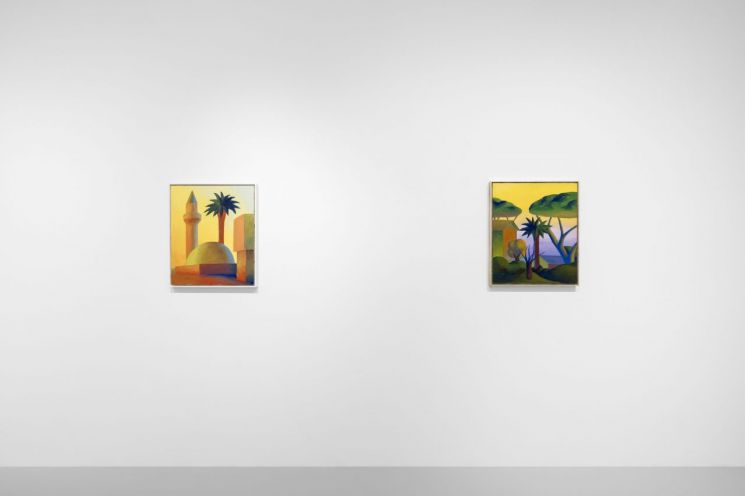
Salvo's travels continued into the 1990s, and the inspiration he gained from these journeys is reflected in his artwork. He usually traveled by driving himself, and the works inspired by these trips have been brought together for his first solo exhibition at Gladstone Gallery, centered on the theme of "travel." The exhibition is titled "Salvo, in Viaggio." The works on display are oil paintings created between the 1980s and 2010s, inspired by Salvo's travels around the world. This marks his first solo exhibition in Korea. The artist presents pieces that depict both real landscapes he witnessed and imagined environments from his journeys through the Middle East, North Africa, Europe, and Asia.
In fact, Salvo did not start out as a painter. In his early years, he was devoted to conceptual art using a variety of materials. However, in 1973, he shifted to painting, unveiling avant-garde works that depicted vividly colored and diverse landscapes. At the time, conceptual art?such as bringing horses or stones into exhibition spaces?was the norm, so Salvo's turn to painting was seen as unexpected. Regarding this, Norma Mangione, Salvo's daughter and co-founder of the Salvo Foundation, explained at a press conference held at Gladstone Gallery on the 29th, "My father did not want to be an artist who lived only in his own era; he aspired to live as a master like Van Gogh, whose influence transcends time."
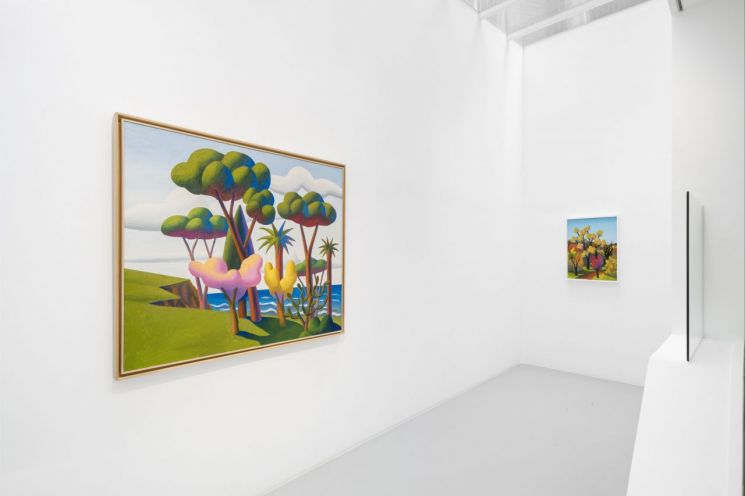
One of the hallmarks of Salvo's paintings is the rare appearance of human figures. This is because, in keeping with the theme of travel, he focused on landscapes. According to the Salvo Foundation, which has identified the whereabouts of Salvo's works based on reports from various sources, there are about 4,000 pieces in existence. Of these, the foundation owns around 400, and with few exceptions, most of his paintings do not feature people.
Another distinctive feature of Salvo's work is his avoidance of black. Salvo deliberately excluded black from his palette, believing that black does not exist in nature. Norma Mangione explained, "Even shadows are not truly black, as they reflect the color of the object, so he chose not to use black."
Although most of Salvo's works are based on places he visited, the piece "KHIVA" (2015) was completed without ever having visited the city. The painting reflects the artist's longing for Khiva, a city in Uzbekistan he deeply wished to see in his later years.
Salvo, who is regarded as a master who made a significant mark on the history of contemporary Italian art, is holding his first solo exhibition in Korea at Gladstone Gallery until July 12.
© The Asia Business Daily(www.asiae.co.kr). All rights reserved.













