Bank of Korea:
"Withdrawal of U.S. Reciprocal Tariffs Could Push Growth Rate Above 0.9%"
Cautions Remain Over Limited Impact and Structural Challenges
The Bank of Korea projected on May 29 that if the United States withdraws its reciprocal tariff policy following a ruling by a U.S. federal court, South Korea's economic growth rate could exceed 0.9% this year. However, the Bank also noted that even if reciprocal tariffs are lifted, item-specific and base tariffs will remain in place, so the growth rate is not expected to improve significantly.
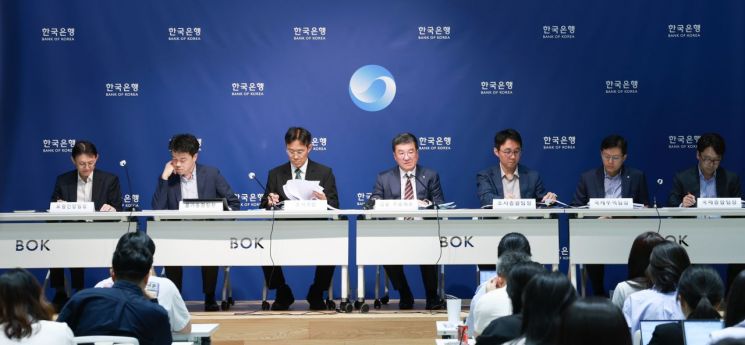 May 29 afternoon, Economic Outlook Briefing held at the Bank of Korea in Jung-gu, Seoul. (From left) Kyunghoon Park, Head of Model Forecasting Team; Gaguk, Head of Inflation Trends Team; Jiho Lee, Director of Research Department; Woong Kim, Deputy Governor; Changhyun Park, Head of Research Coordination Team; Jaemin Baek, Head of International Trade Team; Sejun Park, Head of International Comprehensive Team. Provided by the Bank of Korea.
Woong Kim, Deputy Governor of the Bank of Korea, stated at an economic outlook briefing that afternoon, "If the U.S. reciprocal tariffs are withdrawn, the situation would be similar to or better than the optimistic scenario we have presented."
In its May economic outlook, the Bank of Korea revised its growth forecast for this year downward from 1.5% to 0.8%. The Bank also presented how the growth forecast would change under optimistic and pessimistic tariff policy scenarios, estimating that under the optimistic scenario, the growth rate could rise by an additional 0.1 percentage points this year and 0.2 percentage points next year.
Reflecting this, the withdrawal of reciprocal tariffs could push South Korea’s economic growth rate above 0.9%. Specifically, the optimistic scenario assumes a 10% tariff rate on Korean products. If reciprocal tariffs are canceled, the average tariff rate would drop to 9.7%. In its February outlook, the Bank of Korea reflected a tariff rate of 5?10%, while in the May outlook, it raised the average to 13?15%.
On the night of May 28, the U.S. Court of International Trade ruled that President Donald Trump had exceeded his authority by imposing reciprocal tariffs on various countries, declaring the tariffs invalid in the first trial.
Deputy Governor Kim said, "We have calculated the direct effect on exports to the U.S., but have not yet calculated the impact through other countries, psychological effects, or the effects that would result from the resolution of uncertainty, so it is difficult to provide a specific figure at this time." He added, "There are still processes remaining, such as injunction requests, so we will monitor the situation and reflect it in our outlook."
The Bank of Korea also stated that if a second supplementary budget is implemented, the growth rate could improve further. Deputy Governor Kim said, "We have reflected the first supplementary budget of 13.8 trillion won in our outlook, but have not conducted scenario analysis or included the second supplementary budget in our forecast." He added, "If the second supplementary budget is pursued, it would be a factor that raises the growth rate."
The Bank of Korea emphasized that the significant downward revision of the economic growth rate was largely due to sluggish construction investment. However, it also stressed that indiscriminately promoting construction to boost the economy would not be helpful for long-term economic growth.
Jiho Lee, Director of the Research Department, pointed out, "In the past, when the economy was in severe downturn, there were calls from all sectors to boost construction investment. When excessive construction or a boom occurred, household debt accumulation was the final result, which directly reduced the capacity for private consumption. Measures taken to address economic downturns ended up seriously exacerbating South Korea’s structural problems."
He further commented on future construction investment, stating, "Considering aging demographics and supply-demand imbalances between regions, it will be difficult to see a significant increase in housing construction. Investment in non-residential infrastructure such as roads has already matured, and there is already a high vacancy rate in commercial buildings, making further construction unfeasible. Companies also tend to invest more in intangible assets rather than tangible assets like factories. Given these structural and long-term trends, it is difficult to expect construction investment to continue driving South Korea’s economy."
He added, "It is no longer the case that building more cement structures in regional areas will improve our economy. Construction investment should be directed toward areas that are truly necessary and can contribute to future growth, such as the development of AI-related industries, so that it supports South Korea’s long-term economic prospects."
© The Asia Business Daily(www.asiae.co.kr). All rights reserved.












