Lotte Construction Secures Six Major Intellectual Property Rights in Q1
DL E&C Obtains Five; Hyundai Engineering & Construction and SK Ecoplant Also Secure Four Each
Development Directions Revealed... First-Mover Advantage in Technology

As new technologies such as artificial intelligence (AI) continue to attract attention across industries, construction companies are also intensifying efforts to secure intellectual property rights. The types of intellectual property rights being secured offer a glimpse into the future business models that each construction company is targeting.
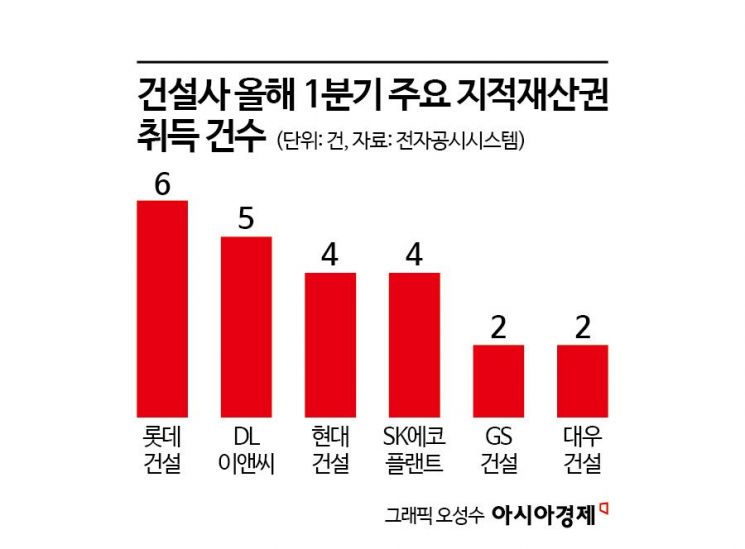
According to the Financial Supervisory Service's electronic disclosure system on May 31, Lotte Construction secured a total of six major intellectual property rights in the first quarter of this year. This included five patents and one certification for green technology from the Ministry of Land, Infrastructure and Transport. As of the first quarter, Lotte Construction holds 193 patents and 18 new technologies certified by the government.
Lotte Construction's intellectual property portfolio shows a clear focus on modular construction. All five patents obtained in the first quarter relate to modular construction, such as a joint structure that prevents water leakage without waterproofing work when combining modular housing units. Modular construction is mainly used in Western countries such as Europe, and involves prefabricating 70 to 80 percent of the building process, including the basic framework and electrical wiring, in a factory and then assembling the components on site like Lego blocks.
Other construction companies are also striving to develop new technologies through intellectual property rights. In the first quarter, DL E&C secured five major intellectual property rights, while Hyundai Engineering & Construction and SK Ecoplant each obtained four. Both GS E&C and Daewoo E&C increased their intellectual property portfolios by two each.
However, it remains uncertain whether acquiring these intellectual property rights will have a direct impact on future revenue or performance. The companies noted in their disclosures that "it is not possible to quantify the expected effects, such as contributions to the company's current revenue, from intellectual property rights." Nevertheless, construction companies are investing personnel and resources in patent commercialization because the industry is experiencing a boom in smart construction, with increasing reliance on new technologies such as AI integration and diversification of construction methods to improve operational efficiency.
The intellectual property rights being secured also reveal the technological focus of each company. Hyundai Engineering & Construction obtained patents for construction-related 3D printing devices and AI-based safety and health education systems and methods. SK Ecoplant focused on environmentally friendly technologies, acquiring patents for methods and devices to calculate greenhouse gas emissions, integrated waste management systems, and wastewater treatment. Both of Daewoo E&C's newly acquired patents relate to offshore wind power. GS E&C obtained patents related to modular construction as well as light rail track inspection vehicles.
An industry official explained, "Unlike traditional construction, it has become a key task to improve efficiency by integrating smart construction, AI, and robotics. Patents provide a competitive edge in securing technology, which is intensifying research and development competition among construction companies."
© The Asia Business Daily(www.asiae.co.kr). All rights reserved.













