"Decline in Birth Rate, Fewer Repeat Test-Takers, and Increase in Overseas Study Cited as Main Causes"
"Number of Applicants Drops, but Competition Expected to Remain Fierce"
This year, the number of students taking entrance exams to enroll in Chinese universities has decreased for the first time in eight years.
On May 29, China National Radio, citing data released the previous day by the Ministry of Education, reported that "the number of applicants for this year's national college entrance exam, the Gaokao, stands at 13.35 million, down by 70,000 compared to last year's 13.42 million." The report also noted that this is the lowest figure since 2017.
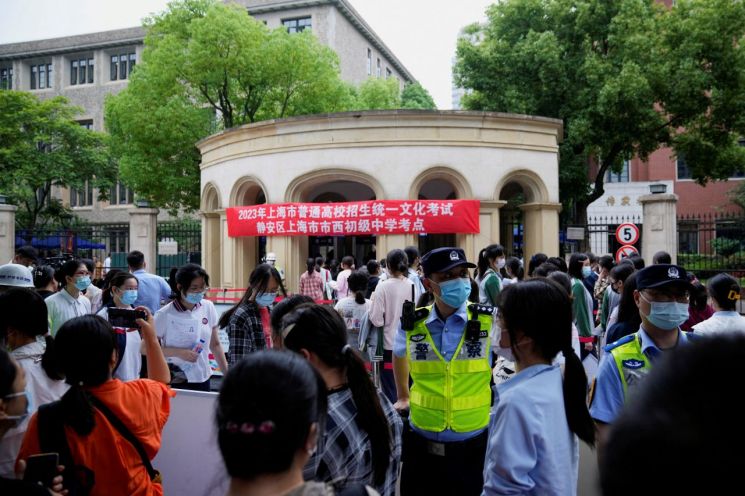 Students are lining up near police officers at a high school in Shanghai, China, to take the annual national college entrance exam, the Gaokao. Photo by Reuters Yonhap News
The number of applicants for university entrance in China has steadily increased over the past ten years. From 2015 to 2018, the figure remained in the 9 million range, and from 2019, it rose to 10.31 million. The number increased to 11.93 million in 2022, 12.91 million in 2023, and 13.42 million in 2024.
China National Radio cited the decline in birth rates as the main reason for the decrease in university entrance exam applicants. The students taking the exam this year were born in 2006 and 2007, with 15.81 million and 15.91 million births recorded in those years, respectively. The report also pointed out significant changes in the number of repeat test-takers. Last year, out of 13.42 million applicants, 4.1 million were repeaters. This year, however, the proportion of repeaters has decreased due to the introduction of a new entrance exam system and the diversification of admission methods.
The diversification of pathways to higher education has also been analyzed as a factor contributing to the decrease in applicants. The Chinese government has recently been vigorously promoting policies to expand vocational education. The revised Vocational Education Law of 2022 granted vocational education equal status with general education. In major cities such as Shanghai, a variety of vocational education programs have been expanded, including integrated secondary and higher vocational education and five-year integrated programs. This year in Shanghai, 210 integrated courses were established from secondary vocational schools to higher vocational schools, 80 integrated courses from secondary schools to universities, and 75 five-year integrated programs. An official from the city’s education department told China National Radio, "The diversification of vocational education and training methods, such as integrated secondary schools, five-year integrated programs, and secondary-to-higher vocational school integration, signals that Shanghai will continue to focus on cultivating technical talent in the long term."
The integrated secondary-to-higher vocational program refers to a system combining three years at a secondary vocational school with three years at a higher vocational school. The integrated secondary-to-university program connects secondary vocational schools with general universities (bachelor’s degree programs). These pathways allow students to advance to higher education institutions without taking a separate entrance exam like the Gaokao. As a result, some students are choosing alternative routes to university, such as the "vocational high school entrance exam" and the "technical high school entrance exam," instead of the Gaokao.
There is also an opinion that the number of students studying abroad has increased as more families become financially capable. China National Radio reported, "The number of Chinese students studying abroad in 2023 was 800,000," representing a 23% increase compared to 2019.
Although the number of university entrance exam applicants has decreased, competition is expected to remain intense. According to the Ministry of Education, the enrollment quota for universities and graduate schools nationwide will be further expanded this year. Pan Shudi, director of the Education Evaluation Center at Tongji University, advised, "Although the number of applicants nationwide has decreased, some regions have seen an increase. As there will likely be a concentration in certain departments and majors, it is advisable for test-takers to focus on fields that match their own abilities and interests."
© The Asia Business Daily(www.asiae.co.kr). All rights reserved.












