Presentation of Research Results on Improvement of Fatty Liver Indicators
Prevalence of Hepatic Steatosis Revealed at the European Congress on Obesity
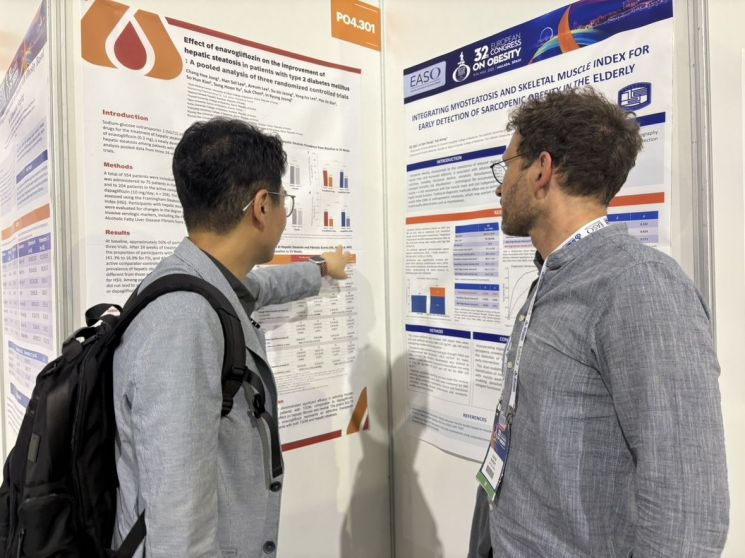 Professor Changhee Jung of the Department of Endocrinology at Asan Medical Center Seoul (left in the photo) is explaining research results to attendees. Photo by Daewoong Pharmaceutical
Daewoong Pharmaceutical's Enblo has demonstrated its potential as a new treatment option for patients with type 2 diabetes who also have fatty liver disease.
On May 29, Daewoong Pharmaceutical announced that it had presented research findings confirming improvements in hepatic steatosis indicators for its SGLT-2 inhibitor type 2 diabetes treatment, Enblo, at the 2025 European Congress on Obesity (ECO) held in Malaga, Spain on May 11.
Numerous studies both in Korea and abroad have reported that patients with type 2 diabetes often also have fatty liver disease. In fact, an analysis of three clinical trials of Enblo conducted by Daewoong Pharmaceutical found that approximately 50% of the type 2 diabetes patients who participated in the trials already had fatty liver disease at the start of the studies.
This study conducted an integrated analysis of the effects of Enblo on hepatic steatosis indicators using data from three phase 3 clinical trials involving a total of 554 patients with type 2 diabetes.
The results showed that patients who took 0.3 mg of Enblo daily for 24 weeks experienced a reduction in the prevalence of fatty liver, as measured by the Hepatic Steatosis Index (HSI) and the Framingham Steatosis Index (FSI), by 32% and 25% respectively compared to baseline, indicating that Enblo significantly improved the prevalence of hepatic steatosis.
In the Enblo treatment group, the prevalence of fatty liver based on the hepatic steatosis index decreased from 48.0% to 16.0% in the placebo-controlled study, and the prevalence based on the Framingham Steatosis Index decreased from 41.3% to 16.0%. The mean scores improved by -3.72 (p<0.0001) and -1.16 (p=0.0006) respectively compared to the placebo group, showing statistically significant differences.
In comparison with dapagliflozin, another drug in the same class, Enblo showed a significantly lower mean hepatic steatosis index by 1.02 points (p=0.0257), indicating a notable improvement.
These findings suggest that Enblo may offer additional benefits such as reducing hepatic fat accumulation, at a time when the prevalence of metabolic dysfunction-associated steatotic liver disease (MASLD) among patients with type 2 diabetes is steadily increasing. This is significant because it demonstrates the potential of Enblo not only for the treatment of type 2 diabetes but also for improving the commonly coexisting fatty liver disease.
Professor Changhee Jung of the Department of Endocrinology at Asan Medical Center Seoul, who led the study, explained, "SGLT-2 inhibitors fundamentally induce glucose excretion through urine, leading to weight loss. Enblo binds strongly to the SGLT-2 protein, enabling more effective glucose excretion. This weight loss may have contributed to the reduction in hepatic fat accumulation."
Park Hyungchul, Head of ETC Marketing Division at Daewoong Pharmaceutical, stated, "We are pleased to announce these meaningful research results, which present new possibilities for Enblo as a treatment option for patients with type 2 diabetes accompanied by hepatic steatosis. We will accelerate related research and development so that Enblo can contribute to improving the quality of life for patients with complex metabolic diseases, beyond just type 2 diabetes."
Meanwhile, Enblo is the 36th domestically developed new drug in Korea and the first SGLT-2 inhibitor type 2 diabetes treatment introduced by a Korean pharmaceutical company. Even at a low dose of just 0.3 mg, it delivers a powerful glucose-lowering effect compared to other drugs in the same class. Through various studies, Daewoong Pharmaceutical has demonstrated not only the superior glucose-lowering effect of Enblo but also its various benefits, including weight loss, improvements in blood pressure and lipid profiles, and enhanced insulin resistance.
© The Asia Business Daily(www.asiae.co.kr). All rights reserved.












