KITA Holds Industry Meeting in Busan
"Actively Conveying Voices from the Field to the Government and the United States"
As the Trump administration in the United States imposed a 25% tariff on auto parts following similar measures on automobiles, the Korean auto parts industry has voiced concerns about the resulting difficulties.
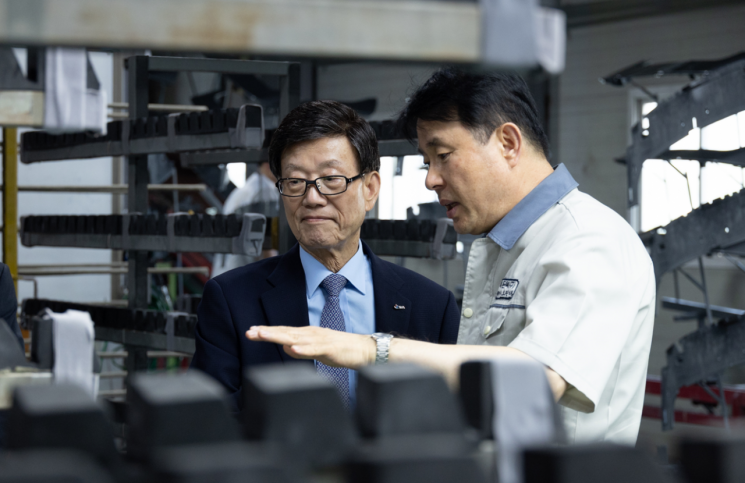 Yoon Jinsik, Chairman of the Korea International Trade Association, is visiting EdenTech, an auto parts manufacturing company located in Gangseo-gu, Busan, to receive an explanation about the products. On the left in the photo is Yoon Jinsik, Chairman of the Korea International Trade Association, and on the right is Oh Rintae, CEO of EdenTech. Photo by Korea International Trade Association
The Korea International Trade Association announced on May 29 that Chairman Yoon Jinsik visited EdenTech, a company located in Gangseo-gu, Busan, on May 28 to hold a 'Busan Auto Parts Industry Meeting' and listen to feedback from the field regarding the U.S.-imposed tariffs.
Five auto parts companies based in Busan attended the meeting to discuss the challenges and response strategies following the recent imposition of a 25% tariff by the United States on imported auto parts.
Oh Rintae, Chairman of the Busan Auto Parts Cooperative Association and CEO of EdenTech, said, "Since the 25% tariff was imposed on auto parts starting from the 3rd, operating profits for companies exporting to the U.S. have plummeted," and appealed, "If the U.S. tariff measures continue for an extended period, the very survival of these companies could be threatened."
He further emphasized, "Because the tariff issue is a trade matter that is difficult for small and medium-sized enterprises to address independently, active support from the government and the association is urgently needed."
A representative from Company A also stated, "Out of over 300 types of parts we export directly and indirectly to the United States, 48 types are classified as steel and aluminum derivative products and have been subject to a 25% tariff since March. For the remaining parts, we face general tariffs of 10% and auto parts tariffs of 25%. Each time the U.S. imposes additional tariffs, we experience difficulties with identifying affected items and responding accordingly."
He added, "Unlike parts from Mexico and Canada, which meet the United States-Mexico-Canada Agreement (USMCA) standards and are exempt from tariffs, Korean-made parts do not receive tariff exemptions, raising concerns about weakened price competitiveness."
Company A is currently absorbing about a 10% increase in costs through negotiations with finished car manufacturers, but warned that if the U.S. tariff measures continue for an extended period, not only will profitability deteriorate, but exports to the U.S. may become unfeasible altogether.
Participants at the meeting especially highlighted the uncertainty of U.S. tariff policies, the burden of tariffs being passed on to U.S. importers, and the contraction in demand due to increased manufacturing costs for finished vehicles in the U.S. as major challenges.
Chairman Yoon Jinsik explained, "During two recent visits to the United States, I met with governors of states where Korean companies have invested, members of the House and Senate, and senior officials from the Department of Commerce to emphasize that active investment and exports by Korean companies are making significant contributions to the advancement of U.S. high-tech industries and job creation."
He further promised, "Including today's meeting, we will closely assess the damage and feedback from the trade industry resulting from the U.S. tariff measures and actively communicate these to both the Korean government and the U.S. side."
© The Asia Business Daily(www.asiae.co.kr). All rights reserved.












