"Foreigners Deprive Americans of Harvard Admission Opportunities"
Refers to Columbia University, Says "Harvard Wants to Fight"
Responds to Criticism of Tariff Threats and Retreats: "That's Negotiation"
U.S. President Donald Trump has argued that the proportion of international students at Harvard University should be limited to 15%. Trump, who has been in conflict with major private universities in the United States due to issues of antisemitism and progressive tendencies, strongly criticized Harvard, stating that while Columbia University is cooperating with the government, Harvard is "hurting itself by fighting." He also expressed discomfort with criticism that he has imposed extremely high tariffs on various countries only to later lower them, describing this as a "negotiation" strategy.
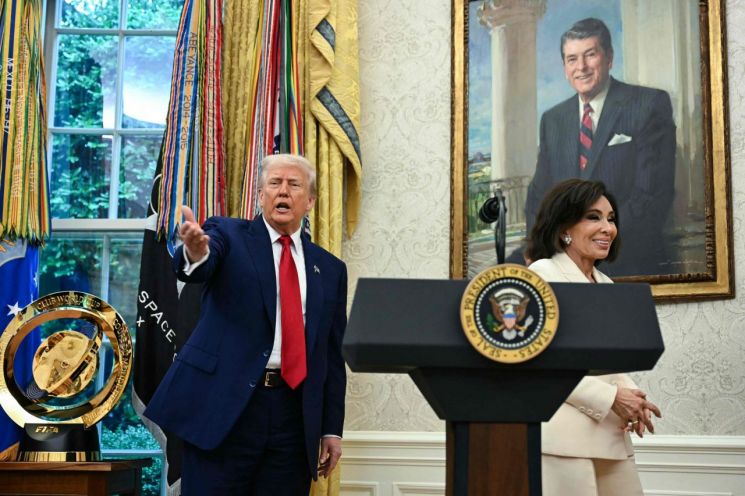
On May 28 (local time), President Trump told reporters at the White House, "Those who want to attend Harvard and other schools are unable to do so because of international students," and added, "Harvard should limit the proportion of international students to 15%, not 31%."
According to Harvard University, international students currently account for about 27% of the total 6,800 enrolled students. This figure has steadily increased from 19.6% in 2006, but it is still lower than President Trump's claim. However, if fellows and participants in non-degree programs are included, the number of international students at the university exceeds 10,000.
President Trump also mentioned Columbia University, criticizing Harvard for fueling conflict by opposing the government.
He said, "Harvard needs to understand that I do not want to harm them," and added, "Columbia University is very antisemitic and has done many other bad things, but they are working with us to find solutions." He continued, "On the other hand, Harvard wants to fight and show how smart they are, but as a result, they are being thoroughly defeated."
This statement is seen as targeting Harvard's recent legal response against various pressures from the Trump administration. Previously, the Trump administration pressured major private universities, including Harvard, by threatening to cut or freeze federal funding, demanding changes to campus policies and government intervention in personnel decisions. In particular, for Harvard, which refuses to "compromise," the administration has taken extremely tough measures, such as revoking the eligibility of international students to enroll. In response, Harvard immediately filed a lawsuit, and the court granted an injunction, suspending the effect of these measures.
President Trump's attempt to "discipline universities" was directly triggered by pro-Palestinian protests that erupted after the outbreak of the Gaza Strip war. However, some interpret the essence of this situation as a "culture war" and "ideological war" in which Trump is attacking progressive-leaning universities, thus engaging in a broader conflict with the entire progressive camp.
In this context, the U.S. State Department recently announced that it would strengthen the screening of social networking service (SNS) accounts for students seeking to enter the United States, and ordered all U.S. embassies and consulates worldwide to suspend all student visa interviews.
President Trump reiterated his stance that entry should be blocked for international students with anti-American tendencies, emphasizing, "International students must be people who can love America."
Meanwhile, President Trump showed visible displeasure when asked about the so-called "TACO trade," a term mocking his approach of threatening trading partners with extremely high tariffs and then lowering them again. TACO stands for "Trump Always Chickens Out," a neologism coined by a columnist at the Financial Times (FT) in the United Kingdom. The "TACO trade" refers to the expectation that even if President Trump threatens tariffs, he will soon back down and the stock market will rebound. In response to the reporter who asked this question, President Trump said, "That's a very nasty question," and countered, "That's what you call negotiation."
© The Asia Business Daily(www.asiae.co.kr). All rights reserved.












