Met with Reporters Before Special Lecture at Seoul National University
"In the Short Term, We Aim to Strengthen Our Fundamentals"
Trump Hints at 25% Tariff on US-Imported Smartphones
On Philippine Plant Expansion: "Discussions Underway"
Jang Deokhyun, President and CEO of Samsung Electro-Mechanics, met with reporters on the afternoon of the 28th at Seoul National University in Gwanak-gu, Seoul, prior to delivering a special lecture to the Department of Materials Science and Engineering. Regarding the "25% tariff pressure on smartphones originating from the United States," he stated, "We are considering various measures, including supply chain restructuring."
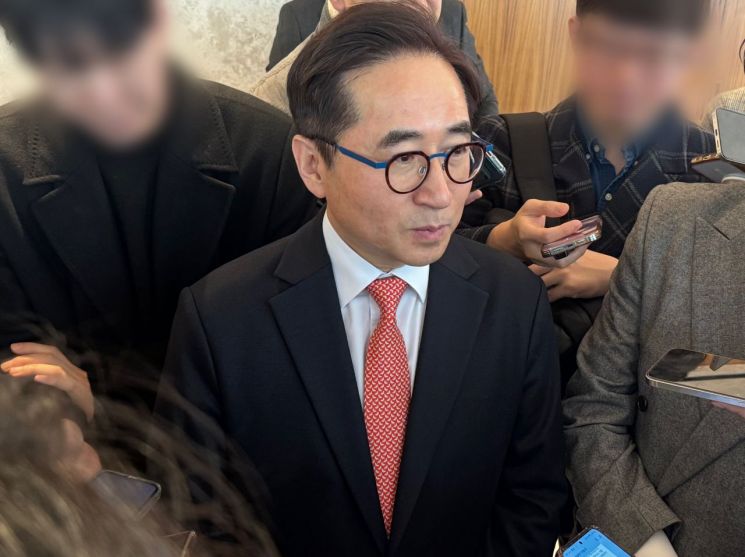
President Jang explained, "In the short term, we are aiming to strengthen our fundamentals, such as technology development." Previously, on May 23 (local time), U.S. President Donald Trump indicated plans to impose a minimum 25% tariff on all smartphones imported into the United States from overseas, including not only Apple iPhones but also those produced by Samsung Electronics and others, starting at the end of next month.
If this policy is implemented, it is expected that smartphone set (finished product) manufacturers will be directly affected. However, Samsung Electro-Mechanics, which supplies components such as multilayer ceramic capacitors (MLCCs), semiconductor substrates, and camera modules for smartphones, is also expected to face indirect impacts, such as downward pressure on unit prices.
President Jang commented, "Since the policy has not yet been finalized, we will need to monitor concerns about price reductions from set manufacturers a bit further."
President Jang's remarks are interpreted as indicating that, in addition to the U.S.-originated smartphone tariffs, the company is reviewing various scenarios?such as new production sites or adjustments to production volumes?to avoid uncertainties including the scheduled expiration of mutual tariff exemptions in July and investigations for semiconductor tariffs under Section 232 of the Trade Expansion Act. Currently, Samsung Electro-Mechanics operates production bases in Korea (Busan and Sejong), China, Vietnam, and the Philippines.
Regarding the "expansion of the Philippine plant" to increase MLCC production capacity, President Jang said, "We are currently in detailed discussions with the Philippine government," adding, "The demand for MLCCs is extremely positive in the mid- to long-term." Local media and industry sources in the Philippines expect Samsung Electro-Mechanics to make a large-scale investment in expanding the plant. This expectation is based on President Jang's remarks last October at Pohang University of Science and Technology (POSTECH) in Pohang, North Gyeongsang Province, where he stated, "We need to expand MLCC capacity with high utilization, and we are considering the Philippine plant."
It is also known that in early October last year, Lee Jae-yong, Chairman of Samsung Electronics, visited the Samsung Electro-Mechanics site in the Philippines to inspect the MLCC plant and urged President Jang to seize opportunities arising from the expansion of the AI, robotics, and electric vehicle markets. Regarding the "glass substrate business," President Jang said, "We are currently building a pilot line and plan to provide samples to at least two or three major U.S. tech companies within this year. The pilot line is in its final stages," adding, "The demand for glass substrates for AI and servers remains robust in the mid- to long-term."
Meanwhile, at the special lecture attended by about 200 students from the Department of Materials Science and Engineering at Seoul National University, President Jang introduced Samsung Electro-Mechanics' innovation strategy and the role of next-generation talent under the theme "Core Technologies of the Digital Future."
© The Asia Business Daily(www.asiae.co.kr). All rights reserved.












