76 More Branches Closed by Top 5 Banks in Q1
Branch Closures Accelerate as Non-Face-to-Face Transactions Rise
Specialized Branches for Foreign Residents Continue to Increase

Due to changes in demographic structure and the expansion of digital banking, the number of bank branches is rapidly declining. In contrast, as the number of foreign residents in South Korea gradually increases, the number of specialized branches catering to foreigners?who are emerging as a new customer base for banks?is steadily on the rise. Some point out that accessibility for certain groups, such as the elderly, is being compromised. However, banks maintain that this is an efficiency strategy in response to changes in customer usage patterns.
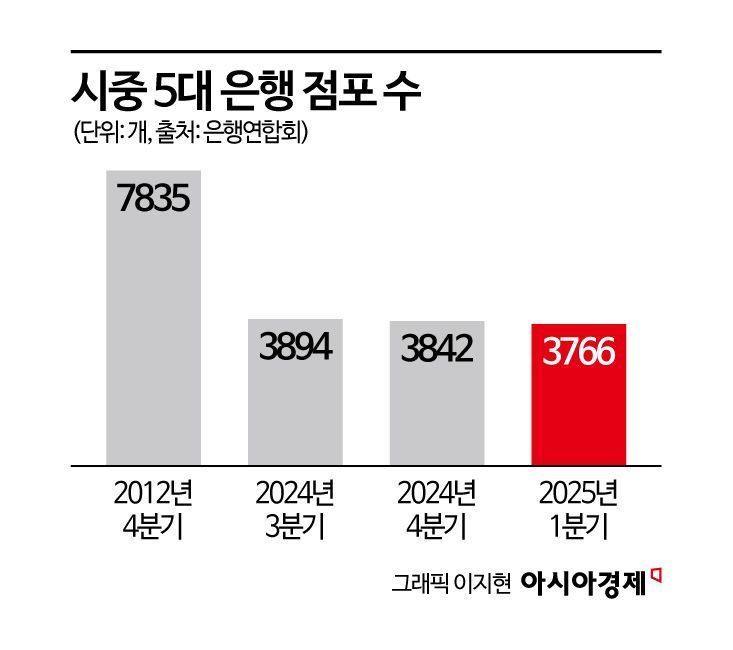
According to the banking sector on May 28, the total number of domestic branches operated by the five major commercial banks (KB Kookmin, Shinhan, Hana, Woori, and NH Nonghyup) stood at 3,766 as of the end of the first quarter of this year. This represents a decrease of 76 branches compared to the previous quarter (the fourth quarter of 2024), when there were 3,842 branches. After falling from 3,894 at the end of the third quarter of last year to 3,842 at the end of the fourth quarter?a reduction of 52 branches?the pace of decline has accelerated. The number of bank branches peaked at 7,835 at the end of the fourth quarter of 2012 and has been steadily decreasing since then. By the end of the fourth quarter of 2017, the number had dropped below 7,000, and by the end of the third quarter of 2022, it had fallen below 6,000.
The decrease in bank branches is attributable to the increase in non-face-to-face transactions. According to the Bank of Korea's Economic Statistics System, the proportion of transactions conducted through bank branches dropped from 26.9% in the first quarter of 2005 to 4.1% in the first quarter of 2024.
An official from a commercial bank stated, "As the number of customers visiting bank branches has significantly decreased, there is a trend toward consolidating branches within walking distance of each other. This is a matter of resource efficiency rather than cost efficiency. To improve accessibility for the elderly, we are supporting accessibility improvements in various ways, such as providing education on how to use mobile applications."
On the other hand, the number of specialized branches targeting foreigners is steadily increasing. According to the Korea Federation of Banks and individual banks, as of May 27, there were 36 foreigner-specialized branches, approaching the previous peak of 40 in 2018. The number of these branches sharply declined after the COVID-19 pandemic, as many foreign workers left the country, but has been rising again since the end of last year. According to the Ministry of Justice's statistics on immigration and foreign residents, the number of foreigners who registered for residency in South Korea for more than 90 days after entry reached 1,348,626 in 2023. This figure surpassed 1 million for the first time in 2014, up from 870,636 in 2009, and has continued to grow steadily except during the COVID-19 pandemic.
By bank, Hana Bank operates the largest number of foreigner-specialized branches with 16 locations. This is followed by KB Kookmin Bank with 8, Woori Bank with 5, Jeonbuk Bank with 3, Shinhan Bank with 2, Gwangju Bank with 1, and IBK Industrial Bank of Korea with 1, for a total of 36 foreigner-specialized branches operated by seven commercial banks. Shinhan Bank opened its second foreigner-specialized branch in Doksan-dong, Geumcheon-gu, Seoul, on May 26, and plans to open additional branches in Bucheon and other locations within the year. Hana Bank also plans to open a branch in Namdong Industrial Complex, Incheon, within the year. As a result, the number of foreigner-specialized branches operated by commercial banks is expected to exceed 40 by the end of the year. In addition, as of the end of April, there were 1,047 specialized branches, including those located in government offices and currency exchange centers.
An official from a commercial bank stated, "Due to the nature of banking products, there is little room for differentiation from other banks aside from interest rates, making it difficult to expand the customer base. As the number of foreign residents in South Korea continues to increase, foreigners are emerging as an important new customer base for banks."
© The Asia Business Daily(www.asiae.co.kr). All rights reserved.













