Overseas Relay Briefing on Customs Response Held for 160 Korean Companies in Vietnam
Presenting Strategies to Address Export Challenges
Offering Solutions for Companies Impacted by Tariff Measures
# Company A, a Korean company operating in Vietnam, manufactures bags and exports them to the United States. However, with the recent prospect of U.S. reciprocal tariff measures, major buyers have started shifting their orders to countries with lower tariffs, resulting in a tangible decrease in export volume and causing actual losses for the company.
To support Korean companies in Vietnam in responding to tariff issues, the Ministry of Trade, Industry and Energy and KOTRA (Korea Trade-Investment Promotion Agency) are holding an "Overseas Relay Briefing on Customs Response" for approximately 160 local companies?on the 27th in Hanoi and on the 29th in Ho Chi Minh City.
Since the launch of the new U.S. administration, Korean companies operating overseas have been facing difficulties adapting to the rapidly changing global trade environment. In April, the U.S. government announced a 46% reciprocal tariff on Vietnamese goods. Despite a 90-day grace period, this measure continues to create uncertainty for Korean companies operating in Vietnam.
In particular, companies operating overseas cite a lack of information on U.S. tariff policies in the local market as a major challenge. A representative from Korean company B, which operates in Vietnam, stated, "Because the U.S. tariff measures target the global market, it is not easy to hastily relocate production facilities to other countries."
KOTRA recognizes that Korean companies in Vietnam are struggling to keep up with frequently changing tariff trends. As a result, the agency is sharing information on U.S. tariff measures and alternative markets, the "Customs Response 119" service and major consultation cases, and the response status of both the Vietnamese government and local companies. In addition, KOTRA is presenting practical support measures for companies, including customs response vouchers, origin management strategies, and systems to support the restructuring of overseas production bases and reshoring to Korea.
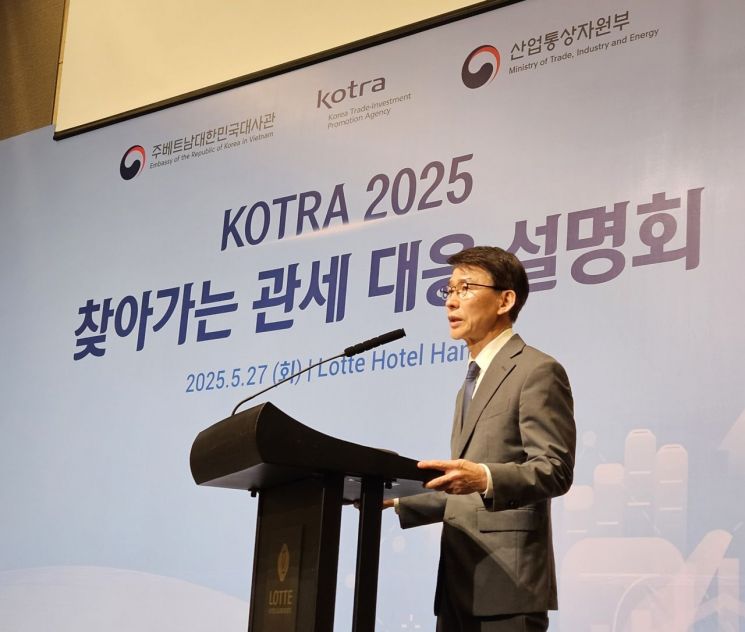 KOTRA (Korea Trade-Investment Promotion Agency) held an "Overseas Relay Briefing on Customs Response" on the 27th in Hanoi for more than 160 companies entering the Vietnamese market. Before the briefing, Lee Jihyung, Head of KOTRA's Economic and Trade Cooperation Division, delivered the opening remarks. KOTRA.
Vietnam is the largest investment destination for Korean companies in ASEAN, with about 9,000 Korean firms operating in the country, of which around 4,000 are manufacturing-related. In particular, the northern region of Vietnam, including Hanoi, is home to many companies in the electrical and electronics, auto parts, and machinery and equipment sectors, while the southern region, including Ho Chi Minh City, has a large concentration of textile and garment manufacturers. While some companies have entered the market to target local demand, most focus on exports to the United States and the European Union (EU), making them highly sensitive to changes in U.S. tariff policies.
Especially in the electrical and electronics sector, there is a strong connection with Korea's own exports to Vietnam. As of last year, electrical and electronics items (such as semiconductors, flat panel displays and sensors, wireless communication devices) accounted for about 59% of Korea's exports to Vietnam. If reciprocal tariffs lead to a decrease in Vietnam's exports to the U.S., this is expected to also impact Korea's exports of intermediate goods to Vietnam. In the textile and garment sector, more than 90% of Korean companies in Vietnam produce goods for export to the U.S., but most of these are small and medium-sized enterprises (SMEs) or mid-sized companies, which face significant challenges in responding to tariff changes. This situation calls for close public-private cooperation and support.
To help address these on-site challenges, KOTRA is organizing "on-site customs consulting" during the briefing period, visiting textile and garment, electrical and electronics, and auto parts manufacturers located in Hai Duong and Long An provinces. KOTRA will visit companies in suburban areas that have difficulty attending the briefing sessions and provide customs and logistics consultations, as well as tailored on-site consulting.
Lee Jihyung, Vice President and Head of the Economic and Trade Cooperation Division at KOTRA, stated, "U.S. tariff policies are becoming more prolonged and diversified, and their impact is growing not only for domestic companies but also for those operating overseas. We will actively support Korean companies in Vietnam in overcoming export challenges by providing timely and accurate trade information and helping them explore alternative markets."
© The Asia Business Daily(www.asiae.co.kr). All rights reserved.












