Kim Sunghyuk, Senior Research Fellow of Quantum AI Task at LG Electronics
A Breakthrough for Industries Requiring Advanced Computation
Potential Applications in New Drug Development, Batteries, and Finance
Hybrid Integration with Classical Computers Rather Than Direct Competition
Exploring Quantum Computing Applications in LG Electronics Product Design
Quantum Computing as a Convergence of Multiple Industrial Technologies
The Challenge of Building Talent and Ecosystems to Bridge the Gap
Kim Sunghyuk, Senior Research Fellow (Executive Director) of Quantum AI TASK at LG Electronics, recently met with Asia Economy at LG Science Park in Magok and stated, "Although it is still limited, quantum computing technology has already begun to be commercialized in some areas, and practical quantum advantage will first emerge in certain fields within five to ten years."
Quantum advantage refers to a state in which quantum computers can solve problems that are difficult or would take decades for conventional supercomputers to handle, much faster and more efficiently. Kim expects this transition to appear first in fields such as chemical simulations that require precise calculations at the molecular level, or in optimization problems that need to consider countless combinations.
He emphasized that quantum computing could become a practical breakthrough across industries that require highly complex calculations, such as battery material simulation, protein structure prediction, and financial risk analysis. In particular, he predicted that in areas where even the smallest variables must be precisely considered, such as the search for next-generation batteries or new drug candidates, practical results could be achieved in the short term.
LG Electronics is exploring ways to apply quantum computing to product design. The company believes that quantum simulation could be useful for precisely analyzing the operation of complex systems, such as washing machines, where heat, fluids, forces, and chemical reactions occur simultaneously. Kim stated, "It will take time to complete quantum computers, but even the byproducts generated in the process have significant industrial value."
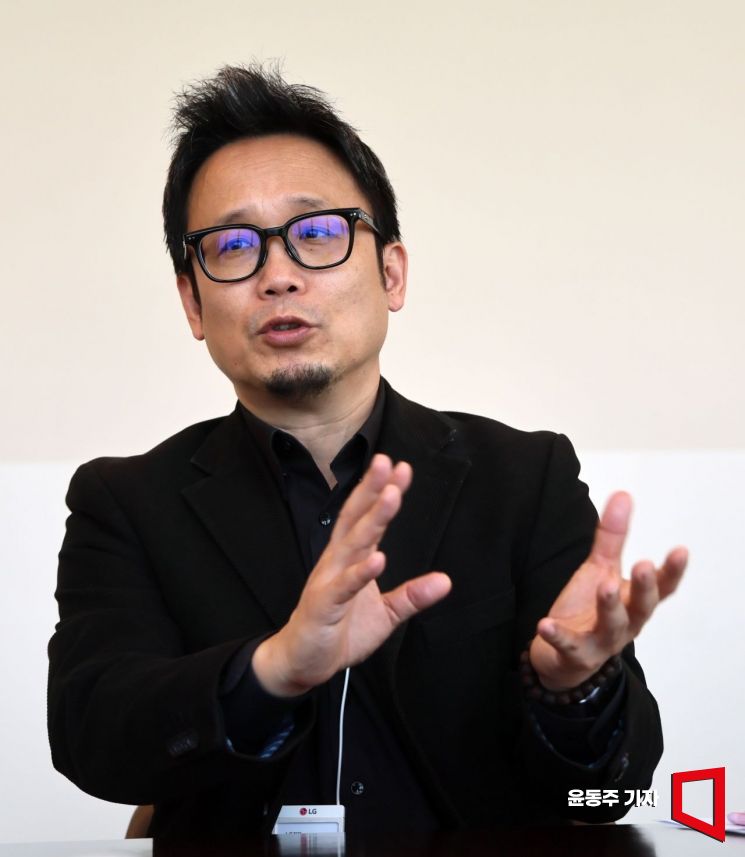 Kim Sunghyuk, Senior Research Fellow of Quantum AI TASK at LG Electronics, is being interviewed by Asia Economy. Photo by Yoon Dongjoo
Currently, LG Electronics is collaborating with Pasqal of France to develop algorithms based on multiphysics analysis. Kim believes that quantum computing is more likely to be applied to industry in a hybrid form that combines quantum computers with classical computers, rather than as a competitor to classical computers.
In this approach, classical computers handle data preprocessing, while quantum computers perform complex calculations. He also explained that when combined with artificial intelligence (AI), the same computations can be processed with much less power, which could lead to meaningful achievements in terms of energy efficiency.
Kim said, "To properly simulate natural phenomena, a quantum mechanical approach is necessary, and quantum computers are the right tool for this." While conventional computers process information as either 0 or 1, quantum computers perform parallel computations based on qubits, which can exist as both 0 and 1 at the same time. Because quantum computers can explore multiple paths simultaneously to reach the optimal solution, they are particularly strong in solving complex physical and chemical reactions or combinatorial optimization problems.
He sees the fact that quantum computers are not yet complete as an opportunity. Since standards and methods have not yet been established in this field, those who enter now can set new standards.
He identified "workforce and ecosystem development" as the key challenges currently facing the quantum computing industry. He explained that in order for machines, programs, and experimental equipment to work together seamlessly, people who can connect these elements are essential, but there is a severe shortage of such talent.
Quantum computing is not a single technology but a complex system that integrates multiple industrial technologies. Only when hardware that can stably implement qubits, software to efficiently control and utilize them, and experimental equipment are all in place, can a single application become possible. Kim emphasized, "Now is the time for an integrated approach to build the entire ecosystem, rather than focusing on individual components."
He diagnosed that while LG Electronics possesses the capabilities to define problems and design solutions, securing the infrastructure and specialized personnel for experimentation and verification remains a challenge for the future. This is a common issue faced not only by domestic companies but also by all companies and institutions worldwide. He said, "To be honest, even now we do not fully understand quantum computing. There are many unfamiliar concepts and parts that are difficult to understand, but it is clear that it will become a tool to tackle problems we have not been able to solve before. Right now, challenge comes before understanding."
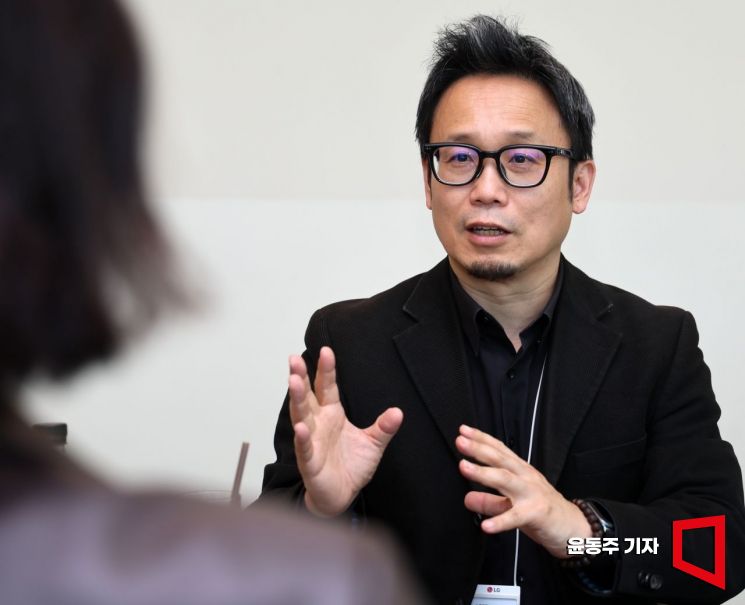 Kim Sunghyuk, Senior Research Fellow of Quantum AI TASK at LG Electronics, is being interviewed by Asia Economy. Photo by Yoon Dongjoo
▲Kim Sunghyuk, Senior Research Fellow (Executive Director) at LG Electronics: Leader of AI Sensing and Quantum AI R&D, CTO Division, LG Electronics (since January 2024); Executive Member of the Quantum Strategy Committee (since March 2025); Quantum Industry Policy Advisor for Seoul Metropolitan Government (since March 2024)
© The Asia Business Daily(www.asiae.co.kr). All rights reserved.













