On Park Beomgye's Proposal to Increase Non-Lawyer Justices: "Not the Party's Position"
"I Will Punish Rebellion Forces but Will Not Engage in Petty Political Retaliation"
Lee Jaemyung, the presidential candidate of the Democratic Party of Korea, stated that although judicial and prosecutorial reform is an important issue, the current priority should be on economic and livelihood recovery, indicating that such reforms would be placed on the back burner.
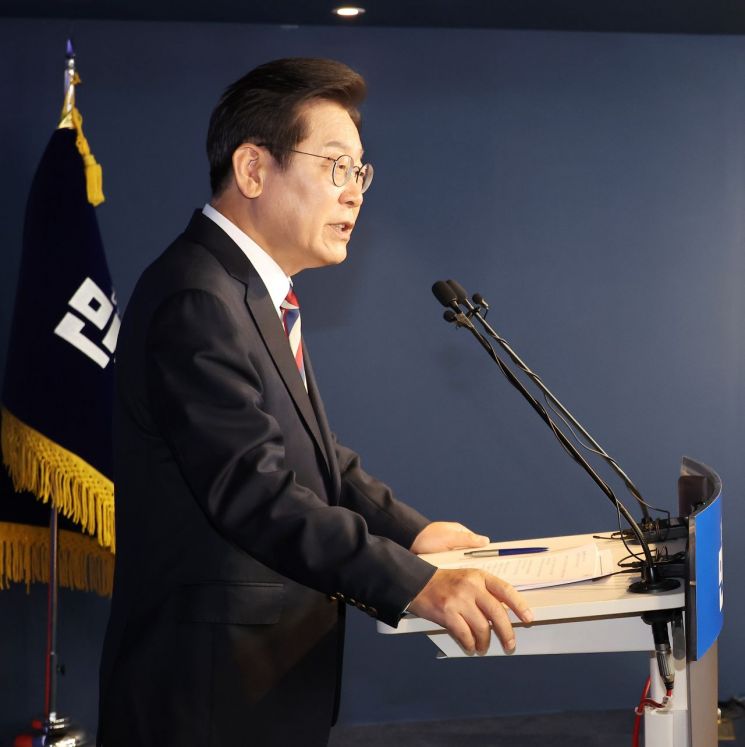
At a press conference held at the Democratic Party headquarters in Yeouido, Seoul on the 25th, Lee said, "Judicial and prosecutorial reforms, such as the adjustment of investigative powers, are important, but I don't think now is the time to focus on them early and expend our energy there," adding, "In the initial period after (being elected), all our energy should be directed toward economic and livelihood recovery."
He explained, "The public is extremely divided and experiencing confrontation and conflict, so we need to pool national energy to overcome this crisis," and continued, "If we focus on contentious issues that are not urgent, it will be difficult to gather energy or achieve social integration. Therefore, I will prioritize issues related to people's livelihoods, which have fewer elements of conflict."
Regarding Democratic Party lawmaker Park Beomgye and others pushing for an amendment to the Court Organization Act to increase the number of Supreme Court justices from non-legal backgrounds, Lee said, "This is neither the official position of the party nor the right time to pursue it," and added, "Although I am a legal professional myself, opening the Supreme Court to non-lawyers is not something that can be discussed lightly."
In a similar context, Lee had previously stated in his opening remarks, "Those involved in rebellion will be punished, but there will be no political retaliation against specific individuals." When asked by reporters to define the scope of "those involved in rebellion," Lee responded, "There are a few key figures who have been identified as ringleaders of rebellion and are on trial, but I believe there are many others involved as well," and emphasized, "Punishment is necessary for the main actors with key roles." However, he clarified that this would not be extended to commanders, soldiers, and others who participated under orders at the scene.
Lee said, "If I am given a brief five-year opportunity, there is so much to do in that time," and added, "If we draw battle lines against someone and start using national resources for sanctions or retaliation, it will only lead to resistance and conflict, making integration impossible." He emphasized, "I will not act in a petty or childish manner by saying things like, 'You did this in the past, you did that too.'"
However, when asked whether his pledge not to pursue political retaliation also meant he would not seek a special investigation into Supreme Court Chief Justice Cho Heedae, who presided over the Supreme Court's decision to remand Lee's Public Official Election Act case, Lee gave an ambiguous answer, saying, "Chief Justice Cho is not a politician, is he?"
© The Asia Business Daily(www.asiae.co.kr). All rights reserved.












