Household Loans Surge by Over 3 Trillion Won in 14 Trading Days
Last-Minute Demand Rises Ahead of July DSR Phase 3... Financial Sector on Edge
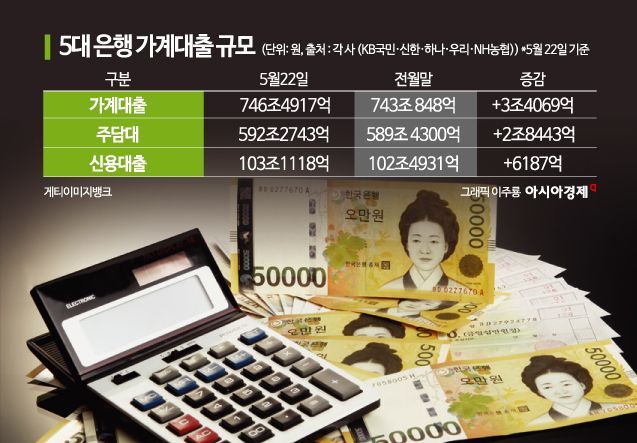
Household loans at the five major commercial banks (KB Kookmin, Shinhan, Hana, Woori, and NH Nonghyup) have increased by more than 3 trillion won so far this month. This figure represents about 75% of the previous month’s total increase in just two weeks, and if this trend continues, the total increase is expected to exceed 5 trillion won by the end of the month. Factors contributing to this surge appear to include falling interest rates, the temporary suspension of the land transaction permit system, and a rise in credit loans due to leveraged investments. In addition, with demand surging ahead of the implementation of the third stage of the Debt Service Ratio (DSR) regulations in July, there are growing concerns that household loan growth could accelerate further, causing tension across the entire financial sector.
According to the banking sector on the 26th, as of the 22nd, the outstanding balance of household loans at the five major banks stood at 746.4917 trillion won, an increase of 3.4069 trillion won compared to the end of the previous month (743.0848 trillion won). If this pace continues, the increase by the end of the month is projected to easily surpass the 4.5337 trillion won recorded in April (compared to March), which was the largest monthly increase this year, and could exceed 5 trillion won.
After surging last year, household loans began to decline in January this year as financial authorities tightened lending as part of household debt management policies. However, the pace of increase has picked up again, with household loans rising by 1.7992 trillion won in March and 4.5337 trillion won in April.
This trend is attributed to the beginning of a full-fledged interest rate decline, as well as the temporary suspension and subsequent reinstatement of the land transaction permit system (Toheje) in February and March, which contributed to the increase in household loans. In addition, the rise in credit loans due to leveraged investments flowing into the stock and virtual asset markets has further accelerated the growth of household loans. In fact, as of the 22nd, the volume of credit loans at the five major banks reached 103.1118 trillion won, up 618.7 billion won from the previous month (102.4931 trillion won). This represents about 70% of the previous month’s increase of 886.8 billion won, indicating a rapid rise this month. Furthermore, there are concerns that the surge in demand ahead of the July implementation of the third stage of DSR regulations could further expand the increase in household loans going forward.

An official at a major commercial bank said, "The impact of the suspension of the land transaction permit system is being reflected in household debt figures for May, and the increase in demand for credit loans due to leveraged investments, as well as borrowers seeking to secure credit loans in advance of the implementation of the third stage of DSR regulations in July, appear to be contributing factors."
There are also opinions that the introduction of equity-based mortgages, which are likely to be implemented in the second half of the year, could further fuel the increase in household loans. Equity-based mortgages allow home purchases with only 15?20% of the property price, which could act as a buy signal in the market.
Some observers are raising concerns that, with the loan-to-deposit interest rate spread widening to record levels and the implementation of the third stage of DSR regulations reducing loan limits, genuine end-users may end up being unfairly affected.
An official at a major commercial bank said, "We are closely monitoring the situation, as falling interest rates, the impact of the suspension of the land transaction permit system, and increased lending ahead of the third stage of DSR regulations are all contributing to higher loan demand. In addition, depending on the direction of the real estate market after the presidential election, loan demand could increase further."
© The Asia Business Daily(www.asiae.co.kr). All rights reserved.













