Airway Rupture Traps Air Beneath the Skin
The Danger of Suppressing Sneezes by Blocking the Nose and Mouth
There has been a warning that blocking your nose and mouth to suppress a sneeze can increase the pressure in the upper airway to more than 20 times higher than when you sneeze normally, posing a significant risk.
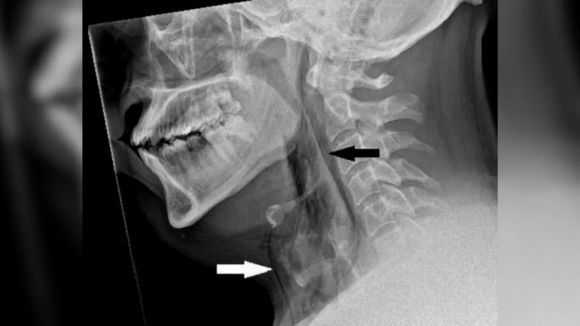 A British man who forcibly suppressed a sneeze was found to have a ruptured airway, causing an air pocket to be trapped beneath the skin of his neck. British Medical Journal
On May 21, the U.S. science media outlet Live Science reported a case of a man whose airway ruptured after he suppressed a sneeze. A British man in his 30s, referred to as Mr. A, visited the hospital emergency room because his neck was swollen and he had difficulty moving.
Previously, while driving, Mr. A tried to suppress a sneeze triggered by pollen allergy symptoms by pinching his nose and keeping his mouth closed. However, he was unable to hold back and sneezed in that state, which caused pain and led him to seek emergency care.
He did not have any problems with breathing, swallowing, or speaking. However, when the medical staff took an X-ray, they found signs of pneumomediastinum, a condition in which air becomes trapped beneath the deepest tissue layers under the skin. A CT scan revealed a tear between the third and fourth vertebrae in Mr. A's neck, allowing air to escape from the airway and enter the space between the neck tissues and the lungs. The hole in the airway measured 2 millimeters in diameter.
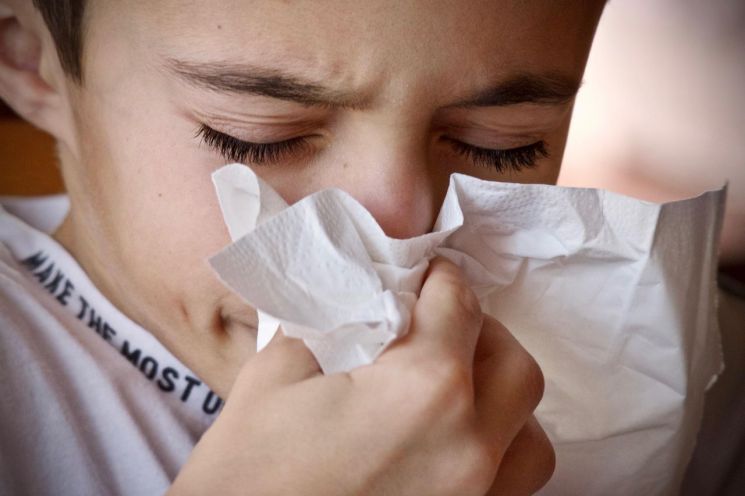
The medical staff explained, "It is highly likely that the pressure in the bronchial tubes rose sharply and caused a tear when he sneezed while blocking his nose and keeping his mouth closed." They added, "When you block your nose and mouth while sneezing, the pressure in the upper airway can increase to more than 20 times higher than when you sneeze normally and expel the air."
The medical team determined that surgery to repair the rupture in Mr. A's airway was not necessary, but admitted him for two days to monitor his oxygen levels and other vital signs. On the first day, he was not given any oral food. Afterwards, Mr. A was prescribed painkillers and medication for pollen allergy, and was instructed by his doctor to avoid strenuous activity for two weeks before being discharged. At a follow-up examination five weeks later, a CT scan confirmed that the tear in his neck had completely healed.
Dr. Rasaz Mishirovs, who reported the case in the British Medical Journal, emphasized, "Sneezing is an important function that expels irritants such as viruses from the body, and it should not be forcibly suppressed." He added, "When sneezing, you should cover your face with your hand or the inside of your elbow to prevent irritants like viruses from spreading to those around you." However, if you must suppress a sneeze, he recommended, "Instead of blocking the nasal passages when you feel a sneeze coming, press just below the upper lip with your thumb for a few seconds."
Not only in Mr. A's case, but there have been other reports of people facing risks because the internal pressure was transmitted when they tried to suppress a sneeze. There have been cases of eardrum rupture, and although extremely rare, there have also been cases of cerebral aneurysm caused by pressure to the face. In addition, suppressing sneezes caused by a cold or flu can push bacteria-laden air into the middle ear, leading to otitis media, and the pressure on the diaphragm can cause pneumothorax, so caution is advised.
© The Asia Business Daily(www.asiae.co.kr). All rights reserved.













