Flexible Work Arrangements Utilized by Only 11.5%... Downward Trend for Three Consecutive Years
Proportion of Workers Exceeding 52 Hours per Week Drops by 14% Over 10 Years
"Need to Expand Autonomy Over Working Hours for Labor and Management"
The proportion of small and medium-sized enterprises (SMEs) utilizing flexible work arrangements has been declining over the past three years. As smaller companies show lower adoption rates, and as workers' perceptions of work-life balance shift, there are growing calls to expand autonomy and choice regarding working hours for both labor and management in SMEs.
According to the report "Trends in Working Hours and the Utilization of Flexible Work Arrangements in SMEs," released on the 25th by Noh Minseon, a research fellow at the Korea Small Business Institute, only 11.5% of SME wage workers subject to the 52-hour workweek utilized flexible work arrangements last year. This is less than one-third of the rate among large enterprises (36.6%).
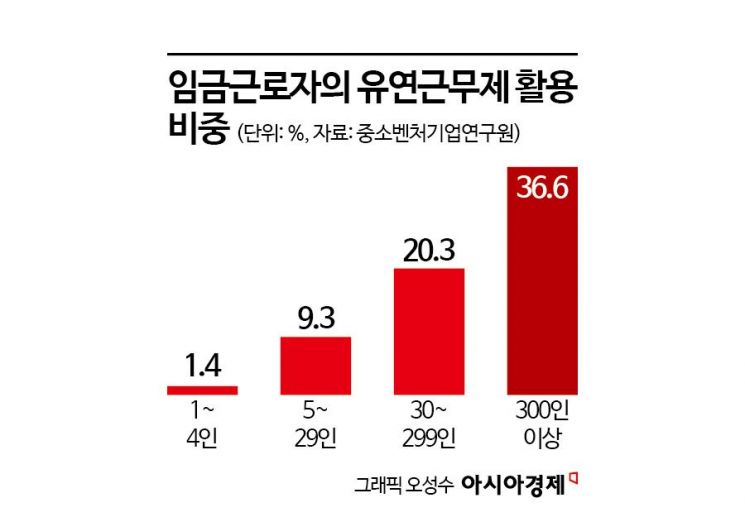
The proportion of SMEs adopting flexible work arrangements has steadily decreased, from 12.9% in 2021 to 12.0% in 2022, and 11.8% in 2023. By company size, the utilization rate was 1.4% for companies with 1-4 employees, 9.3% for those with 5-29 employees, and 20.3% for those with 30-299 employees.
Among SME wage workers, the utilization rates for different types of flexible work arrangements were all below 5%: staggered working hours (3.6%), flexible working hours (2.6%), selective working hours (1.8%), reduced working hours (1.3%), and remote or telecommuting arrangements (1.2%).
The average working hours of SME wage workers have decreased significantly over the past decade. The proportion of workers at SMEs with fewer than 300 employees who worked more than 52 hours per week, including both primary and secondary jobs, fell from 19.6% in 2014 to 6.0% in 2024?a 13.6 percentage point decrease over the past 10 years. The proportion of those working more than 60 hours per week dropped from 6.7% in 2014 to 1.6% in 2024, a decrease of 5.1 percentage points.
However, the proportion of long working hours remains higher among smaller companies. As of 2024, 6.0% of workers at SMEs with fewer than 300 employees worked more than 52 hours per week, which is 1.4 percentage points higher than the rate for large enterprises with 300 or more employees (4.6%). Among SMEs, the rates were 8.4% for companies with 1-4 employees, 5.6% for those with 5-29 employees, and 5.2% for those with 30-299 employees.
The proportion of workers working 40 hours or less per week, including both primary and secondary jobs, increased from 45.6% in 2014 to 73.9% in 2024, a rise of 28.3 percentage points. Among workers aged 29 or younger, the proportion working 40 hours or less per week was the highest at 76.7% compared to other age groups.
Noh emphasized, "Given that perceptions about long working hours are changing, especially among young people, there is a strong likelihood that total working hours will continue to decrease in the future." He added, "The issue of working hours should be addressed in a way that guarantees autonomy and choice for both labor and management in SMEs."
© The Asia Business Daily(www.asiae.co.kr). All rights reserved.












