Eliminating Gaps in Pest Control with Drones:
Ten Operations Focused on Mosquito Larvae Habitats Along Streams
Eco-Friendly Agents Safe for the Ecosystem:
Proactive Control at the Larval Stage
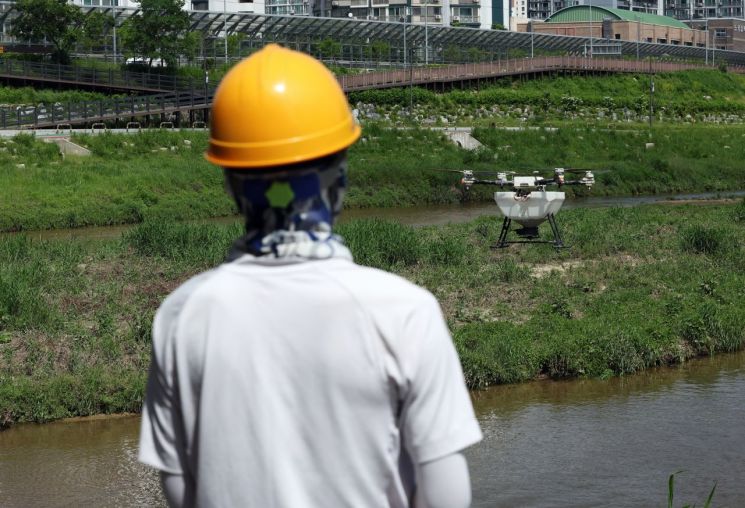
Nowon District in Seoul (District Mayor Oh Seungrok) announced that it will actively begin using drones to control mosquito larvae along local streams.
According to the Korea Disease Control and Prevention Agency, the mosquito breeding season is starting earlier and the overall mosquito population is increasing due to recent climate change. Mosquitoes can transmit diseases such as Japanese encephalitis, malaria, dengue fever, yellow fever, Zika virus infection, and West Nile fever.
To proactively prevent the spread of infectious diseases caused by the increase in mosquito populations during the summer, the district conducts annual mosquito larvae control operations. By eliminating mosquitoes at the larval stage, the district aims to curb their spread before they mature into adults, taking a preemptive approach to vector control.
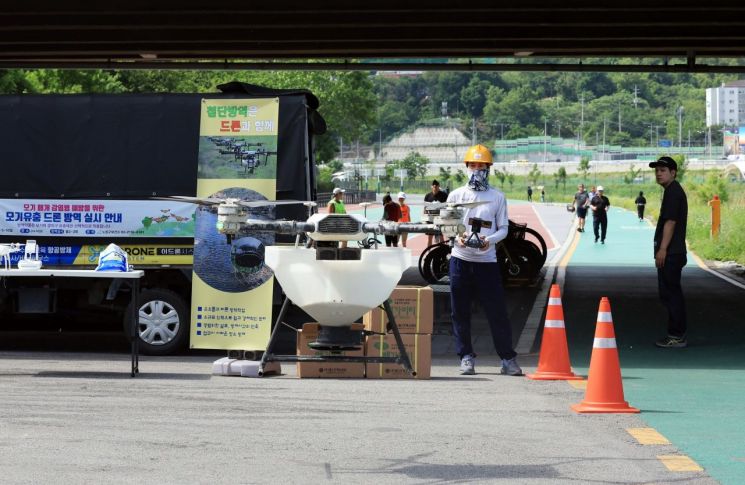
This year, in particular, the district has introduced drone-based control operations in addition to the existing vehicle- and manpower-based methods. This enables faster and wider coverage, including areas that were previously difficult to access. Drone control will focus on vulnerable areas along the Jungnangcheon and Mukdongcheon streams, where human access is normally limited. Starting with the first operation on May 22, the district plans to conduct a total of 10 operations, two to three times per month.
The agents used for control are also environmentally friendly and safe for humans and the ecosystem. The B·t·i (Bacillus Thuringiensis Israelensis) agent being used this time is a spore-forming bacterium derived from soil. The toxic protein crystals contained within the spores selectively target mosquito and chironomid larvae, providing effective control.
In addition to drone-based control, the district is also implementing various infectious disease prevention measures. Since March, it has distributed larvicide to apartment complexes, multi-family housing, and multi-use facilities, and has provided customized control consulting for 185 large buildings with a total floor area of over 3,000 square meters, thereby establishing a thorough disease prevention network.
District Mayor Oh Seungrok stated, "As climate change causes the mosquito larval season to begin earlier, a proactive response is necessary. This year, by incorporating drone-based control, we will focus on effective pest management and infectious disease prevention."
© The Asia Business Daily(www.asiae.co.kr). All rights reserved.

![Clutching a Stolen Dior Bag, Saying "I Hate Being Poor but Real"... The Grotesque Con of a "Human Knockoff" [Slate]](https://cwcontent.asiae.co.kr/asiaresize/183/2026021902243444107_1771435474.jpg)















