Authorities: "No casualties, cause under investigation"
Roof tiles collapse, forcing nearby citizens to evacuate
Structure collapses just 15 months after reopening following repairs
A large-scale roof tile collapse occurred at a cultural heritage site built during the Ming Dynasty in Anhui Province, China, prompting authorities to launch an investigation. On May 20 (local time), the Chinese state-run English-language media outlet Global Times reported that at around 6:30 p.m. the previous day, roof tiles of the Mingzhongdo Goru in Pyeongyanghyeon, Chizhou City, Anhui Province, collapsed, causing nearby citizens to evacuate in a hurry.
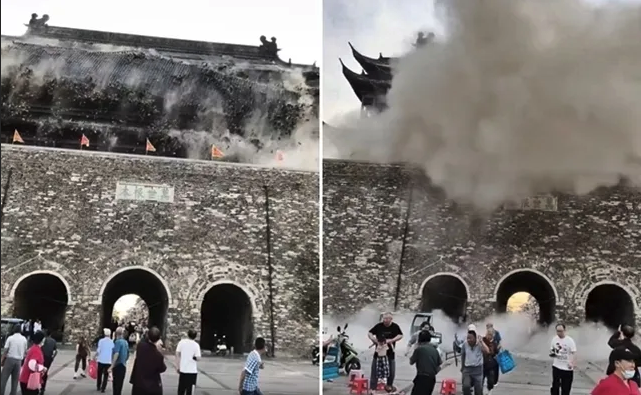 A video filmed at the time of the accident shows roof tiles on the upper part of the building collapsing like a tsunami, creating a massive dust cloud. It is reported that people nearby evacuated after someone shouted, "The tiles are falling." Weibo
There were no reported casualties. A video filmed at the time of the accident shows roof tiles on the upper part of the building collapsing like a tsunami, creating a massive dust cloud. It is reported that people nearby evacuated after someone shouted, "The tiles are falling." The tiles fell for about one to two minutes, and footage of the incident spread via social networking services (SNS). Immediately after the accident, the local cultural heritage department was dispatched to the scene, set up safety control lines, and conducted an emergency inspection. The Pyeongyanghyeon Culture and Tourism Bureau has begun investigating the exact cause of the accident, including whether there was faulty construction, and has decided to temporarily close access to the Mingzhongdo Goru until roof repairs are completed. In an official notice, the Pyeongyanghyeon Culture and Tourism Bureau stated, "Some roof tiles of the Mingzhongdo Goru, which was reconstructed in 1995, have fallen, but there were no casualties," adding, "The exact cause is currently under investigation."
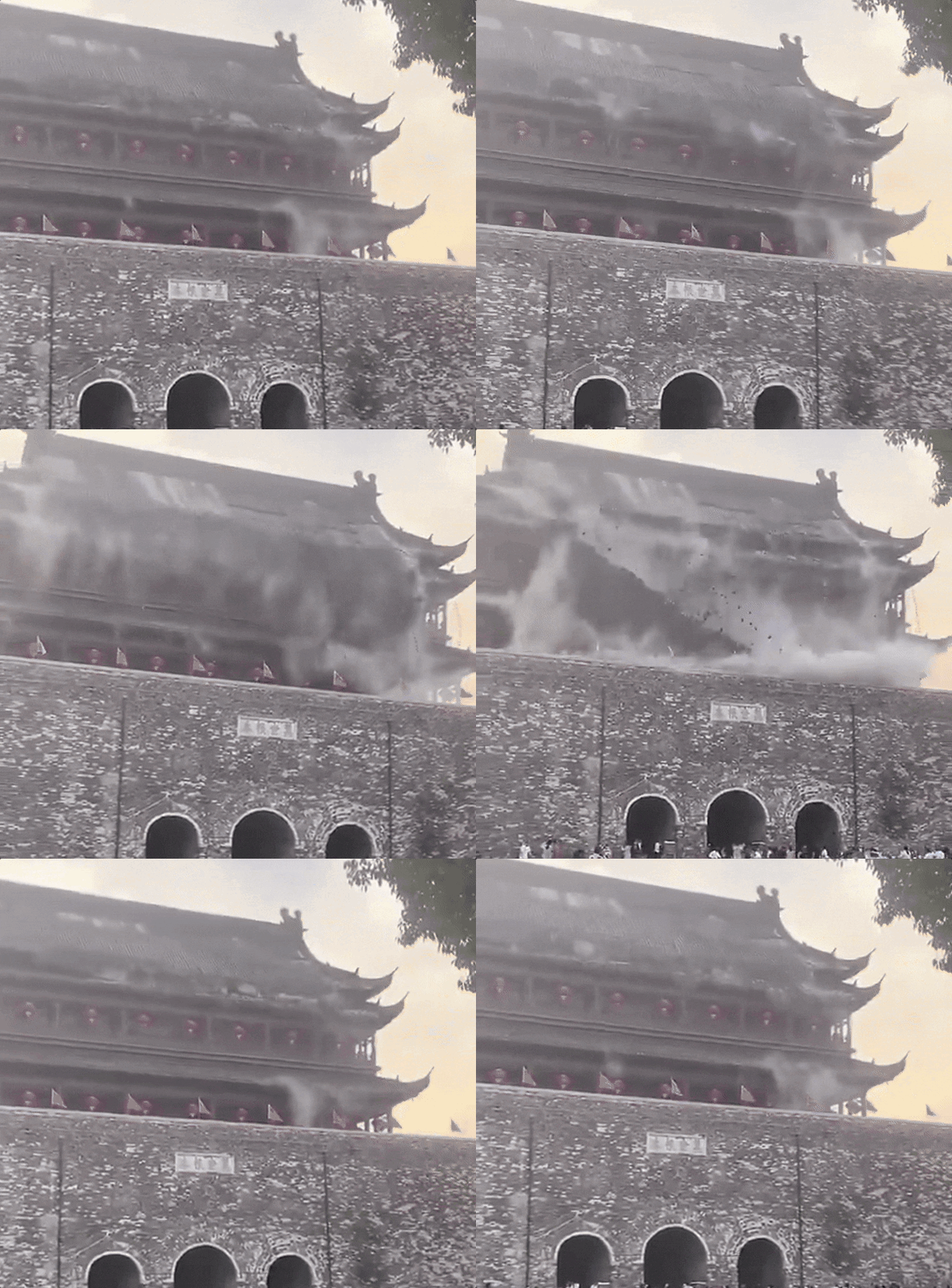 The Mingzhongdo Goru, the largest existing pavilion-style structure in China, is a historic building constructed in 1375 in Pyeongyanghyeon as part of the Ming Dynasty founder Zhu Yuanzhang's plan to relocate the capital. Except for the stone pedestal built during the Qing Dynasty, the original structure was completely lost, and the current upper building was reconstructed in 1995. Weibo
The Mingzhongdo Goru, the largest existing pavilion-style structure in China, is a historic building constructed in 1375 in Pyeongyanghyeon as part of the Ming Dynasty founder Zhu Yuanzhang's plan to relocate the capital. Except for the stone pedestal built during the Qing Dynasty, the original structure was completely lost, and the current upper building was reconstructed in 1995. The structure, which had been operated as a memorial hall introducing the life of Zhu Yuanzhang and the early history of the Ming Dynasty, experienced sporadic incidents of roof tile falls and eaves damage from 2017. In September 2023, repairs were initiated at a cost of 3.4 million yuan (approximately 650 million won), and the restoration was completed in March 2024. However, with most of the tiles collapsing just 15 months later, there has been a flood of criticism over "shoddy construction" and "waste of budget," as well as suspicions of poor workmanship.
Meanwhile, Lu Deyong, head of the Pyeongyanghyeon Culture and Tourism Bureau, further fueled public anger by stating, "The building in question is an 'illegal structure' that was not approved by the Anhui Provincial Cultural Heritage Bureau when it was reconstructed in 1995," and explaining, "The pedestal is a cultural heritage, but the upper building is not."
© The Asia Business Daily(www.asiae.co.kr). All rights reserved.

![Clutching a Stolen Dior Bag, Saying "I Hate Being Poor but Real"... The Grotesque Con of a "Human Knockoff" [Slate]](https://cwcontent.asiae.co.kr/asiaresize/183/2026021902243444107_1771435474.jpg)















