Excavated from Tomb No. 120-2 in Hwangnamdong, Gyeongju
"Revealing the Wearer's Social Status Beyond Mere Aesthetic Expression"
Decorations made from silk beetle wings have been identified on a gold crown discovered in a tomb in Hwangnamdong, Gyeongju.
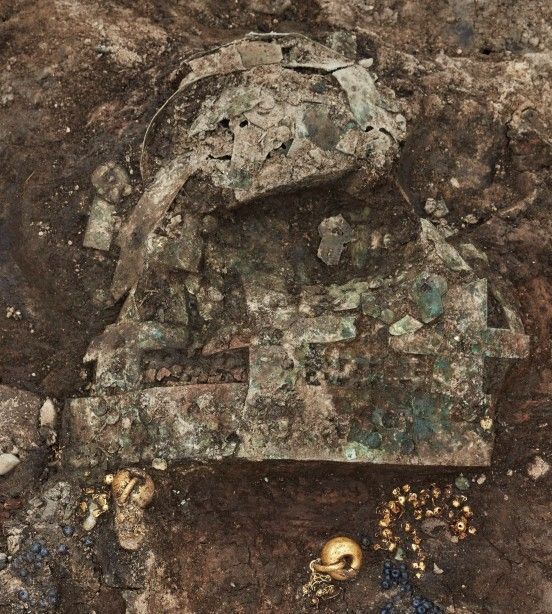
The National Heritage Administration announced on May 21 that, during the preservation process of a gold crown excavated from Tomb No. 120-2 in Hwangnamdong, Gyeongju in 2020, they found fifteen silk beetle wing decorations. This is the first time that silk beetle wing decorations have been found on a gold crown or a gilt-bronze crown; previously, such decorations were only identified on horse trappings and belts.
The silk beetle is considered the most beautiful beetle among the insects distributed in Korea. Its green or brown body boasts a brilliant sheen, making it highly prized since ancient times. The presence of silk beetle wings has only been confirmed in the most prestigious Silla tombs, such as Hwangnamdaechong and Geumgwanchong.
The tomb located south of Tomb No. 120 in Hwangnamdong is estimated to have been constructed during the 5th to 6th centuries of the Silla period. At the time of excavation, a full set of ornate accessories, including the gilt-bronze crown, gilt-bronze shoes, gold earrings, and bead bracelets, was found in the same condition as when the tomb's owner wore them.
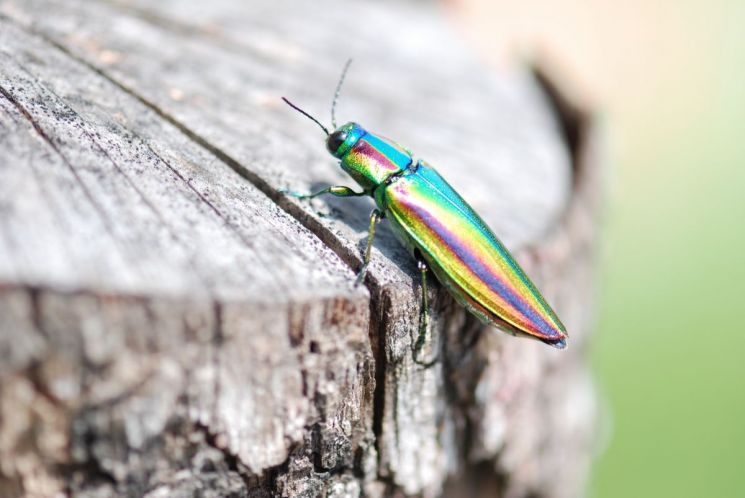
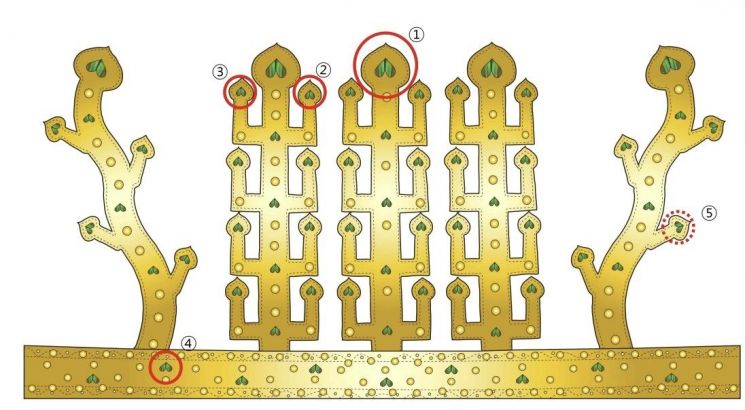
The most notable item, the gilt-bronze crown, features a round headband at the base, with three upright ornaments in the shape of the Chinese character "出" and two upright ornaments shaped like deer antlers attached above. Both the upright ornaments and the headband are decorated with upside-down heart-shaped holes. Silk beetle wings were attached behind these holes, and it is believed that the holes throughout the crown were filled and decorated in this way.
The research team stated, "Among the seven decorations still attached to the crown, some were layered in groups of three, while the rest were single pieces. Most have changed color, but in some areas, the original hue remains."
The National Heritage Administration plans to continue research and investigation while preserving the gilt-bronze crown. An official commented, "The silk beetle wing decorations are more than mere aesthetic expressions; they provide clues about the wearer's social status. They are highly valuable as materials that demonstrate the relationship between the splendid Silla craft techniques and the culture of the ruling class."
The academic community believes, based on contextual evidence, that the wearer was a woman. The National Heritage Administration also revealed, after examining teeth found in the tomb last year, that the tomb's owner was a female aged between 12 and 15, and that a child around three years old appears to have been buried alongside her as a sacrificial burial.
© The Asia Business Daily(www.asiae.co.kr). All rights reserved.














