Nvidia Suffers Billions in Losses Due to China Export Controls
Huang: "Hope the Truth on the Ground Will Influence Policy Decisions"
Jensen Huang, CEO of Nvidia, expressed strong frustration. He openly criticized the export controls on China imposed by the Biden administration and continued by the current Trump administration, declaring that these policies have "failed" and publicly voicing his dissatisfaction that Nvidia has incurred losses amounting to billions of dollars as a result.
At the GTC Taipei Global Press Conference held on the morning of the 21st at the Mandarin Oriental Hotel in Taipei, Jensen Huang responded to a question regarding the impact of U.S. export regulations and his stance on these policies by stating, "Due to export controls, we have been unable to ship the H20 product to China, and ultimately, we had to write off billions of dollars' worth of inventory. This amount is comparable to the total annual sales of some semiconductor companies," he said.
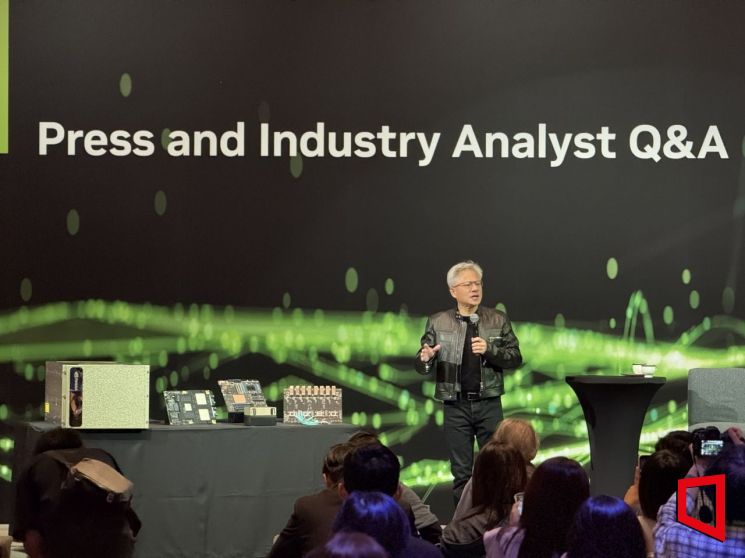 Jensen Huang, CEO of Nvidia, is answering questions at the GTC Taipei Global Press Conference held on the morning of the 21st at the Mandarin Oriental Hotel in Taipei, Taiwan. Photo by Jang Heejun
Last year, Nvidia generated approximately $17 billion in revenue from China, accounting for 14% of the company's total sales. The H20 chip had been the only chip that Nvidia was legally allowed to sell in China, with its performance intentionally reduced. However, the Trump administration has recently moved to restrict even the export of the H20 chip.
Huang stated, "Four years ago, when the Biden administration began, Nvidia held a 95% share of the Chinese artificial intelligence (AI) chip market, but now that share has been halved. Moreover, since we could only sell lower-spec products, our average selling price (ASP) dropped, and we lost profits as a result."
However, Huang dismissed speculation that Nvidia would launch an even lower-performance version of the H20 chip in China. He said, "There is no way to further reduce the performance of the current H20 or Hopper architectures. If we did, the products would become useless in the market."
He repeatedly emphasized the importance of the Chinese market. Huang stated, "Fifty percent of AI researchers worldwide are in China, and we want them to build AI on the Nvidia platform. The DeepSeek model was built on Nvidia, and that was a gift both for us and for the world." He continued, "China is the second-largest computing market in the world, and in my estimation, the entire AI market will reach about $50 billion next year. This represents an enormous opportunity for Nvidia, and it would be a shame to miss it."
He also pointed out problems with U.S. policy. Huang said, "The current policy direction is wrong. For whatever reason, I hope that what is actually happening on the ground?the 'truth on the ground'?will influence policymakers so that the policy can change and we can compete in the Chinese market again." He added, "(Through the Chinese market) the U.S. can increase tax revenue, create jobs, and sustain its industry." "The options are very limited, and there is no immediate solution, but we will continue to consider alternatives for the Chinese market," he added.
© The Asia Business Daily(www.asiae.co.kr). All rights reserved.












