Includes Space-Based Sensors and Interceptor Weapons
Intercepts Missiles Launched from Space
Prepared for Attacks on US Mainland by North Korea, China, and Russia
$175 Billion Budget...Expected Hurdles in US Congress
US Secretary of State: "If Russia Is Not Interested in Negotiations and Wants to Continue the War, Additional Sanctions Will Follow"
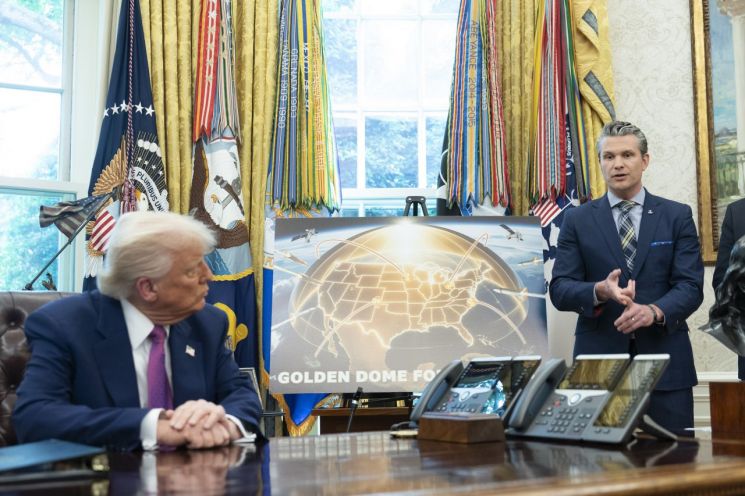 US President Donald Trump (left) announced on the 20th (local time) in the White House Oval Office, together with Defense Secretary Pete Hegseth, that he would deploy the missile defense (MD) system "Golden Dome" during his term. President Trump said, "Once the construction of Golden Dome is completed, it will be able to intercept missiles launched from the opposite side of the Earth and from space." UPI News
US President Donald Trump has announced that the US missile defense system, "Golden Dome," will be deployed during his term, which ends in January 2029. The administration plans to revive the so-called "Star Wars" initiative, which former President Ronald Reagan promoted during the US-Soviet Cold War era but was left incomplete. However, the Democratic Party is opposing the plan, arguing that allocating a total budget of $175 billion (approximately 243 trillion won) could accelerate the US fiscal crisis, and significant hurdles are expected in getting the bill through Congress.
On the 20th (local time), President Trump stated at an announcement event held in the Oval Office of the White House, attended by Defense Secretary Pete Hegseth, that the Golden Dome "must be fully operational before the end of my term," setting the goal of having the system ready for real-world deployment by January 2029. He also appointed General Michael Getline, Deputy Commander of the US Space Force, as the chief officer in charge of the Golden Dome project.
Regarding the Golden Dome, President Trump explained, "We will deploy next-generation technologies, including space-based sensors and interceptor weapons, on land, at sea, and in space." He added, "Canada has contacted us, expressing interest in being part of the project. We plan to discuss this with them." He emphasized, "Once the construction of Golden Dome is completed, it will be able to intercept missiles launched from the opposite side of the Earth and from space. We will build the best system in history."
The Golden Dome is a next-generation missile defense system similar to Israel's Iron Dome. On January 27, President Trump signed an executive order outlining the establishment of the Golden Dome. This executive order instructed the Department of Defense to develop, within two months, an implementation plan for a new interceptor system capable of countering ballistic missiles, hypersonic missiles, and new types of cruise missiles.
The most distinctive feature of the Golden Dome initiative is the establishment of a space-based interceptor system. The plan is to track new types of missiles, which are difficult to detect with ground-based radar, using space sensors mounted on satellites, and to intercept missiles in their boost phase with interceptors deployed in space. This appears to be aimed at countering the US homeland strike capabilities of China, Russia, and North Korea. In a report published on the 13th, the US Defense Intelligence Agency (DIA) stated, "North Korea has successfully tested ballistic missiles with sufficient range to reach the entire United States," and projected that North Korea could possess as many as 50 intercontinental ballistic missiles (ICBMs) capable of carrying nuclear warheads by 2035.
The main issue with this initiative is the enormous budget required. President Trump stated that "a total of $175 billion will be needed to build the Golden Dome." Of this, only $25 billion, corresponding to the initial phase, is reflected in the so-called "Big and Beautiful Single Bill" (a comprehensive bill reflecting President Trump's budget and tax reduction policy), which is currently pending in Congress. The United States also attempted a similar plan using satellites to intercept enemy nuclear missiles under the name "Star Wars" during the Reagan administration in the 1980s, but the project was halted due to budget constraints and technological limitations. President Trump said, "We will truly complete what President Reagan started 40 years ago."
If the budget bill, which has not yet received final congressional approval, fails to pass, the project will immediately face funding issues. Currently, the US Democratic Party is opposing the plan, citing the enormous fiscal burden and the potential to trigger a global arms race. The Congressional Budget Office (CBO) estimates that building the Golden Dome could cost up to $542 billion (approximately 753 trillion won) over the next 20 years, suggesting that the final financial burden could increase further. The current US fiscal situation is severe; on the 16th, international credit rating agency Moody's downgraded the US national credit rating by one notch from "Aaa" to "Aa1."
Meanwhile, when asked whether he had discussed the Golden Dome with Russian President Vladimir Putin, President Trump stated, "We will discuss it at the appropriate time." Regarding questions about sanctions against Russia, he said, "That is my decision to make. It is not for someone else to decide," adding, "We will see how Russia behaves." US Secretary of State Marco Rubio also testified before the Senate Foreign Relations Committee, supporting President Trump's remarks by stating, "If Russia is not interested in peace negotiations and wants to continue the war, additional sanctions could be imposed."
© The Asia Business Daily(www.asiae.co.kr). All rights reserved.











