"Drug prices must match those in countries with at least 60% of U.S. national income"
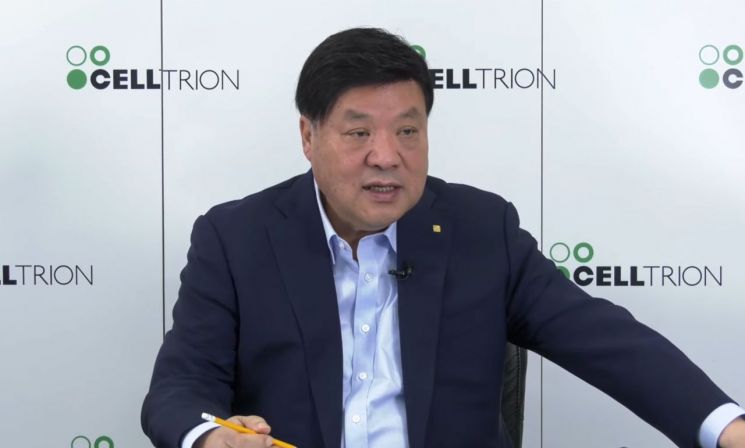 On the 15th of this month, Seo Jungjin, chairman of Celltrion, spoke at an online meeting held regarding the U.S. government under Donald Trump's policies on drug price reductions and pharmaceutical tariffs. Photo by Celltrion YouTube screen capture
Celltrion has stated that the impact of the U.S. Donald Trump administration's follow-up measures to the executive order on drug price reductions will be limited for its products, as biosimilar products are not subject to these measures.
On May 20 (local time), the U.S. Department of Health and Human Services (HHS) set specific drug price targets at the "most-favored-nation" level, which pharmaceutical companies must meet to comply with the executive order. The standard for the most-favored-nation price refers to the lowest price among countries in the OECD (Organization for Economic Cooperation and Development) where national income is at least 60% of that of the United States, targeting high-priced prescription drugs. HHS stated, "We will announce in the coming weeks the results of our negotiations with pharmaceutical companies to ensure that Americans do not pay more for drugs than patients in other countries," and added, "We expect that setting price targets at the most-favored-nation level will significantly lower U.S. drug prices, which are currently three to five times higher than those overseas."
In response, Celltrion stated, "If the prices of high-priced original drugs are reduced through the most-favored-nation pricing policy, the environment will shift from original drugs being prioritized in formularies to direct competition with biosimilars, thereby creating opportunities to expand prescriptions of biosimilar products." The company also explained, "In the case of Zympentra, it has only been approved as a new drug in the United States, and is currently sold as a biosimilar in countries other than the United States, so it is not expected to be subject to the most-favored-nation price reference."
Biosimilars are generally sold at prices 10% to 30% lower than those of original drugs. In the United States, the drug pricing system is structured so that the government (Medicare) pays medical institutions an amount equal to the average sales price plus 6%. The higher the price of the original drug prescribed, the greater the profit for the hospital. This is why, despite similar efficacy, lower-priced biosimilars are often less prescribed in hospitals. If drug price reduction policies are implemented, hospitals will have less incentive to prescribe original drugs, leading to expectations that biosimilar prescriptions will increase.
Celltrion further stated, "Considering all these factors, it appears that favorable policy trends for the company, such as the expansion of biosimilar use and improvement of the intermediary distribution structure, are being maintained following previously announced drug price reduction executive orders," and added, "We expect this to present positive opportunities for Celltrion's business activities."
Previously, Seo Jungjin, chairman of Celltrion Group, said at an online press conference on May 15, "None of the biosimilars supplied by Celltrion to the United States are priced higher than in Europe," and firmly stated, "There is almost no possibility that the U.S. government's drug price reduction policy will directly impact Celltrion." He went on to say, "The core issue lies in the intermediary distribution structure that takes the profits," and added, "If the U.S. government embarks on structural reform, it will actually work in Celltrion's favor."
Celltrion stated, "Since the drug price reduction policy is proceeding within the range we had anticipated, we believe it will be advantageous for Celltrion as a biosimilar manufacturer," and added, "Celltrion will continue to respond swiftly to changes in global healthcare policies, including those in the United States, and will do its utmost to leverage these as opportunities to deliver results."
Meanwhile, under the U.S. executive order on drug price reductions, pharmaceutical companies must voluntarily lower prices within 30 days or negotiate with the government for 180 days, and if they do not cooperate, the government is expected to take mandatory actions such as price controls or allowing the import of low-priced drugs from overseas. However, there are criticisms that the executive order alone lacks sufficient legal basis to control drug prices. During the first Trump administration, similar measures were attempted, but implementation was ultimately halted after legal disputes.
© The Asia Business Daily(www.asiae.co.kr). All rights reserved.











