Moody's Downgrades U.S. Credit Rating to "Aa1"
All Three Major U.S. Assets?Stocks, Treasuries, and Dollar?See Simultaneous Sell-Offs
10-Year Treasury Yield Surpasses 4.5%, 30-Year Breaks Above 5%
As global credit rating agency Moody's abruptly downgraded the United States' credit rating, all three major indices on the New York Stock Exchange fell simultaneously on May 19 (local time). U.S. Treasury prices and the U.S. dollar also declined, signaling a renewed wave of "Sell America" as investors offload American assets. As bond yields, which move inversely to bond prices, surged, the yield on the 10-year U.S. Treasury surpassed 4.5%, while the 30-year yield broke through 5%.
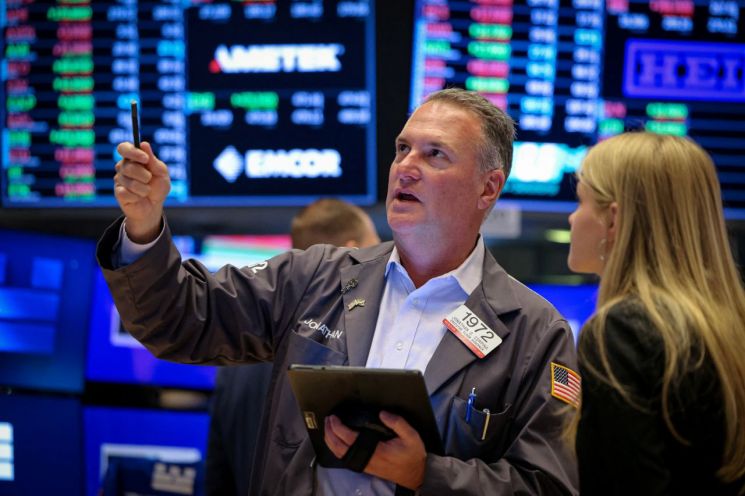
As of 9:31 a.m. on the same day at the New York Stock Exchange, the Dow Jones Industrial Average, which focuses on blue-chip stocks, was down 298.4 points (0.7%) from the previous trading day, standing at 42,356.34. The large-cap S&P 500 index dropped 59.18 points (0.99%) to 5,899.2, and the tech-heavy Nasdaq index slid 246.28 points (1.28%) to 18,964.82.
On May 16, Moody's downgraded the U.S. sovereign credit rating from the highest grade of 'Aaa' to 'Aa1'. With this move, the United States lost its top credit rating status from all three major credit rating agencies?Fitch, Standard & Poor's (S&P), and now Moody's. The main reason for this downgrade is the rapid increase in U.S. federal government debt. Moody's stated, "This one-notch downgrade reflects the fact that the government debt and interest payment ratios have increased to significantly higher levels than those of similarly rated countries over the past decade," adding, "We acknowledge the United States' considerable economic and fiscal strength, but this is no longer sufficient to fully offset the deterioration in fiscal indicators."
Due to the credit rating downgrade, investors are selling U.S. Treasuries, causing long-term Treasury prices to fall and yields to soar. In theory, when a country's credit rating is downgraded, the risk of default on its bonds increases, leading investors to demand higher interest rates. The yield on the 10-year U.S. Treasury, which serves as a global bond benchmark, jumped 12 basis points (1bp = 0.01 percentage point) from the previous day to 4.55%. The 30-year Treasury yield surged 13 basis points to 5.02%. The uncertainty surrounding President Donald Trump's tariff policies, combined with the credit rating downgrade, has further heightened instability in the Treasury market.
Additionally, the passage of President Trump's tax cut plan through the House Budget Committee the previous day has also weighed on Treasury prices. Hardline Republicans had previously voted against the tax cut plan, demanding further cuts to Medicaid (health insurance for low-income individuals), but changed their stance in a re-vote the previous day. Experts believe that President Trump's income and corporate tax cut pledges will further worsen the federal government's fiscal deficit.
The value of the dollar is also weakening alongside U.S. stocks and Treasuries. The dollar index, which measures the value of the dollar against the currencies of six major countries, fell 0.81% from the previous trading day to 100.13.
Peter Boockvar, Chief Investment Officer (CIO) at Bleakley Financial Group, said that Moody's downgrade of the U.S. credit rating is "symbolic in that credit rating agencies are highlighting America's mounting debt and deficit problems," and pointed out, "The fundamental factors of declining foreign demand for Treasuries and the continually expanding volume of debt that needs to be rolled over will not change."
Jordan Rochester, Head of EMEA Macro Strategy at Mizuho International, commented, "I don't want to overstate the significance of this downgrade, but it adds to the already established trend of de-dollarization."
However, some analysts believe that the market shock from Moody's action will be temporary. Kim Forrest, Chief Investment Officer (CIO) at Bokeh Capital Partners, said, "The downgrade of the U.S. credit rating may serve as a warning, but it's not the first time," adding, "Bond investors are fully aware of the debt issues," and predicted that the impact on the market would not be significant.
By individual stocks, Walmart is down 1.5%. This follows President Trump's call for Walmart to absorb tariffs through negotiations with China and withdraw its planned price increases, after he warned of price hikes due to tariff burdens. Netflix is down 0.88% after JPMorgan downgraded its investment rating from overweight to neutral. As investors become more risk-averse, technology stocks are also weakening. Nvidia and Tesla are down 1.87% and 4.53%, respectively.
© The Asia Business Daily(www.asiae.co.kr). All rights reserved.












