Reopening of the Peabody Essex Museum Korean Hall
Introducing Korean Art and Culture from the 19th Century to the Present
Over 100 Collection Pieces on Display
The Korean Hall reopened under the new name "Yoo Giljun Korean Hall" on May 17, following a renovation. The updated Korean Hall was redesigned using the Peabody Essex Museum's own budget and now covers an area of 232 square meters.
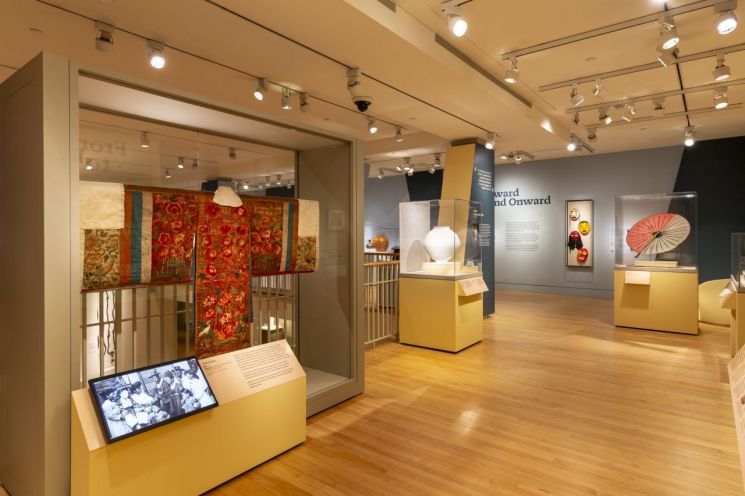
The Peabody Essex Museum is the oldest existing museum in the United States and was the first American museum to systematically collect Korean artworks. In particular, since the opening of Joseon in the 19th century, the museum has continued to collect Korean cultural heritage, based on exchanges between Korea and the United States.
The new name, "Yoo Giljun Korean Hall," was chosen in honor of Yoo Giljun (1856-1914), a member of the American diplomatic mission Bobingsa, Korea's first overseas student, and author of "Seoyugyeonmun." This decision was based on the relationship between Yoo Giljun and Edward Morse, then director of the Peabody Academy of Science (the predecessor of the current Peabody Museum). After coming to the United States in 1883 as part of the Bobingsa, Yoo Giljun remained in Salem to study for about a year at the suggestion of Director Morse. During this time, he advised Morse on 225 Korean artifacts that Morse had acquired in 1884 through Paul Georg von M?llendorff (1848-1901), a German who served as King Gojong's diplomatic advisor. The newly reopened Korean Hall now displays clothing and personal items Yoo Giljun donated to the museum upon his return to Korea, as well as a letter he wrote to Morse on the ship back home.
The Korean Hall at the Peabody Essex Museum features a wide range of items, from 19th-century everyday objects to 21st-century contemporary artworks. Among the exhibits that demonstrate exchanges between Korean and American diplomats, missionaries, and intellectuals is a Western gentleman's hat made of traditional Korean horsehair, which was given to Percival Lowell, a member of the Bobingsa and author of "Choson, The Land of the Morning Calm." In addition, a unique hexagonal silver box received by missionary Mabel Paulling (1870-1909) from the Joseon Ministry of Home Affairs bears the Korean inscription "Mrs. Paulling."
This exhibition also unveils, for the first time, a family photograph of Lee Beomjin (1852-1911), who served as Korean minister to the United States from 1896 to the early 1900s. During his three and a half years in Washington as minister, Lee Beomjin developed a close relationship with Morgan, who later accompanied Lee's wife back to Korea in 1899 at Lee's request, as she was suffering from homesickness. The photograph features Lee Beomjin's wife, his eldest son Lee Gijong, and his second son Lee Wijong, who later served as a special envoy to The Hague in 1907. Lee Beomjin also served as minister to Russia, France, and Austria, and in 1900 moved to Russia, where he dedicated himself to defending the sovereignty of the Korean Empire and the independence movement. He died in 1911 after Korea lost its sovereignty in 1910. Morgan served as a diplomat for the Korean Empire from 1900 to 1901, and later as the last minister of the Korean Empire in 1905, before taking up ambassadorial posts for the United States in several South American countries.
The reopening ceremony took place on May 15 at the Korean Hall and a separate reception area at the Peabody Essex Museum. The event was attended by Kim Jaehong, Director of the National Museum of Korea; Kim Jaehwi, Consul General of the Republic of Korea in Boston; representatives from the Peabody Essex Museum; and numerous figures from the local cultural community and the Korean American community.
Kim Jaehong, Director of the National Museum of Korea, stated, "I am delighted that the Korean Hall has reopened after more than 30 years since 1994. I hope that more people will experience Korean history and art in the Korean Hall, and that cultural exchanges between the two countries will deepen further."
© The Asia Business Daily(www.asiae.co.kr). All rights reserved.












