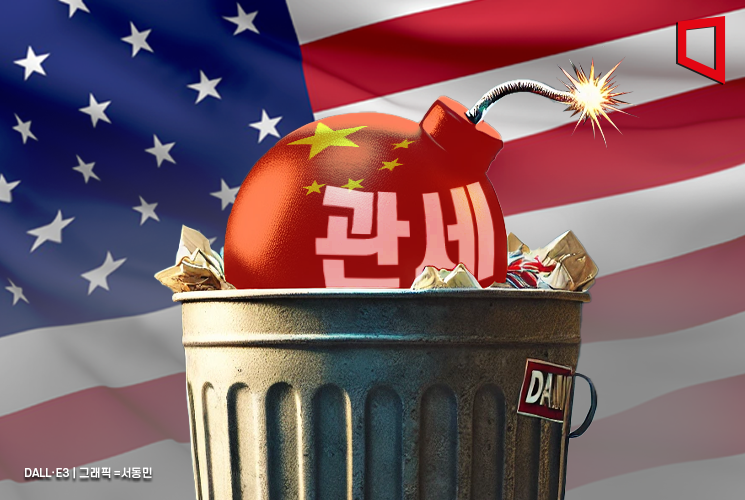
China has continued to reduce its holdings of U.S. Treasury bonds, and as of March this year, its ranking fell to third in the world, behind Japan and the United Kingdom.
According to Yonhap News Agency and foreign media outlets on May 18, citing data from the U.S. Department of the Treasury, foreign holdings of U.S. Treasury bonds increased for the third consecutive month in March, reaching an all-time high of $9.05 trillion (approximately 12,680 trillion won).
Among these, China's holdings stood at $765.4 billion (approximately 1,072 trillion won), a decrease of $18.9 billion (approximately 26 trillion won) from the previous month, reversing a two-month upward trend.
As a result, China dropped to third place among holders of U.S. Treasury bonds, while the United Kingdom increased its holdings by $29 billion (approximately 40 trillion won) during the same period, reaching a total of $779.3 billion (approximately 1,092 trillion won) and moving up to second place. Japan maintained its top position in March, holding $1.13 trillion (approximately 1,583 trillion won) in U.S. Treasury bonds.
China's holdings of U.S. Treasury bonds peaked at $1.316 trillion (approximately 1,844 trillion won) in November 2013 and have been declining since then.
By the end of 2017, the figure had dropped to $1.184 trillion (approximately 1,659 trillion won), and by the end of 2018, it was $1.124 trillion (approximately 1,575 trillion won). The downward trend continued, with holdings falling to $867 billion (approximately 1,127 trillion won) at the end of 2022 and $816 billion (approximately 1,143 trillion won) at the end of 2023. By the end of last year, the figure had decreased further to $759 billion (approximately 1,063 trillion won).
Analysts say that China's reduction in U.S. Treasury holdings is linked to concerns in the market that such moves could be used as a bargaining tool during the U.S.-China trade war. In particular, after former U.S. President Donald Trump announced reciprocal tariffs last month and instability in the Treasury market intensified, speculation arose that China might be behind these developments.
On May 15, Yu Yongding, a member of the Chinese Academy of Social Sciences and former member of the Monetary Policy Committee of the People's Bank of China, said in an interview with local media that, given the increased risks resulting from former President Trump's tariff policies, foreign investors holding U.S. dollar assets?especially Treasury bonds?should also consider the possibility of a U.S. default. He advised, "China needs to develop response strategies that consider various scenarios in order to ensure the safety of its overseas assets."
© The Asia Business Daily(www.asiae.co.kr). All rights reserved.












