An artificial intelligence (AI) communication tool app has been developed to facilitate meaningful conversations between children with autism and their parents. This app is notable for encouraging children with autism to actively express themselves and to initiate conversations by asking about the other person's intentions, thereby promoting child-led dialogue.
On May 18, KAIST announced that a research team led by Professor Hong Hwajeong of the Department of Industrial Design, in collaboration with Naver AI Lab and Dodagim Child Development Center, has developed an AI-based communication tool called "AAcessTalk."
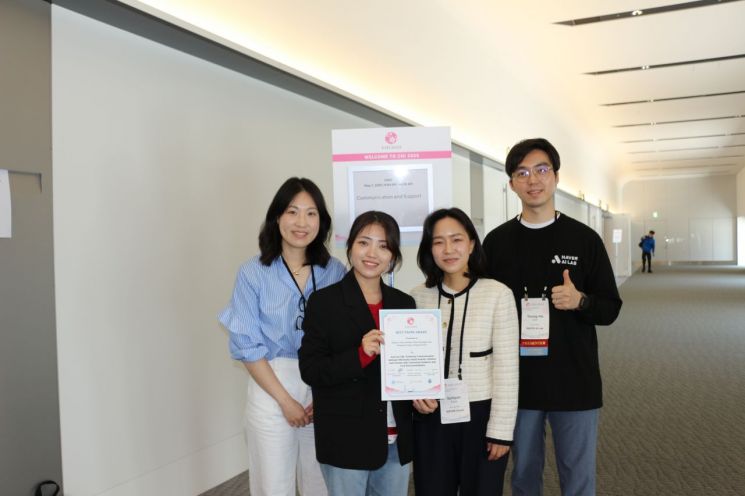 (From left) Professor Hong Hwajeong of the Department of Industrial Design and PhD candidate Choi Dasom of the Department of Industrial Design are taking a commemorative photo with researchers from Naver Cloud AI Lab. Provided by KAIST
AAcessTalk is a tablet-based AI communication system designed to facilitate conversations between minimally verbal autism (MVA) children, who have difficulty expressing themselves verbally, and their parents.
Although augmentative and alternative communication (AAC) tools have existed previously, they were limited to supporting communication through a restricted set of cards, which clearly failed to fully capture the child's interests and subtle emotions.
To address this, the research team utilized AI technology to design a system that recommends personalized word cards in real time, reflecting the child's interests and situational context, while also providing parents with specific conversation guides tailored to each situation.
In particular, AAcessTalk includes features to strengthen the child's initiative in communication, allowing children with autism to decide when to start or end a conversation using a "conversation switch button." Another distinctive feature is the "What about you, Mom?" question button, which enables the child to ask the parent's thoughts first.
The research team also conducted a field study over two weeks with 11 families to verify the effectiveness of AAcessTalk. As a result, most family members who participated in the study said, "The child experienced asking questions to the parent first using AAcessTalk," and added, "It felt like we had a serious conversation with our child for the first time."
Another family shared, "We were surprised when our child used an unexpected word," and commented, "Participating in the field study allowed us to gain a deeper understanding of our child's language abilities."
The responses from families who participated in the field study can generally be summarized as follows: due to the characteristics of autism, communication had previously been routine and repetitive, but with AAcessTalk, families experienced richer conversations and, above all, were surprised or moved by witnessing the children with autism take the initiative in communication.
Regarding this, Professor Hong Hwajeong stated, "To encourage meaningful conversations among family members in households with children with autism, it is most important to create an environment where the child can express their own voice," and added, "Through this research, our team confirmed that AI can serve not only to improve communication efficiency but also as a tool to expand mutual empathy and understanding within families."
She continued, "The research team will continue to develop 'human-centered technology' that respects and embraces neurodiversity," and emphasized, "We will especially focus on practical technology applications for vulnerable groups and expand research based on user experience."
The team's research results were also recognized with the Best Paper Award at the international academic conference 'ACM CHI 2025' held in Yokohama, Japan. At the conference, the research team received international attention for its highly regarded human-centered AI approach.
Meanwhile, this research was the result of KAIST Department of Industrial Design PhD candidate Choi Dasom's internship at Naver AI Lab.
© The Asia Business Daily(www.asiae.co.kr). All rights reserved.












