Restoration Begins with the Jisin Goyu Ceremony
Replanting Ginkgo Trees and Rebuilding Haengdan
Reborn as a Symbolic Space of Confucian Culture
The memorial site of Administrative Officer Kwon Sik, a Confucian scholar from the early Joseon Dynasty and widely known as the founder of the Andong Kwon clan in Uiseong, is being restored after more than 600 years. This marks a historic moment as a symbol of Confucian spirit, long forgotten, is revived once again.
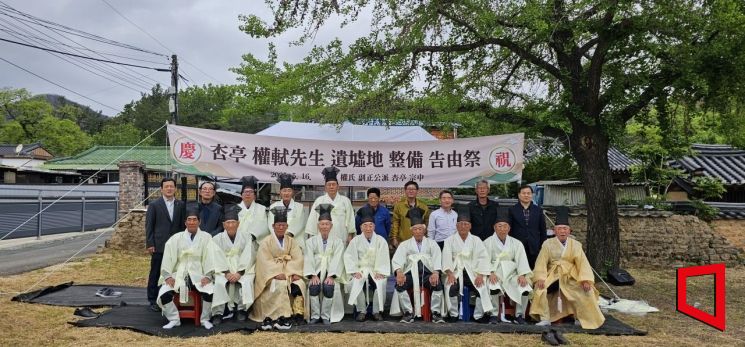 Descendants of Administrative Officer Kwon are performing the Jisin Goyu Ceremony and taking a commemorative photo. Photo by Kwon Byunggun
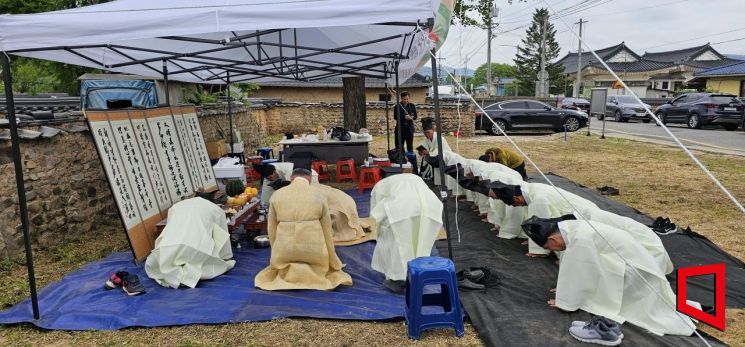
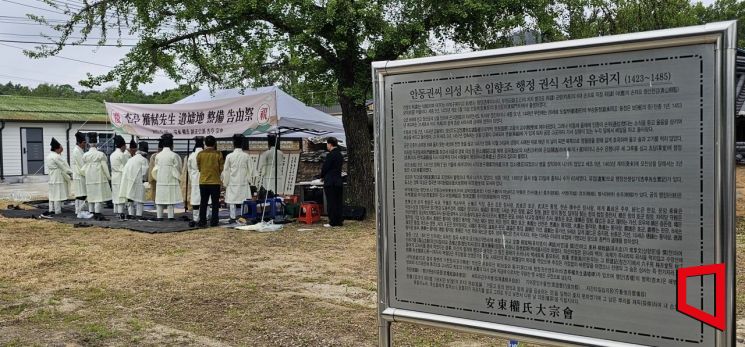
Recently, in Sachon-ri, Jeomgok-myeon, Uiseong-gun, North Gyeongsang Province, the first stage of the restoration project to revive the memorial site of Administrative Officer Kwon Sik began with the Jisin Goyu Ceremony, a ritual to awaken the spirit of the land. This event, in which Uiseong-gun, descendants of the Andong Kwon clan, and local Confucian scholars participated together, was a symbolic ceremony that went beyond mere restoration, serving to revive regional identity and historical consciousness.
The current restoration project focuses on replanting three ginkgo trees and restoring the 'Haengdan,' a space for scholarly training. In the 1450s, following the dethronement and death of King Danjong, Kwon Sik resigned from government service, returned to Sachon-ri, planted ginkgo trees himself, and established an educational space to teach his disciples.
This place was called 'Haengdan,' a name derived from the 'Forest of Qufu,' where Confucius, the founder of Confucianism, taught his disciples.
Kwon Sik left a poem expressing his wish for future generations' education and virtue, stating, "Though I cannot follow the virtuous pine of Confucius, I will carry on his will by planting ginkgo trees for my descendants to nurture." However, through turbulent times such as the Imjin War, the Byeongja War, and the Korean War, both the Haengdan and the ginkgo trees were lost.
Since then, descendants and the local community have long hoped for restoration, and this project marks the first step in making that wish a reality.
The restoration targets include: replanting three ginkgo trees; restoring the original Haengdan; refurbishing the memorial stele and information boards; and developing historical storytelling content. In the future, plans are also being considered for creating a Confucian cultural experience space, youth Confucian education programs, and utilizing the site as a local cultural tourism resource.
Kwon Sik was born in Andong in 1423 (the 5th year of King Sejong's reign), passed the Saengwon examination in 1452, and served as an instructor at Changwon Hyanggyo in 1454, where he practiced rigorous Confucian education based on the Baekrokdonggyu.
After King Danjong was dethroned in 1457, Kwon Sik, unable to contain his grief, retired to Sachon-ri and devoted his life to scholarship and education. Among his descendants were Kwon Heumjo, who passed the Jinsa examination; Kwon Gyeongjo, who passed the state examination; Kwon Sungjo, who served as Byeolje; Kwon Huisun, who served as Janggi Hyeongam in the late Joseon period; and Kwon Sugyeong, who was posthumously appointed as Minister of Personnel.
The Gicheonrisa shrine, built in 1860 with the consensus of the local Confucian community, was destroyed by arson during the Japanese colonial period. However, its legacy continues through Gicheonjeongsa (Uiseong-gun Cultural Heritage No. 38), which was rebuilt by descendants in 1934, and through the memorial stele.
Descendants of Kwon Sik stated, "We hope this restoration will not merely serve as a commemoration, but as an opportunity to once again awaken the Confucian spirit and educational ideals of our ancestor in today's society," adding, "We, together with the local community, will continue to carry on this spirit."
An official from Uiseong-gun commented, "The restoration of Administrative Officer Kwon Sik's memorial site is not only about preserving Confucian cultural heritage, but also a crucial opportunity to restore the region's historical identity. We will spare no effort to support its development into a complex cultural space where education, culture, and tourism come together."
This restoration project serves as a cultural foundation for inheriting Confucian ideals and educational spirit, and as a grand restoration of collective memory, reflecting the wishes of local residents and descendants. The ginkgo trees to be revived at Haengdan are not merely trees, but are preparing to greet a new era as symbols of 600 years of Confucian spirit.
ㅠ
© The Asia Business Daily(www.asiae.co.kr). All rights reserved.














