"Like an island or a fixed aircraft carrier between Japan and China"
Significant strategic importance for Indo-Pacific security
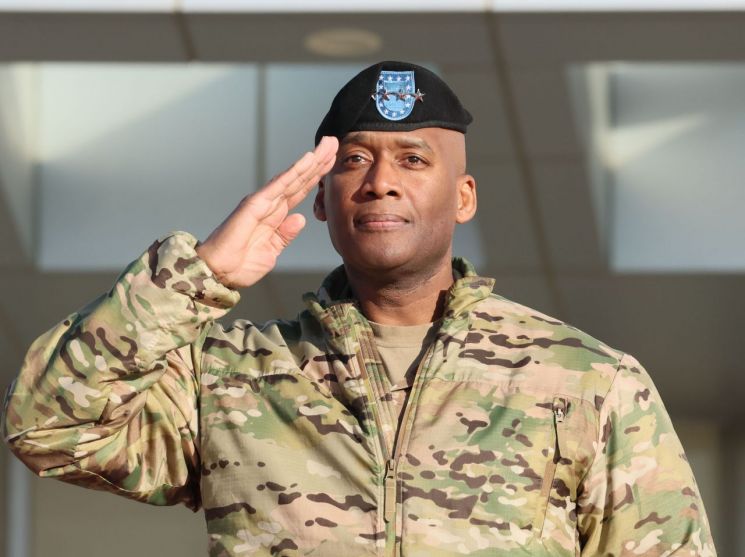 Xavier Brunson, Commander of the ROK-US Combined Forces Command, is saluting at the welcoming honor guard ceremony for the ROK-US Combined Forces Commander held at the Ministry of National Defense parade ground in Yongsan, Seoul, on January 9. On the 15th (local time), he emphasized the strategic significance of the presence of US Forces Korea in the security of the Indo-Pacific region. Photo by Yonhap News Agency
On the 15th (local time), Xavier Brunson, Commander of US Forces Korea, emphasized that the presence of US Forces Korea has significant strategic implications in the Indo-Pacific region, as it influences the strategic actions of North Korea, Russia, and China.
At the Pacific Land Forces (LANPAC) Symposium of the Association of the United States Army (AUSA) held in Hawaii on the same day, Commander Brunson explained that US troops stationed in Korea play a major role in overcoming the "tyranny of distance" that makes military operations in the vast Indo-Pacific region challenging.
He highlighted the strategic importance of Korea's geographic location, describing Korea as "the closest allied presence to Beijing" and likening it to "an island or a fixed aircraft carrier floating between Japan and mainland China."
He further explained, "US Forces stationed in Korea alter the calculations of the leadership in North Korea, Russia, and China, impose costs, and provide our nation's highest-level leaders with options in any conflict."
He added, "US Forces Korea does not focus solely on deterring North Korea. We are also focusing on regional operations, activities, and investments as a small part of the larger Indo-Pacific strategy."
These remarks are noteworthy in the context of the strategic flexibility of US Forces Korea. Since the re-election of President Trump, there have been observations that the United States will pursue 'strategic flexibility,' expanding the operational scope of US Forces Korea beyond the Korean Peninsula to respond to various geopolitical crises in Northeast Asia, such as a possible Chinese invasion of Taiwan.
He also mentioned that Hanwha Ocean recently completed maintenance on the US Navy transport ship 'Cesar Chavez,' saying, "It looks better than when it was new," and argued that Korea's production, manufacturing, and maintenance, repair, and overhaul (MRO) capabilities can greatly assist US military activities in the Indo-Pacific region.
However, a Hanwha Ocean official explained to Yonhap News Agency that the US Navy vessel recently serviced was the logistics support ship 'Wally Schirra.' It is possible that Commander Brunson confused the ship names.
Commander Brunson expressed concern that North Korea may be receiving technical support in exchange for dispatching troops to Russia, stating, "North Korea is advancing some of its (weapons) programs in ways we did not expect they could."
He went on to say, "I am concerned about whether North Korea will learn how to mount its nuclear weapons on its current air delivery systems," adding, "North Korea is making leaps that would have taken years without cooperation with Russia."
Regarding trilateral military exercises among South Korea, the United States, and Japan, he stated, "ROK-US-Japan cooperation should become routine, and we must remove obstacles that block it," adding, "I want every partner we can bring to the Korean Peninsula to come and train."
© The Asia Business Daily(www.asiae.co.kr). All rights reserved.











