Lee Jaemyung: "Designing the Startup Ecosystem"
Kim Moonsu: "Creating an Autonomous Environment"
Consensus on Investment in AI Technology Startups
Field Voices: "Fundamental Overhaul of Outdated Systems
Need to Strengthen Adaptability to the Global Environment"
As the 21st presidential election approaches, the venture and startup pledges put forward by Lee Jaemyung of the Democratic Party and Kim Moonsu of the People Power Party, both leading candidates, are showing clear contrasts. Lee advocates for a government-led design of the startup ecosystem, while Kim emphasizes the creation of an autonomous, market-driven environment. On the ground, there is a growing demand for structural reforms aimed at fundamentally overhauling outdated and rigid systems and strengthening adaptability to the global environment, regardless of the specific details of the major candidates' pledges.
With increasing voices from the field pointing out that old and inflexible regulations are hindering the growth of ventures and startups, there are doubts as to whether the policy directions of each candidate will actually lead to improvements in the startup environment.
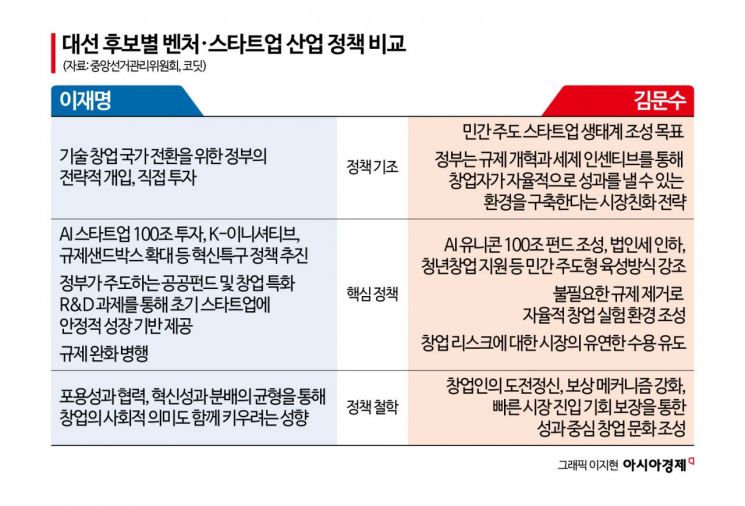
According to the candidates’ pledge materials submitted to the National Election Commission on the 16th and analysis by CODIT, an artificial intelligence (AI)-based policy analysis firm, both sides agree on the necessity of large-scale investment, viewing technology startups?including those in AI?as a core strategy for future national growth. However, there are clear differences in the main agents and implementation methods of their policies.
Lee, as his first pledge, proposed building a "world-leading economic powerhouse" by establishing a startup ecosystem funded by the government. Specifically, his plan includes: ▲expanding the budget for the Korea Fund of Funds, ▲strengthening research and development (R&D) investment for ventures and startups, ▲creating region-based Startup Parks, ▲establishing universities and knowledge industry centers as hubs, and ▲revitalizing the mergers and acquisitions (M&A) exit market. The idea is to strengthen support throughout the entire startup lifecycle by expanding public-led funding and infrastructure.
Recently, the "Meoksanism" Committee of Lee’s election campaign signed a policy agreement with the Korea Association of Innovative Venture Organizations, selecting as key tasks: expanding innovative finance through measures such as utilizing pension fund investment pools, rationalizing labor systems for the innovative growth of venture companies, and rationalizing regulations to discover new industries and expand opportunities for innovation.
In contrast, Kim has focused on private sector autonomy and the role of the market. With the slogan "A Country That Is Good for Business," Kim has pledged to enact the "Basic Law on Free Economic Innovation." His plan is to abolish regulations on new technologies and industries and to create an environment aligned with global standards. To foster the AI industry, he has pledged to eliminate data regulations and introduce a "Regulatory Benchmarking System" to abolish regulations unique to Korea. He also advocates for the creation of an "AI Startup and Venture Growth Fund" led by domestic and international companies, as well as greater flexibility in working hours, emphasizing a private sector-led structure.
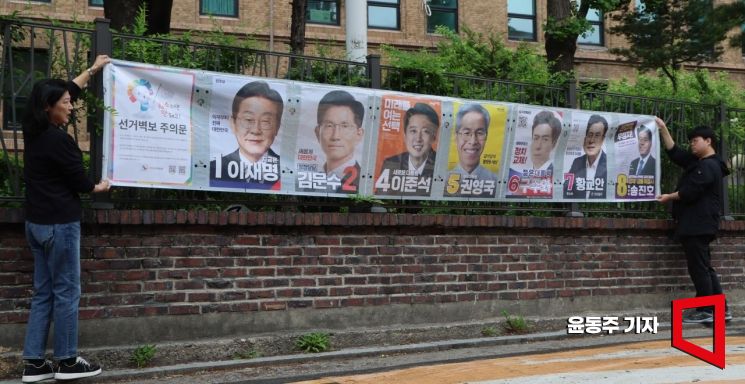 On the 15th, officials from the Seoul Metropolitan Election Commission are posting election posters of the 21st presidential election candidates on a wall near the Artist's House in Jongno-gu, Seoul. Photo by Dongju Yoon
However, challenges faced in the startup field go beyond investment or financial support, with criticism focusing on the lack of global adaptability in the overall system. At a policy forum held the previous day at the National Assembly Members’ Office Building in Yeouido, Seoul, experts pointed out that Korea’s startup system is still designed mainly for the domestic market and does not fit business structures that cross borders. In particular, domestic laws that conflict with investment contract structures favored by overseas venture capital, foreign exchange regulations on capital inflow, and taxation issues for overseas listings were cited as practical obstacles.
This reveals a gap between the startup ecosystem envisioned by the pledges and the reality. For startups aiming for global expansion, whether the ecosystem is government-led or market-driven, the effectiveness of policy is inevitably limited unless the overall system is flexible and open. Lee Hanbin, CEO of Seoul Robotics, said, "When we receive investment from abroad, we are required to convert it into Korean won, but the approval procedures and fee barriers are too high. There is even talk that it is better to start a business overseas."
A representative from CODIT said, "A government-led approach expands opportunities to participate in public funds and policy projects, whereas a private sector-led approach makes tax incentives and market competitiveness more important, which can change fundraising strategies. Startups should flexibly design their strategies for participating in government projects, attracting private investment, and responding to regulations according to each candidate’s startup policy direction."
The venture industry is more interested in whether the policies proposed in this election will actually be implemented than in their overall direction. With major tasks promised by the Yoon Sukyeol administration still unfulfilled, there is cautious scrutiny regarding the next administration’s ability to deliver on its policies, alongside expectations. The venture industry is urging the next government to implement policies to ensure the continued growth of the ecosystem, such as ▲mandating statutory funds for venture and startup investment, ▲reforming working hour systems including the 52-hour workweek, and ▲setting targets for regulatory innovation and benchmarking global standards.
An industry insider said, "Ultimately, securing funding and enacting legislation to ensure feasibility and sustainability are essential to overcoming the current crisis and bringing about real change in economic revitalization."
© The Asia Business Daily(www.asiae.co.kr). All rights reserved.













