KAIST announced on May 16 that it will hold the "2025 First Half National Strategic Technology Innovation Forum" on May 22 at the Jung Kunmo Conference Hall of the Academic and Cultural Center at its main campus in Daejeon.
National strategic technologies refer to twelve core technologies and fifty key sub-technologies that are recognized as strategically important from diplomatic and security perspectives, and have significant impact on the national economy and related industries, including artificial intelligence (AI), advanced biotechnology, quantum technology, and semiconductors.
The forum is being organized to examine the direction of domestic policies for fostering national strategic technologies in the rapidly changing international landscape, marked by escalating tensions between the United States and China and increasing global security uncertainties. It will also discuss ways to strengthen technological innovation between Korea and the United States to secure scientific and technological sovereignty and future growth engines.
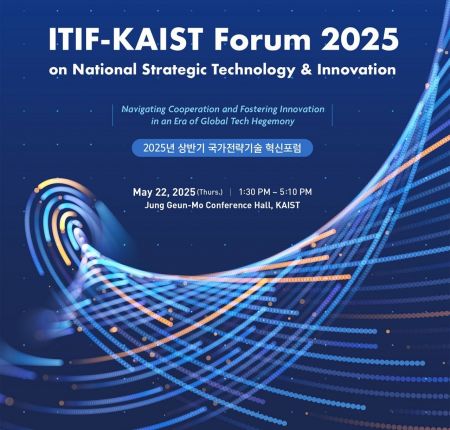
This forum will be divided into two sessions. In each session, domestic and international experts will deliver keynote presentations, followed by comprehensive discussions and Q&A sessions.
Robert Atkinson, President of the Information Technology and Innovation Foundation (ITIF) in the United States, will deliver the keynote speech on the theme "The Trump 2.0 Era: Korea's New Growth Strategy." He suggests that Korea should move beyond its traditional export-driven growth model, seek new growth strategies through broad-based technological innovation, and promote innovation by improving shadow regulations and other social practices that act as barriers.
Stephen Ezell, Vice President for Global Innovation Policy at ITIF and the first speaker in Session 1, will emphasize in his presentation, "US-China Conflict: Korea's Response and Global Implications," that Korea must overcome current crises by enhancing overall national productivity and fostering a competitive service industry.
Next, Song Kyungjin, Head of the Korea Office of The Asia Foundation, will speak on "Strengthening Korea-US Strategic Technology Partnership." He will suggest that, as global technological hegemony competition reshapes the diplomatic and security landscape, Korea-US cooperation should develop into an institutional and sustainable partnership through multilayered structures involving both countries' legislatures, industries, academia, and civil society.
Jung Jaemin, Dean of the College of Convergence Science and Technology at KAIST, will discuss "The Value of Humanities, Social Sciences, and Arts in the Age of AI." He will highlight the role and importance of the college in linking technological innovation to human-centered values, and will introduce related joint AI research projects with MIT.
In Session 2, Kim Yonghee, Director of the KAIST Policy Research Institute for National Future Strategic Technologies, will deliver the first presentation. He will address "Korea-US Cooperation for Truly Sustainable Next-Generation Nuclear Power," reviewing how many countries and companies are pursuing nuclear power for carbon neutrality and energy security. He will emphasize the need to resolve three major issues?safety, spent fuel, and uranium resources?for sustainable nuclear power.
He will also propose that the Molten Salt Fast Reactor (MSFR), an advanced reactor, could be an effective solution. The MSFR is a type of next-generation (Generation IV) reactor that uses molten salt as both nuclear fuel and coolant, and is a form of fast neutron reactor.
Hong Byunghee, Professor in the Department of Chemistry at Seoul National University, in his presentation "Strategic Industry Innovation Driven by Mass Production Technology for Graphene Materials," will identify graphene as a "dream material" that can surpass the limitations of existing technologies. He predicts that if Korea succeeds in mass-producing graphene, it will bring tremendous innovation to the nation's leading industries, including AI semiconductors and sensors, quantum computing, and biomedical sectors.
The final speaker in Session 2, Yoo Hoejun, Head Professor at the KAIST Graduate School of AI Semiconductors, will present on "The Present and Future of AI Semiconductors." He will point out that, with the full-scale utilization of large-scale AI such as ChatGPT, semiconductor design is shifting from a computation-centric to a memory-centric approach. He will present the direction and feasibility of mid- to long-term strategies for the competitive development of Korea-style AI semiconductors.
Lee Kwanghyung, President of KAIST, stated, "National strategic technologies are core agendas directly linked to Korea's future growth," and added, "KAIST will continue to provide a platform for communication between science, technology, and policy in collaboration with domestic and international industry, academia, and research institutions."
The forum is co-hosted by the Information Technology and Innovation Foundation, a US think tank, with support from the Ministry of Science and ICT.
© The Asia Business Daily(www.asiae.co.kr). All rights reserved.












