Legal and Institutional Reform Needed with "Cross-Border Enterprises" in Mind
Even Investment Fund Conversion Requires Approval... "Starting a Business in the US Is Preferable"
The primary obstacle hindering the globalization of Korean startups has been identified as "outdated, domestic market-oriented regulations." Experts point out that the legal and institutional frameworks surrounding the startup ecosystem, including investment contract structures, foreign exchange controls, and the tax system, still remain at a 20th-century level. They emphasize that, in order to nurture startups into global companies, policy perspectives must shift to assume the existence of "cross-border enterprises."
Legal and Institutional Reform Needed with "Cross-Border Enterprises" in Mind
Kim Sunghoon, managing partner at Mission Law Firm, stated at the "Policy Discussion to Strengthen Startup Global Competitiveness" held on May 15 at the National Assembly Members' Office Building in Yeouido, Seoul, "The domestic startup system is thoroughly designed on the premise of starting and operating a business only in Korea." He added, "All structures need to be redesigned to fit the 'cross-border company' strategy, where companies are based in and grow across two or more countries."
He particularly called for an overhaul of investment contract structures. "While overseas venture capital (VC) firms exercise joint voting rights in each funding round, in Korea, each investor is given veto rights," he explained. "If a startup with more than 30 participating VCs must obtain unanimous consent to make business decisions, it inevitably becomes an unattractive market for global investors."
He continued, "For example, in Israel, there are no separate tax issues during the process of flipping to an overseas headquarters," and pointed out, "It is essential to improve systems that require excessive taxes on unrealized capital gains during the flip process."
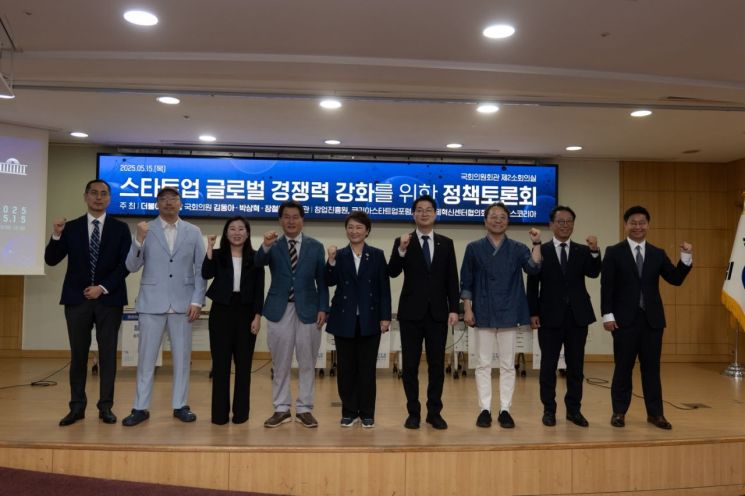 Korea Startup Forum held a policy discussion on the 15th at the National Assembly Members' Office Building in Yeouido, Seoul, titled "Policy Discussion to Strengthen Startup Global Competitiveness," where participants are taking a commemorative photo. Korea Startup Forum
Park Daehee, CEO of Daejeon Center for Creative Economy and Innovation, highlighted the importance of talent inflow in the internationalization of the startup ecosystem. He said, "While Silicon Valley in the United States has fostered its startup cluster by strategically attracting highly skilled immigrants, Korea's retention rate of foreign talent is extremely low."
In fact, the employment rate of foreign students in Korea after graduation is only 8%, and the number of foreigners entering through the technology startup visa (D-8-4) has remained at around 300 over the past 10 years. Park emphasized, "Simple visa policies are not enough," adding, "There must be an integrated policy design that includes settlement support, family accompaniment, tax benefits, and support for cultural and language adaptation."
He further stated, "While the number of unicorns in Korea has stagnated for several years, more than half of all unicorns in the United States have been founded by immigrant entrepreneurs." He added, "Before discussing technology and capital, it will be difficult to talk about global competitiveness unless we transform into a country that attracts talent."
Even Investment Fund Conversion Requires Approval..."Starting a Business in the US Is Preferable"
Lee Hanbin, CEO of Seoul Robotics, an autonomous driving technology developer, asserted, "Korea is a difficult market for overseas VCs in terms of investment, exit, and IPO."
He said, "Although we have operated our business with overseas investment from the beginning, capital inflow is still frequently blocked. When we receive investment funds in dollars, billions of won are lost to currency conversion fees, and we must obtain prior approval for foreign exchange. The same costs occur during exit, so from the perspective of foreign investors, Korea is inevitably an unattractive market."
Lee also pointed out the tax structure for overseas listings. He said, "Even if we try to exit through an overseas IPO, we have to pay a 30% tax. When I asked why the system makes it so difficult for foreign investors to invest, I was told that the regulations have not been updated since the Park Chunghee administration. The response from authorities was that foreign investors usually only invest in listed companies, not startups, so the system has remained unchanged."
Song Myungsoo, CEO of Pen Ventures Korea, emphasized the need for long-term policy design. He stated, "A company only becomes truly global when more than 80% of its sales come from overseas," and stressed, "Policies should be pursued with clear goals for what results will be achieved over at least 15 years."
Song added, "To attract large-scale investment from overseas, it is important to build local references." He suggested, "Rather than allocating 20 billion won to a single fund at the government level, it would be better to distribute 2 billion won each to ten different funds, thereby increasing the number of participating players."
© The Asia Business Daily(www.asiae.co.kr). All rights reserved.

![Clutching a Stolen Dior Bag, Saying "I Hate Being Poor but Real"... The Grotesque Con of a "Human Knockoff" [Slate]](https://cwcontent.asiae.co.kr/asiaresize/183/2026021902243444107_1771435474.jpg)














