Delivered to Kim Kyungsoo, Chief Election Committee Chair of the Democratic Party of Korea
On May 15, the Non-Capital Region Chamber of Commerce Council held a press conference in the main conference hall on the second floor of the Changwon Chamber of Commerce and Industry in South Gyeongsang Province. At the event, the council delivered its proposed presidential election pledges for balanced regional development to Kim Kyungsoo, Chief Election Committee Chair of the Democratic Party of Korea, as well as to other presidential campaign teams.
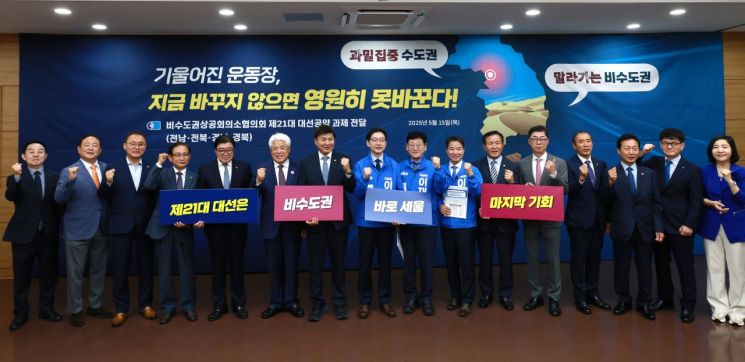 The Non-Capital Region Chamber of Commerce Council delivered a proposal letter to Kim Kyungsoo, Chief Election Committee Chair of the Democratic Party of Korea.
This joint proposal saw chambers of commerce from South Jeolla, North Jeolla, South Gyeongsang, and North Gyeongsang provinces unite to advocate for the survival and growth of non-capital region businesses. In the current environment, where the concentration of economic activity in the capital region is intensifying, the council presented three core policy tasks that must be addressed to secure the self-sufficiency of local economies.
The first proposed task is the "Differentiated Application of Corporate, Income, and Inheritance Taxes by Region for Non-Capital Areas." Currently, over 70% of national tax revenue in Korea is collected from the capital region. Specifically, the capital region accounted for 78.1% of corporate tax revenue (as of 2023) and 74.8% of earned income tax revenue (as of 2022), highlighting the severe concentration of tax collection. The council also explained that the share of total tax revenue from non-capital regions is steadily declining, which indicates a relative slowdown in the economic activities of businesses and workers in those areas. The council emphasized that tax reforms are urgently needed to attract companies and encourage population dispersal, thereby promoting regional development.
The second proposed task is the "Abolition of the Periodic Auditor Designation System for Non-Capital Regions." This system, introduced in 2018 to enhance corporate accounting transparency, requires companies to regularly change their auditors. However, it has instead increased administrative and financial burdens on companies and reduced the effectiveness of audits. Most accounting firms are concentrated in the capital region, so local companies must bear additional expenses such as travel and accommodation costs when auditors are designated, and they also have weaker negotiating power. The council cited that from 2019 to 2023, external audit costs rose by 52% in the capital region but by 66% in non-capital regions, demonstrating a heavier cost burden for non-capital businesses. The council pointed out that this system is shrinking the local accounting ecosystem and negatively impacting corporate management.
The third proposal calls for "Maintaining Consistency in Industrial and Economic Policies to Stabilize Economic Sentiment." Amid growing domestic and international political and economic uncertainties, the council argued that frequent government policy changes undermine business investment sentiment and weaken industrial competitiveness. In particular, large-scale, long-term projects in sectors such as shipbuilding, defense, nuclear power, renewable energy, and petrochemicals rely on consistent government policy as a fundamental basis. The council noted that past policy shifts have weakened the competitiveness of domestic companies and triggered the outflow of skilled workers. Therefore, the council urged the government to maintain consistency in long-term industrial policy directions and to create a stable investment environment.
Choi Jaeho, President of the Changwon Chamber of Commerce and Industry, stated, "The regions can no longer afford to wait patiently. What is needed now is not empty promises but concrete action plans." He added, "Through this press conference, we hope the urgent realities of the non-capital regions are properly conveyed and that the 21st presidential election pledges not only reflect these needs but also lead to the establishment of practical policies."
Kim Jungtae, President of the Jeonju Chamber of Commerce and Industry, said, "Based on the research results of the Non-Capital Region Chamber of Commerce Council, we plan to request a joint legislative initiative from both the ruling and opposition parties in the National Assembly." He emphasized, "We will continue to take follow-up actions to ensure that this proposal to overcome the crisis of regional extinction does not remain a mere suggestion."
© The Asia Business Daily(www.asiae.co.kr). All rights reserved.












