Threatening situations such as natural disasters, accidents, and violence leave fear memories in the victim's brain. Excessive or distorted fear memories can lead to mental disorders such as post-traumatic stress disorder (PTSD), anxiety disorders, and depression. For the first time in the world, a Korean research team has identified the mechanisms of brain circuits specialized in the formation of these fear memories. This discovery is expected to enable the development of personalized trauma treatments.
On May 15, KAIST announced that a research team led by Professor Jinhee Han from the Department of Biological Sciences has identified the core brain circuit, 'pIC-PBN,' which regulates the formation of fear memories, through experiments using a mouse model.
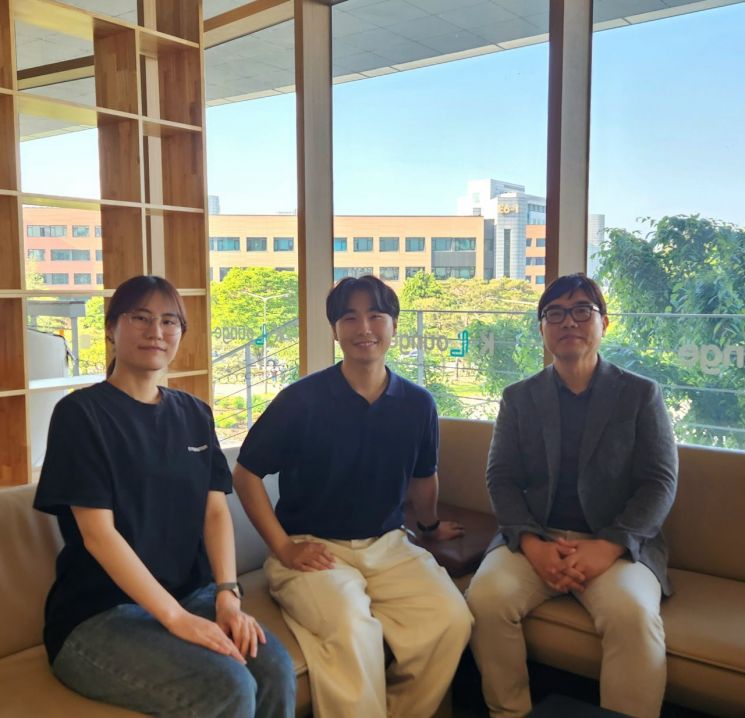 (From left) Seo Boin, PhD candidate in Biological Sciences, Han Junho, PhD in Biological Sciences, Jinhee Han, Professor in Biological Sciences. Provided by KAIST
The pIC-PBN circuit is a descending neural pathway that runs from the posterior insular cortex (pIC) to the parabrachial nucleus (PBN). The study newly revealed that this is a dedicated circuit that transmits psychological pain information.
Previously, the PBN was only known as part of the ascending nociceptive pathway that receives pain information from the spinal cord. However, the research team discovered that the PBN also plays an essential role in fear learning even when the threat stimulus is non-nociceptive.
This study is being recognized as the world's first to experimentally demonstrate that 'emotional pain' and 'physical pain' are processed by distinct neural circuits in the brain.
The research team emphasized that clearly presenting the neural circuit (pIC-PBN) specialized for transmitting emotional pain has significant academic implications in the field of neuroscience.
Previously, the team developed a new fear conditioning experimental model using visual threat stimuli instead of electrical stimulation to identify the brain circuits that process psychological threats.
Mice instinctively exhibit fear responses when a predator rapidly approaches from above. The research team utilized this by presenting a rapidly enlarging shadow on the ceiling screen, making the mice experience a threat as if being attacked by a predator. This experiment demonstrated that fear memories can be formed solely through psychological threat, without any nociceptive input.
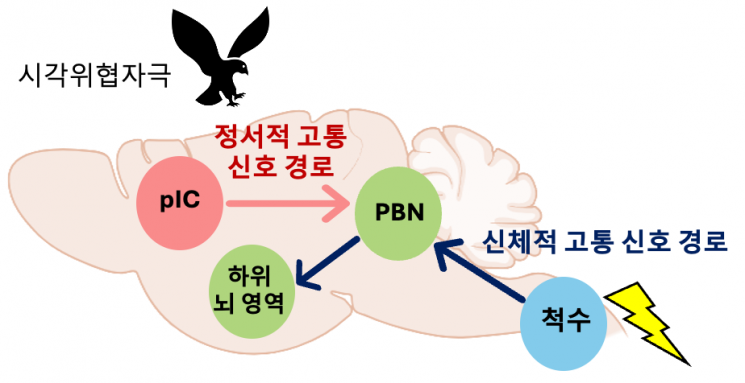 Schematic diagram of brain neural circuits transmitting signals of emotional and physical pain threats. Provided by KAIST
Along with the new behavioral experiment model, the research team used chemogenetic and optogenetic techniques to precisely control neuronal activity, and found that the PBN forms fear memories even with only visual threats. They also analyzed the higher brain regions that transmit information to the PBN and revealed that the pIC, which plays a key role in processing negative emotions and pain, is directly connected to the PBN.
The study also found that artificially inhibiting the pIC-PBN circuit significantly reduces the formation of fear memories in response to visual threats, but does not affect innate fear responses or pain-based fear learning.
Conversely, simply activating this circuit artificially was sufficient to induce fear memories, confirming that the pIC-PBN circuit is a key pathway for processing and learning psychological threat information.
Professor Jinhee Han said, "This study will serve as an important milestone in understanding the mechanisms behind mental disorders where emotional pain is a major symptom, such as post-traumatic stress disorder, panic disorder, and anxiety disorders, and in developing personalized treatments."
This research was supported by the Ministry of Science and ICT's Brain Science Fundamental Technology Development Project and Brain Function Identification and Control Technology Development Project. The research paper, authored by Dr. Han Junho (first author) and Seo Boin, PhD candidate (second author) from the Department of Biological Sciences, was published online in the international journal Science Advances on May 9.
© The Asia Business Daily(www.asiae.co.kr). All rights reserved.













