Development of a Mixed Self-Assembled Molecule Hole Transport Layer
Achieves World-Class Open-Circuit Voltage and Enhanced Durability, Published in Adv. Energy Mater.
A new material has been developed that can improve both the efficiency and stability of tandem solar cells, which generate more electricity by splitting light and absorbing it with multiple layers.
A research team led by Professor Bongsu Kim from the Department of Chemistry at UNIST, in collaboration with Professors Jinyoung Kim and Dongseok Kim from the Graduate School of Carbon Neutrality, has developed a new hole transport layer that can enhance the performance of perovskite-organic tandem solar cells.
 Research team (from bottom left, counterclockwise) Professor Jinyoung Kim, Professor Bongsu Kim, Professor Dongseok Kim, Researcher Sunghyun Heo, Dr. Shahid Amin, Researcher Jungun Son (first author). Courtesy of UNIST
Tandem solar cells are structured by stacking two different types of cells, each absorbing sunlight in different wavelength ranges, one on top of the other. This allows for broader utilization of sunlight.
The combination of perovskite and organic materials enables the production of thin and flexible cells, attracting attention as a next-generation power source for wearable devices and building-integrated power systems.
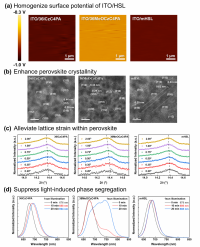 Enhancement of Perovskite Crystallinity Using Self-Assembled Molecules.
The research team developed a hole transport layer by mixing two types of self-assembled molecules, achieving an open-circuit voltage of 2.216V and a power conversion efficiency of 24.73% in these cells.
The open-circuit voltage represents the potential difference formed when the charge generated by the cell reaches the electrode without loss; a higher open-circuit voltage means higher cell efficiency. These values are among the highest in the world for tandem cells combining perovskite and organic materials. Furthermore, the cells maintained over 80% of their initial efficiency even after prolonged light exposure at a high temperature of 65°C, demonstrating long-term stability.
The developed hole transport layer is designed to align well with the energy levels of the perovskite photoactive layer, selectively extracting holes while blocking electrons, thereby suppressing charge recombination. For a solar cell to generate current, the separated negative charge carriers (electrons) and positive charge carriers (holes) must reach the electrodes after absorbing light. If the energy levels are misaligned, the charges cannot be extracted and recombine in the middle, resulting in loss.
This hole transport layer also reduces interfacial defects that hinder charge movement and helps maintain a more stable and uniform crystal structure. This is because the substituents of the self-assembled molecules 36ICzC4PA and 36MeOCzC4PA form strong chemical bonds with metal ions in the perovskite.
Additionally, the self-assembled molecules naturally form a thin and uniform layer on the substrate, simplifying the manufacturing process and allowing for easy application to large areas, which is advantageous for commercialization.
Professor Bongsu Kim stated, "By developing a self-assembled hole transport layer that improves hole extraction, interface stabilization, and structural durability, we have been able to dramatically enhance the performance of tandem cells. This brings us one step closer to the commercialization of next-generation solar cells that are thin, flexible, and maintain high efficiency."
This research was conducted with Researcher Jungun Son and Dr. Shahid Amin as first authors, and the results were published online in the international journal 'Advanced Energy Materials' on April 8.
The research was supported by the National Research Foundation of Korea under the Ministry of Science and ICT.
© The Asia Business Daily(www.asiae.co.kr). All rights reserved.












