Nvidia Rises 2.9% on AI Chip Deal with Saudi Arabia
AMD Surges 7.4% After $6 Billion Share Buyback
U.S.-China Trade Agreement Spurs Strong Appetite for Risk Assets
Dollar Weakens Amid Impact of U.S.-Korea Exchange Rate Talks
The three major indices on the New York Stock Exchange opened higher on May 14 (local time). Following the trade war truce between the United States and China, technology stocks are leading the gains as Nvidia has agreed to supply a large quantity of artificial intelligence (AI) chips to Saudi Arabia. The value of the dollar is declining amid expectations that the United States will pursue a weak dollar policy in future trade negotiations.
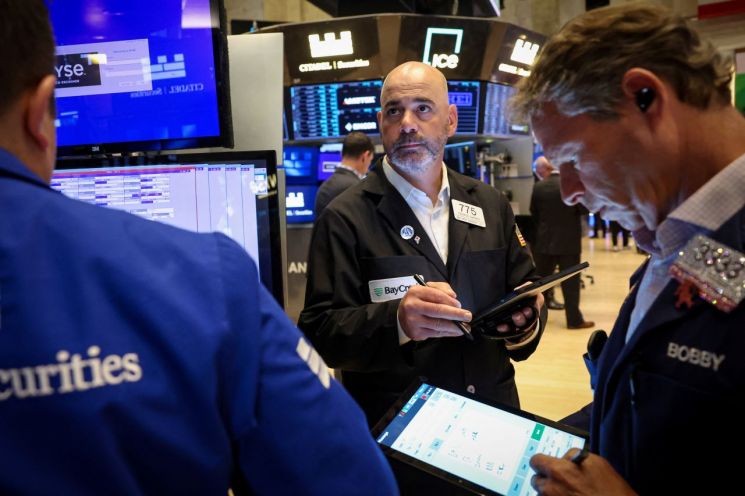
As of 9:36 a.m. on the New York Stock Exchange, the blue-chip Dow Jones Industrial Average (Dow Jones Index) was up 100.41 points (0.24%) from the previous trading day, standing at 42,240.84. The large-cap S&P 500 Index rose by 18.58 points (0.32%) to 5,905.13, while the tech-heavy Nasdaq Index climbed 133.04 points (0.7%) to 19,143.13.
By stock, Nvidia is up 2.91%. The previous day, Nvidia announced it would supply more than 18,000 of its latest AI chips to the Saudi company Humane. AMD, which also supplies semiconductors to Humane alongside Nvidia, surged 7.38% after announcing a $6 billion (about 8.4 trillion won) share buyback. Microsoft (MS) and Meta, the parent company of Facebook, are up 0.45% and 0.5%, respectively.
During his Middle East tour, U.S. President Donald Trump met with Saudi Crown Prince Mohammed bin Salman the previous day, securing $600 billion (about 850 trillion won) in investments for the United States and facilitating U.S. exports to Saudi Arabia. The United States is also expected to attract further investment by expanding AI chip access in Qatar and the United Arab Emirates (UAE) following Saudi Arabia. As a result, investor sentiment toward technology stocks is spreading.
After the U.S.-China trade agreement reached over the past weekend, there has been a clear preference for risk assets in the market. Both countries agreed to lower their previously triple-digit tariff rates by 115 percentage points each. With the easing of trade tensions alleviating some recession fears, the S&P 500 Index, the main benchmark of the U.S. stock market, turned positive for the year the previous day. This index had fallen as much as 17% earlier this year. Optimism is growing that stock prices will continue to rise depending on the outcome of subsequent U.S.-China negotiations.
Leil Akonor, global market analyst at eToro, assessed, "Currently, the appetite for risk is very high," and added, "Although the structural issues between the U.S. and China have not been resolved, I believe there is a clear signal that neither side wants to further escalate trade tensions."
The inflationary pressure stemming from tariffs appears to be limited. Last month, the U.S. Consumer Price Index (CPI) rose 2.3% year-on-year, marking the lowest level in four years and two months since February 2021. This figure came in below both the March reading and market expectations (both 2.4%). This CPI is the first indicator to reflect the effects of reciprocal tariffs that took effect last month, and the direct impact of tariff policy has so far proven to be limited.
The dollar is weakening. The dollar index, which measures the value of the U.S. dollar against the currencies of six major countries, is down 0.44% from the previous day at 100.38. As reports emerged that U.S. and South Korean authorities held working-level talks on exchange rates earlier this month, expectations are growing that the Trump administration will tolerate a weaker dollar in future trade negotiations to reduce the trade deficit.
Government bond yields are steady. The yield on the 10-year U.S. Treasury note, the global benchmark for bond yields, is down 1 basis point (1bp = 0.01 percentage point) from the previous trading day at 4.48%. The yield on the 2-year U.S. Treasury note, which is sensitive to monetary policy, is also down 1bp from the previous day, standing at 4.0%.
Investors are closely watching inflation and consumption data to be released on May 15, one day later. They are expected to gauge the impact of tariff policy through the April Producer Price Index (PPI) and retail sales data, which account for two-thirds of the U.S. economy.
© The Asia Business Daily(www.asiae.co.kr). All rights reserved.












