City Holds Briefing on "Impact Assessment Study of Complex Shopping Mall Commercial Districts"
Most Sectors See Sales Growth... Win-Win Measures Proposed
"Economic Impact of Three New Malls: 19.4 Trillion KRW, 120,000 Jobs Created"
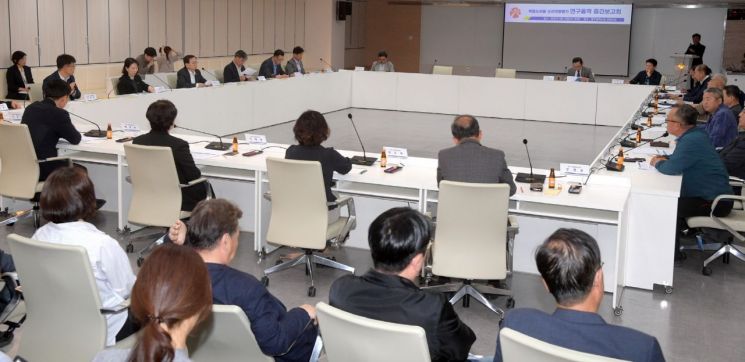 Gwangju City held an interim report meeting on the "Impact Assessment Study of Complex Shopping Mall Commercial Districts" on the 14th at the city hall's main conference room. The meeting was attended by Deputy Mayor Kwangwan Ko, deputy district heads from five autonomous districts, related officials, the Small Business Association, the Merchants Association, and about 30 citizens. Photo by Gwangju City
On May 14, Gwangju City held an interim report meeting for the "Impact Assessment Study of Complex Shopping Mall Commercial Districts" at the city hall's main conference room, where participants shared research findings to date and discussed the future direction of the study. The meeting was attended by Deputy Mayor Kwangwan Ko, deputy district heads from five autonomous districts, related officials, the Small Business Association, the Merchants Association, and about 30 citizens.
The interim report meeting was led by Professor Cho Chunhan of Gyeonggi University of Science and Technology, who is in charge of the research project. Professor Cho presented analyses of the following: sales and customer usage by business type in Gwangju City over the past five years; case studies on the impact of large-scale stores in other regions such as Daejeon and Daegu; and the effects of large-scale store openings (specifically, the first phase of The Hyundai Gwangju) on Gwangju's commercial districts.
The research found that, overall, Gwangju's commercial districts are domestically oriented with low inflow of external customers (as of 2024, 81% of store users are Gwangju residents, while 19% are from other regions). Therefore, a decline in the local population is expected to lead to a decline in commercial activity as well.
In other regions such as Daejeon and Daegu, the opening of complex shopping malls led to increased sales across all business types except for cosmetics and coffee/bakery, and the proportion of customers from outside the region reached 40%.
Applying these findings to Gwangju, within a 5 km radius of The Hyundai Gwangju, positive impacts were observed in supermarkets, restaurants, clothing/fashion/accessories, coffee/bakery, and electronics/furniture/household goods, with the exception of the cosmetics sector.
On a citywide scale, most sectors except for coffee/bakery experienced positive effects. For sectors expected to be adversely affected, various win-win measures, such as expanded special guarantees, were also proposed.
The annual number of visitors to The Hyundai Gwangju is estimated at 30 million, with 19 million of these also visiting nearby stores. Facility investment (1.2 trillion KRW) is expected to generate a production inducement effect of 2.364 trillion KRW, a value-added inducement effect of 999.6 billion KRW, and an employment inducement effect of 12,600 jobs. Store operations (1.1994 trillion KRW) are projected to result in an annual production inducement effect of 2.3112 trillion KRW, a value-added inducement effect of 1.0135 trillion KRW, and an employment inducement effect of 18,951 jobs.
The overall economic ripple effect of the opening of three large-scale stores, including the expansion of Shinsegae Department Store and Starfield Gwangju, is expected to reach 19.4086 trillion KRW. Facility investment (6.9466 trillion KRW) is projected to generate a production inducement effect of 13.6848 trillion KRW, a value-added inducement effect of 5.7865 trillion KRW, and an employment inducement effect of 72,939 jobs. Annual ripple effects from the operation of large-scale stores (2.9704 trillion KRW) are estimated at a production inducement effect of 5.7238 trillion KRW, a value-added inducement effect of 2.51 trillion KRW, and an employment inducement effect of 46,933 jobs.
Professor Cho plans to further analyze the impact of the Shinsegae Department Store expansion and the opening of Starfield Gwangju on local commercial districts, with more detailed breakdowns by distance (3 km, 5 km, 10 km) and business type.
Deputy Mayor Kwangwan Ko stated, "This research project aims to accurately assess the impact of complex shopping mall openings on local commercial districts and to develop optimal win-win measures for small businesses. We will continue to gather feedback from small business owners and strive to achieve outcomes that all stakeholders can agree with."
He added, "Content is competitiveness. As seen in the case of Suwon Hwaseo Station's restaurant alley, where the sales of 50 stores quadrupled following the opening of Starfield Suwon, well-prepared commercial districts can turn complex shopping malls into opportunities, attracting both people and money."
Meanwhile, since August of last year, the city has been conducting the "Impact Assessment Study of Complex Shopping Mall Commercial Districts," focusing on producing reliable results through scientific analysis methods such as utilizing credit card sales data. The win-win measures developed through the research project will be submitted as agenda items to the Win-Win Development Council for continued discussions with large corporations entering the market.
© The Asia Business Daily(www.asiae.co.kr). All rights reserved.












