The First SME Policy Deliberation Committee Held
KRW 1.4 Trillion Invested in Coexistence Payback
KRW 1.4 Trillion Allocated to Burden-Relief Credit
The Ministry of SMEs and Startups announced on May 14 that it held the first SME Policy Deliberation Committee meeting for 2025 at the CCMM Building in Yeouido, Seoul.
This SME Policy Deliberation Committee focused on discussing support measures for the recovery of small business owners and self-employed individuals, and also addressed the "4th SME Technology Protection Support Plan" and the "2025 Startup Support Implementation Plan."
KRW 4 Trillion to Be Invested for Small Business Owners' Livelihood Recovery
The Ministry will prioritize KRW 4 trillion out of the KRW 4.8 trillion supplementary budget to support the livelihood recovery of small business owners.
To ease the burden of fixed costs for micro-business owners, the government will provide a burden-relief credit of up to KRW 500,000 per person, totaling KRW 1.6 trillion, which can be used for electricity, gas, water bills, and insurance premiums. In addition, to help boost sales for small business owners, KRW 1.4 trillion will be allocated to the "Coexistence Payback" program, which refunds a portion of card spending in the form of Onnuri gift certificates. For about five months starting this month, a 10% cashback event for digital Onnuri gift certificates will be held to foster a consumption-friendly atmosphere.
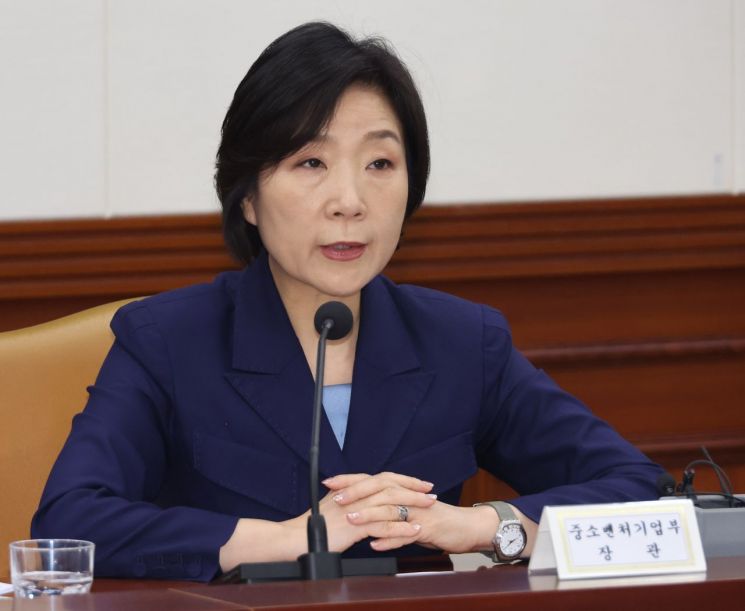 Oh Youngjoo, Minister of SMEs and Startups, is speaking at the Ministerial Meeting on National Issues, the Ministerial Meeting on Economic Affairs, and the Ministerial Meeting on Strengthening Industrial Competitiveness held at the Government Seoul Office on March 19. Photo by Yonhap News
For small business owners with low or medium credit who urgently need short-term operating funds, the government will provide a purchase-only credit card with a limit of up to KRW 10 million. SME policy funds will be expanded by an additional KRW 500 billion, and new guarantees totaling KRW 2 trillion will be supplied through regional credit guarantee foundations. An additional KRW 50 billion from the supplementary budget will be injected into the "Hope Return Package" project, which supports store demolition, re-entrepreneurship, and re-employment for business owners who have closed their businesses, to help them quickly get back on their feet.
"Legal Scope of Technology Protection for SMEs to Be Expanded"
To protect SME technologies, the government plans to focus on eliminating blind spots, providing swift relief and recovery support for victimized companies, among other measures.
First, the legal scope of protection will be expanded to cover the pre-transaction stage, such as negotiations and consultations. As a result, startups with innovative technologies will be able to receive legal protection if they suffer technology leaks during negotiations with large corporations.
To provide swift relief for victimized companies, the mediation system will be improved so that small-scale and minor technology infringement cases involving less than KRW 50 million can be quickly resolved through ex officio mediation procedures. Technology infringement reports submitted to the Ministry will be immediately forwarded to the prosecution and police to enable rapid investigations, establishing a "Prosecution-Police Fast Track."
To ensure that efforts to develop new technologies are properly recognized, the government will improve damage assessment methods to include costs invested in technology development within the compensation scope. This aims to raise the current claim acceptance rate of just 17.5% to 30%, thereby ensuring more substantial compensation for victimized companies.
Startup Support Including Deep Tech Startup Development
This year's Startup Support Implementation Plan is a detailed 2025 inter-ministerial plan to implement the comprehensive startup support plan established in December last year.
The first direction of this year’s startup support plan is to focus on nurturing deep tech startups. The government will provide step-by-step support for the growth of super-gap startups and establish global startup hubs as bases for deep tech startups. In addition, specialized support systems will be set up for key deep tech fields such as artificial intelligence (AI), bio, and climate tech, and "super-gap challenges" will be held between global corporations like Qualcomm, LG, and AI startups.
To accelerate the globalization of Korea's startup ecosystem, a global integrated hub for Korean startups and ventures will be established in Silicon Valley, USA. Global expansion programs and participation in overseas exhibitions for Korean startups will be expanded, focusing on strategic overseas markets such as Dubai, Osaka, and India, and a new global fund of KRW 1 trillion will be created within the year.
The Deep Tech Value-Up Program, which promotes open innovation between Korea's top-tier ventures/startups and large corporations, will also be launched in earnest. In addition, to support the growth of regional startups, KRW 200 billion will be invested in the "Regional Era Venture Fund," and new regionally specialized startup programs (Startup Package, Super-Gap, TIPS) will be introduced to inject vitality into the entire Korean startup ecosystem.
Minister Oh Youngjoo stated, "Small business owners and SMEs are facing difficult management conditions due to the accumulated effects of rising prices and interest rates, as well as the continued slump in domestic demand. We will spare no policy support to alleviate management difficulties and restore vitality for small business owners and self-employed individuals, including prioritizing KRW 4 trillion out of the KRW 4.8 trillion supplementary budget for their livelihood recovery."
She added, "We will create an innovation ecosystem where SMEs can focus on technology development without fear of technology infringement, while actively fostering K-Startups that lead global technology competition."
© The Asia Business Daily(www.asiae.co.kr). All rights reserved.











