Exclusion of Economic Ministry Reorganization from Ten Key Pledges
Reviewing Fiscal Control Measures through the Ministry of Strategy and Finance if Elected
There are diverging interpretations within the political sphere regarding the exclusion of a plan to reorganize economic ministries?centered on separating the powers of the Ministry of Strategy and Finance?from the ten key pledges announced by Lee Jaemyung, the presidential candidate of the Democratic Party of Korea. Although the Democratic Party has previously raised the need for reform, pointing out the excessive concentration of authority within the Ministry of Strategy and Finance, some observers believe that not explicitly including this in the ten key pledges is closely related to political calculations.
Some analysts suggest that the exclusion of the economic ministry reorganization plan from the ten key pledges may indicate a review of ways to control state affairs and finances through the Ministry of Strategy and Finance after taking office. They interpret this as a belief that maintaining the current system of the Ministry of Strategy and Finance, rather than dividing its powers through ministry separation, would be more advantageous for consolidating control over state affairs. In fact, the Ministry of Strategy and Finance is often referred to as a “super ministry” as it oversees the entire spectrum of national finances, including budget formulation, tax policy, government bond issuance, and management of public institutions. Such powers allow for direct influence over state governance and budget allocation, enabling the president to establish a structure for effective control over state affairs.
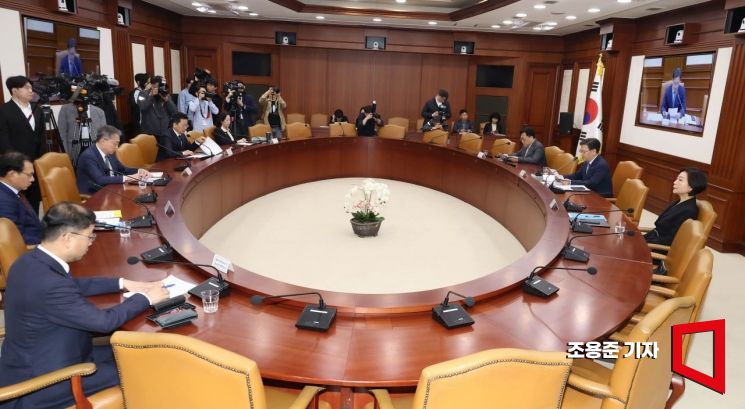 Kim Beomseok, Acting Minister of Strategy and Finance (1st Vice Minister of Strategy and Finance), attended the Economic Ministers' Meeting held on May 8 at the Government Seoul Office in Jongno-gu, Seoul, and spoke about the execution plan for the 2025 supplementary budget. 2025.5.8 Photo by Jo Yongjun
Earlier in the presidential race, candidate Lee expressed his awareness of the issue of concentrated authority, stating, “I partially agree with the criticism that the Ministry of Strategy and Finance is acting like a king among government ministries by holding a tight grip on finances.” However, with the omission of ministry reorganization plans and specific implementation measures from the official policy pledges, there is speculation that Lee has become less proactive about separating the Ministry’s powers. In reality, only a limited number of finance-related policy pledges, such as the expansion of local currencies, were included.
On the other hand, some analysts believe that the Democratic Party’s consideration of transferring budgetary functions to the Office of the President as part of the effort to separate the Ministry’s powers could actually lead to a backlash by excessively concentrating power. This is interpreted as a strategic decision not to highlight politically sensitive issues during the presidential campaign. Previously, discussions within the Democratic Party included separating the Ministry’s budgetary functions into an independent budget office or transferring them to the Office of the President. There were also proposals to transfer the financial policy functions of the Financial Services Commission to the Ministry of Strategy and Finance, while establishing a dedicated agency for financial supervision.
Shin Yul, professor of political science and international relations at Myongji University, observed, “Transferring the budget authority from the Ministry of Strategy and Finance to the Office of the President would significantly strengthen administrative power,” adding, “It appears that concerns over excessive concentration of power have led to a more cautious approach to government reorganization.”
There are also indications that Lee’s campaign prioritized “stability.” In a situation where the new administration would have to launch immediately without a presidential transition committee, there were concerns that uncertain discussions about reorganization could trigger economic risks. While there is speculation that issues such as the reorganization of the Ministry of Strategy and Finance may be reviewed as part of more detailed pledges, it is expected that discussions on reorganization will be postponed until after the presidential election and, if necessary, pursued gradually. A senior official of the Democratic Party’s Central Election Committee stated in a phone interview, “We could not include specific government reorganization measures in the announced policy pledges, as discussions are still ongoing.”
© The Asia Business Daily(www.asiae.co.kr). All rights reserved.












