Four Oriental Stork Chicks Observed Hatching
First Natural Breeding Scene in Naju Confirmed
A scene of natural breeding by an Oriental stork, a first-grade endangered wild species and Natural Monument No. 199, has been observed in Naju, Jeonnam.
According to the Gwangju Environmental Movement Federation on May 13, a pair of Oriental storks was filmed nesting and raising four chicks on a high-voltage transmission tower in the Budeokdong area of Naju, based on a report from a local resident.
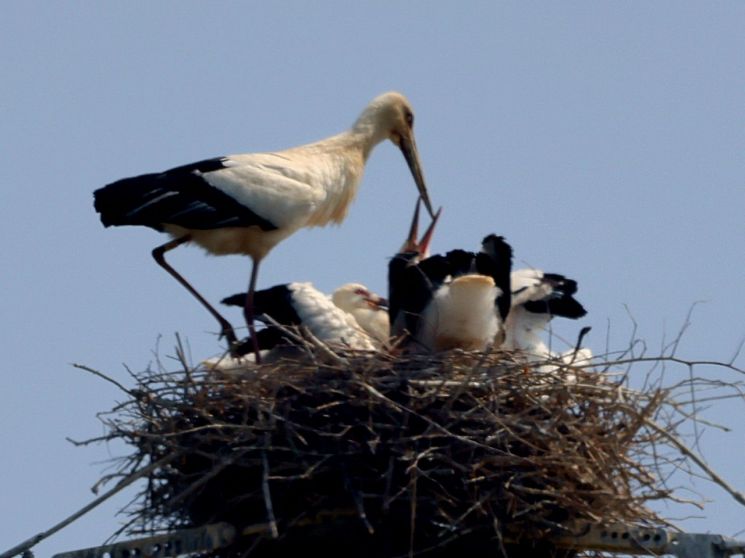 A stork is feeding its four chicks in a nest on a high-voltage steel tower in Budeokdong, Naju, Jeonnam. Provided by Gwangju Environmental Movement Federation
The Oriental stork was once a winter migratory bird that inhabited the entire Korean Peninsula, but its population declined sharply after the mid-20th century. The decrease and destruction of wetlands, which were its main habitats, as well as water pollution and increased use of pesticides, are known to have contributed independently to the decline in population.
Currently, the global population of Oriental storks is estimated at around 3,000. In Korea, this species is designated as Natural Monument No. 199 and as a first-grade endangered wild species, and is protected accordingly. It is also classified as an endangered species on the national Red List.
The Oriental stork mainly breeds in Siberia and northeastern China, then migrates south to spend the winter. In Korea, it is mostly observed in isolated wetlands during the winter season.
The recently filmed nest is located at the top of a high-voltage transmission tower. The Gwangju Environmental Movement Federation stated that relevant organizations, including the Yeongsangang River Basin Environment Office, the Cultural Heritage Administration, and Korea Electric Power Corporation, should cooperate to establish measures for habitat protection.
© The Asia Business Daily(www.asiae.co.kr). All rights reserved.












