May 12, 2:00 p.m., Lotte Hotel Busan Crystal Ballroom:
5th Busan RISE Committee Meeting to Be Held
Mayor Park Heongjoon:
"Full Support for Successful Establishment and Tangible Results of Busan-style RISE"
On May 12 at 2:00 p.m., the city of Busan will hold the 5th Busan RISE Committee meeting at the Crystal Ballroom of Lotte Hotel Busan.
The Busan RISE Committee, established on December 16 last year, is the highest decision-making body for reviewing and resolving major RISE matters. It consists of 30 members, including representatives from the city, city council, universities, industry, the city office of education, and regional innovation agencies.
The meeting will be attended by 30 committee members, including Chairman Park Heongjoon, who is also the mayor, university presidents from the Busan area, business leaders, as well as university officials and representatives of RISE partner companies, totaling around 80 participants.
This meeting has been organized to elect a co-chair who will lead Busan RISE alongside the mayor, who serves as the ex officio chair, and to share each university’s RISE implementation strategies and goals to expand inter-university cooperation.
The co-chair, responsible for building a horizontal and collaborative ecosystem between local governments and universities, will be elected from among the university presidents who are committee members, in accordance with the RISE operating regulations and by mutual selection among the members. The co-chair will represent the committee together with the mayor.
During the meeting, each university will present its RISE implementation strategies and declare its commitment to achieving its goals, aiming to establish Busan-style RISE as a hub for Busan’s development closely connected to the local economy and society. This will facilitate the sharing of specialized strategies by each university and promote active cooperation among universities.
The university presentations will proceed in the following order: four research-oriented universities (Pukyong National University, Korea Maritime and Ocean University, Dong-A University, Busan National University); nine education-oriented universities (Kyungsung University, Kosin University, Tongmyong University, Dongseo University, Dong-Eui University, Busan Catholic University, Busan University of Foreign Studies, Silla University, Youngsan University); and seven vocational and lifelong education-oriented universities (Kyungnam College of Information and Technology, Daedong College, Dong-Eui Institute of Technology?Busan Arts College Consortium, Busan Kyungsang College, Busan Institute of Science and Technology, Busan Health College, Busan Women’s College). The universities will share their RISE visions, areas of specialization, goals for nurturing local talent, and representative projects, expressing their determination to successfully implement RISE based on collaborative relationships.
The Busan-style RISE project for the first year, with a budget of 134.1 billion KRW, selected 122 projects from 21 universities through an evaluation process in April. Without any objections, the final selection was confirmed after receiving revised plans addressing feedback from the evaluation process by the end of April, and the project will officially commence in May.
The city will work with the 21 universities selected this year to implement the RISE project for five years until 2029, in line with the government’s RISE performance indicators. Through this, the city aims to achieve a 15% increase in local employment retention rates by fostering talent tailored to local industries, a 10% increase in collaboration performance among local government, industry, academia, and research through the establishment of collaborative clusters, and a 20% increase in university-led startup rates through the Busan-style university startup package. These efforts are intended to build a sustainable foundation for regional innovation and growth, where future technologies and talent circulate in a virtuous cycle, focusing on tangible results that businesses can experience, from talent development to employment and settlement.
Accordingly, starting in May, the city will work with the Busan RISE Innovation Center to implement measures for enhancing and advancing the Busan-style RISE’s performance, ensuring that each university’s RISE vision and goals are realized and that practical, demand-driven outcomes are achieved for stakeholders such as companies and students.
Beyond simply managing the achievement of performance targets, the city will form a professional consulting team to continuously monitor and consult on the project, addressing issues in the implementation process and improving systems to ensure that meaningful results are achieved.
For this year’s national research institute (NRL 2.0) project, which is being pursued as a national competitive project, Pukyong National University and Busan National University from the Busan region have submitted applications. Local universities, business leaders, and innovation agencies will unite in support and determination to attract this large-scale national project to the region and ensure its successful implementation.
The National Research Lab (NRL 2.0) project aims to strengthen the research competitiveness of domestic universities by selecting university-affiliated research institutes to lead world-class research, providing approximately 100 billion KRW in support to each institute over ten years.
Mayor Park Heongjoon stated, "For Busan to become a global hub city, the growth of local universities is the most important driving force. I hope that universities will become reliable partners that grow together with the local community by working closely with businesses and other innovation actors to realize the value of mutual prosperity. The city will provide full support to ensure that the Busan-style RISE is successfully established and produces tangible results."
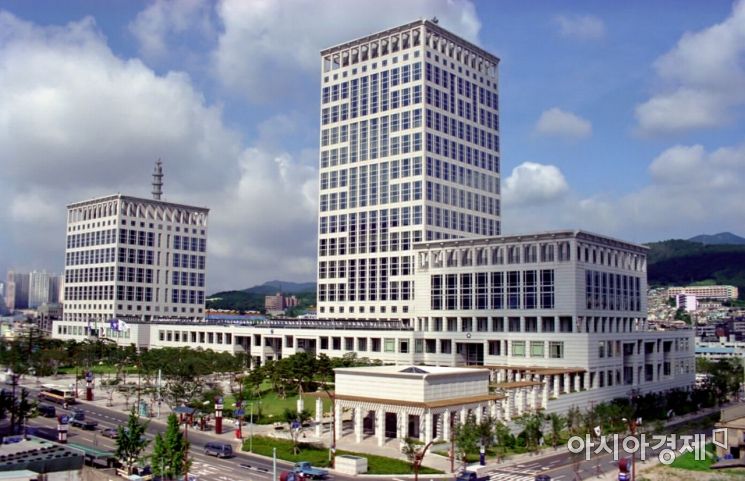 Busan City Hall.
© The Asia Business Daily(www.asiae.co.kr). All rights reserved.











