Joint Meeting Held for Next Year's Long-Term Care Benefit Cost Contract
Jung Kisuk, Chairman: "Financial Burden on Health Insurance Fund Has Increased After Medical Policy Conflicts"
As negotiations begin between the National Health Insurance Service (NHIS) and medical associations over next year's healthcare service fees, the NHIS has announced its intention to rationally adjust the medical fee schedule to ensure appropriate compensation for undervalued medical services.
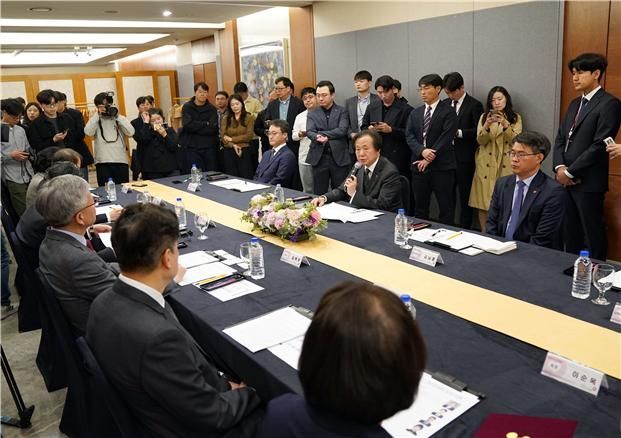 Jung Kisuk, Chairman of the National Health Insurance Service, is speaking at the joint meeting of six medical association leaders for the 2026 long-term care benefit cost contract held at Seoul Garden Hotel on the 9th. National Health Insurance Service
On May 9, Jung Kisuk, Chairman of the NHIS, held a joint meeting at Seoul Garden Hotel with leaders of six medical associations: the Korean Medical Association, the Korean Hospital Association, the Korean Dental Association, the Association of Korean Medicine, the Korean Pharmaceutical Association, and the Korean Midwives Association, to discuss the 2026 long-term care benefit cost contract.
At this meeting, which served as an introductory gathering ahead of full-scale negotiations, Chairman Jung stated, "With health insurance premium rates frozen for two consecutive years, and with the global economic recession and tariff conflicts casting a shadow over domestic and international industry outlooks, the health insurance fund is facing unprecedented difficulties." He added, "Even for the same diagnosis, more expensive procedures are increasingly being substituted, leading to an unexpected rise in benefit expenditures. Since last year, large-scale financial resources have been invested to support the emergency medical system and implement essential medical policies, which is expected to further increase the financial burden on the health insurance fund."
Chairman Jung said, "In the 2026 contract, while taking into account the seriousness of financial management, we will rationally adjust the fee schedule with a focus on essential medical services," and added, "We will fully reflect the realities of the medical field to ensure appropriate compensation for relatively undervalued medical procedures."
He continued, "The NHIS is working to enhance public convenience and financial soundness through the operation of the 'Nice Camp,' an appropriate care promotion group, and a digital transformation initiative," and emphasized, "While considering the seriousness of the financial situation, we aim to rationally adjust the fee schedule with a focus on essential medical services."
The medical fee schedule refers to the payments made by the government from the health insurance fund to medical institutions in return for medical services. The amount is calculated by multiplying the 'relative value score' set for each procedure by a 'conversion factor.' Every year, the NHIS negotiates with organizations representing hospitals, clinics, pharmacies, and Korean medicine providers to determine the rate of increase for the conversion factor.
Once the increase rate is determined, the NHIS and each organization sign the long-term care benefit cost contract by May 31 each year. If negotiations break down, the Health Insurance Policy Deliberation Committee, the highest decision-making body for health insurance policy, sets the fee schedule for each type of provider by the end of June.
During last year's negotiations for this year's fee schedule, talks with hospital and clinic associations broke down, and the Health Insurance Policy Deliberation Committee ultimately applied the NHIS-proposed increase rates of 1.6% for hospitals and 1.9% for clinics. The average increase rate for the conversion factor across all types, including these, was 1.96%.
The increase rate for the conversion factor also affects the level of health insurance premium increases paid by subscribers. However, in both last year and this year, although the fee schedule rose by nearly 2%, health insurance premiums were frozen for two consecutive years.
© The Asia Business Daily(www.asiae.co.kr). All rights reserved.












