Extending the Legal Retirement Age Is Not the Answer: It Blocks Youth Employment
Mandatory Continued Employment Requires Accepting Lower Wages Based on Productivity
Three New Factors Are Driving the Introduction of Job- and Performance-Based Pay
Continued Employment for Workers Over 60 Necessitates Productivity-Based Evaluation
This Will Inevitably Influence Productivity Analysis for All Employees
Continued Employment Is an Issue Primarily for Large Corporations and Public Institutions with Quality Jobs
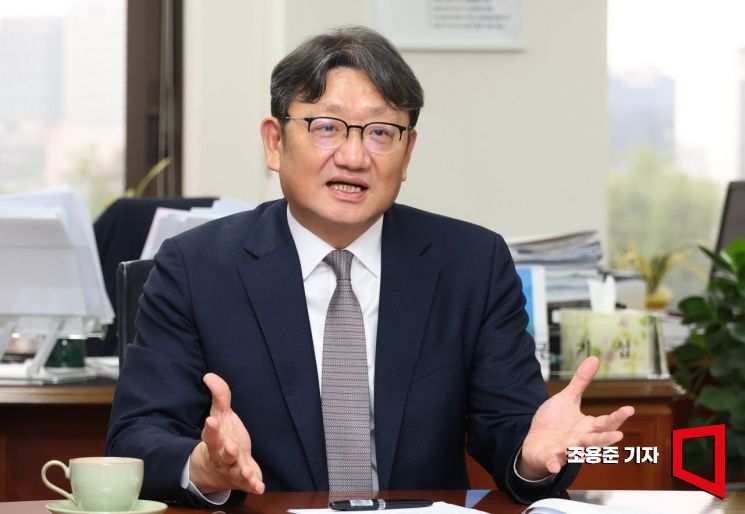 Kwon Kisup, Chairman of the Economic, Social and Labor Council, is being interviewed by Asia Economy at the Gyeongsanowi office in Jongno-gu, Seoul. Photo by Jo Yongjun
Can labor and management reach a grand compromise on the issue of extending the retirement age? On May 8, the Continued Employment Committee under the Economic, Social and Labor Council announced its own compromise proposal, devised by its public interest members. The core of the proposal is to keep the legal retirement age at 60, but to mandate continued employment until 65 starting in 2033, with wages adjusted downward according to productivity. Labor groups voiced opposition, saying the extension of the retirement age had failed, while businesses expressed concerns that the wage system had not been sufficiently reformed from a seniority-based system to a job- and performance-based one.
On May 9, one day after the announcement, Kwon Kisub, Chairman of the Council, emphasized the need for concessions from both labor and management during an interview at the Council's office in Jongno-gu, Seoul. He argued that unions should accept the proposal, as it guarantees five years of employment stability, while companies gain the right to restructure wages for workers over 60. He insisted that both sides should step back and work toward an agreement. Regarding the fact that only public interest members could make recommendations, he pointed out that both labor and management must reflect on whether they had the confidence, capacity, and effort to participate in a true social grand compromise.
The following is a Q&A with Chairman Kwon.
- What do you think labor and management should each concede on the continued employment issue?
▲ The public interest members' proposal made it clear that extending the legal retirement age, as demanded by unions, is difficult. Still, since employment stability for those over 60 has been secured, we are asking labor to accept the proposal. On the other hand, companies have consistently argued that the wage system for all workers should be changed from seniority-based to job- and performance-based, but that is not feasible right now. Therefore, we suggested starting by restructuring the wage system for those over 60 based on productivity.
- From labor's perspective, the extension of the legal retirement age has become difficult. Is the public interest members' proposal biased toward management?
▲ That is exactly the kind of claim we are wary of. Our focus was on how to impose the obligation of continued employment for older workers. We deliberated to find a solution that could realistically be implemented. Deciding which side to take was not a criterion. Although the legal retirement age extension that labor wanted is not included, the fact that continued employment is mandated shows considerable consideration for labor.
- Do you think the proposal is acceptable from the employers' perspective?
▲ There are complaints that business owners have too little discretion. However, since this involves signing new employment contracts, companies can redesign the wage system for workers over 60. Some in management are considering overhauling the entire wage system for all current employees at once, but that is overly ambitious. I think the current proposal is about the maximum our society can achieve. Trying to go further could make things even more difficult.
- Haven't companies lost momentum to reform the seniority-based wage system to a job- and performance-based one, which they had hoped for?
▲ It is extremely difficult to change the wage system, but in fact, there is now internal momentum. First, the continued employment issue has come to the fore. As long as the seniority-based wage system is maintained, continued employment for older workers is impossible. Maintaining a seniority-based system and continued employment means companies cannot hire new young workers. For continued employment of those over 60, they must accept lower wages based on productivity. Only then will there be no excess costs. Also, wages should not be divided into various allowances, but should be based on job or performance. If a job- and performance-based wage system is established for those over 60, it will inevitably affect employees under 60 as well.
Second, amid the US-China trade war, Korea's industries are caught in a "sandwich" situation. The US is demanding that production facilities be relocated to its own soil, while China is overtaking Korea in almost every industry. With the same input of labor and capital as before, the Korean economy cannot survive. Productivity improvement and innovation are essential, but the old seniority-based wage system cannot foster creativity and passion.
Third, there is a generational issue. The seniority-based wage system is unbearable for the younger generation. The most common phrase I heard in interviews with young people was "wolgup lupin" (a neologism meaning someone who idly collects a salary, like the thief Lupin in fiction). Many young people feel it is extremely unfair that those who have simply stayed longer receive much higher pay. To motivate the younger generation and get them to work, we have no choice but to move toward a job- or performance-based system. If we stick with the current wage structure, to put it bluntly, Korea's "lost 30 years" may actually arrive.
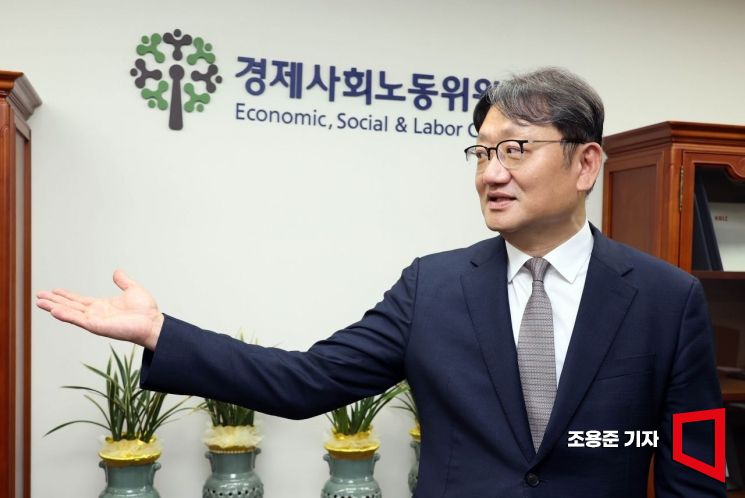 Kwon Kisub, Chairman of the Economic, Social and Labor Council, is being interviewed by Asia Economy at the Gyeongsanowi office in Jongno-gu, Seoul. Photo by Jo Yongjun
- If the wage system changes, could we see companies competing to attract talented workers?
▲ That could happen, but it should not go too far. In Korea, the starting salary at large companies is too high?over 30% higher than in Japan. At the very least, starting salaries should be closer to the average. We need a larger-scale solidarity to reduce wage gaps. Also, the system should reward employees according to their performance and the amount of work they do. Only then will employees feel motivated to work hard and properly. The way to revive our economy is not to raise wages by seniority, but to have a system where pay increases dramatically based on performance.
- Are you saying that if the wage system does not change, we cannot secure the dynamism of our economy?
▲ That's right. It is not that we do not want to extend the retirement age, but the people who will have to work in the future are the young. This could become a huge burden for them. If the wage system does not change, companies will not be able to attract highly motivated and talented people. Given the competitive reality we face, such as the US-China trade war, we cannot win by doing things half-heartedly.
- Wages are an important issue. Why did the public interest members leave wage levels to labor-management autonomy?
▲ Wages cannot be legally mandated. We cannot set them at 80% or 70%. The public interest members' proposal is for "appropriate wage adjustment according to productivity." In other words, it means wages should be reduced. The standard is productivity, considering contribution, performance, and job. From now on, workers over 60 who want continued employment will have to negotiate with their employers. Employers will insist on a cold, hard look at productivity. Those who were already on a performance-based pay system can continue as is. However, those who were on a seniority-based system cannot. Even if related disputes arise later, the law will inevitably side with the employer. Because labor-management relations in Korea are particularly poor, people expect the government to set everything, but it is impossible to determine wages for every industry and job at every company.
- Do you consider wage adjustment through labor-management autonomy to be wage system reform?
▲ Employers will have to study productivity. Through the HR team, they will analyze how much an employee produces and how much contribution and profit the employee brings to sales. Currently, this is not being done. Neither management nor unions are logically assessing employee productivity, but now we are suggesting they do so. That is how wage system reform happens?not by someone else setting the rules. Also, I believe the wages of those who continue employment after 60 will spread throughout the company. That will set the rules. Employees under 60 will also be able to estimate in their minds what the productivity-based wage for their job is. Generally, as in the case of Hyundai Motor Company, continued employment workers will likely receive a salary similar to that of a third-year new employee.
- Since wage adjustment is left to labor-management autonomy, how do you respond to concerns about a large gap in bargaining power between workplaces with unions and those without?
▲ Small and medium-sized enterprises (SMEs) are short of manpower, so continued employment will naturally occur. Because SMEs lack manpower, it is likely that retirement ages will be extended as needed by both labor and management. In some cases, such as securities firms, employees may have to leave much earlier, in their late 40s or early 50s. Currently, workplaces where employees can work until the retirement age are mostly large manufacturing companies with strong unions or public institutions. Issues like continued employment and retirement age extension focus on these groups. They do not lack manpower and are preferred by young people. If the retirement age is uniformly extended, new hiring of young workers will not be possible, but continued employment is still necessary, so a balance must be struck.
- Does the public interest members' proposal focus on large companies and public institutions?
▲ Yes. If large companies also lacked manpower and had a significant income gap, simply extending the retirement age would be fine. But they do not lack manpower, and wage levels are absolutely high. Therefore, if continued employment for those over 60 is to be implemented, there must be careful consideration of how they contribute to the company and how much they should be paid. There is also a high possibility of generational conflict. This is why it is difficult to extend the retirement age indiscriminately. It simply cannot be done. Our conclusion is that we should not move toward a system that strengthens vested interests through a uniform extension of the retirement age.
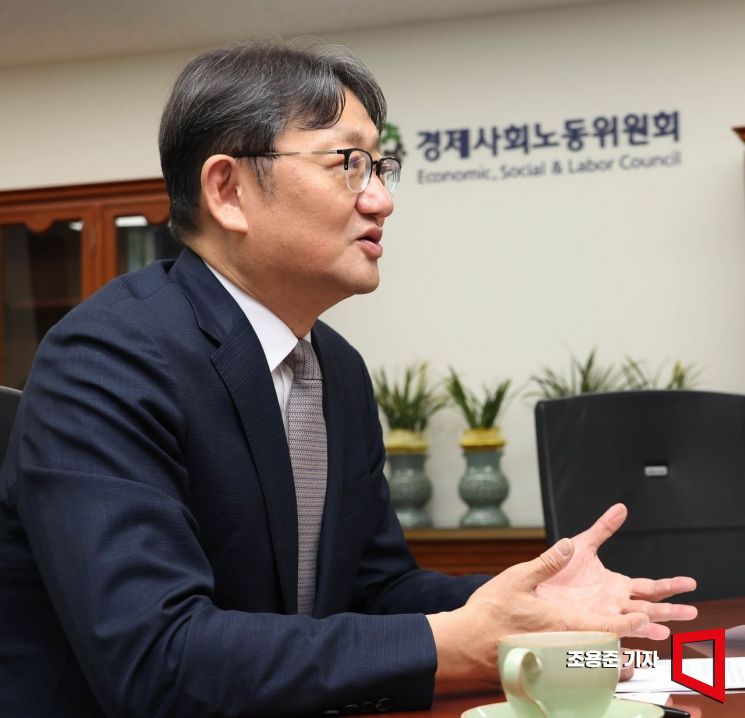 Kwon Kisub, Chairman of the Economic, Social and Labor Council, is being interviewed by Asia Economy at the Gyeongsanowi office in Jongno-gu, Seoul. Photo by Jo Yongjun
- Do you think we will be able to achieve a social grand compromise among labor, management, and government in the future?
▲ There have always been small agreements and compromises. The 915 social grand compromise in 2015 was a very significant compromise between labor and management. There have been achievements since then, but I am not sure whether a very large compromise is possible. That seems to be the nature of society now. Korea has developed in a more advanced and specialized direction, so I am not sure if a grand compromise like in the past is possible. It has become an era where even changing one small thing is difficult. That is why I believe the need for social dialogue is even greater.
- Is self-driven change by labor and management the only way?
▲ There is now a competition for radicalism between the Federation of Korean Trade Unions and the Korean Confederation of Trade Unions. It is regrettable. Although they claim to pursue industrial unions, the structure makes it difficult. Efforts by employers to change are also very important. Currently, employer organizations only address complaints from their member companies. They need to go beyond that. There should be a broader perspective that considers the entire society at the national level.
- What should labor and management do to have initiative and centrality?
▲ They must have responsibility and capability. Both unions and employers need to objectively assess whether they are at a level to lead social dialogue. Even now, unions have not participated in the continued employment discussions. They have postponed them. The decision to wait for a more favorable environment (such as the Democratic Party, which is friendly to unions, winning the presidential election and taking power) was stronger than participating in the tripartite council. If they had confidence and capability, and if the retirement age extension was so urgent, they should have come forward and engaged in open, robust debate. We were actually willing to wait if they said they would participate. But they did not. Of course, I do not think that was necessarily wrong. Every organization has its own position. Nevertheless, I do not believe it was a responsible attitude toward social dialogue.
© The Asia Business Daily(www.asiae.co.kr). All rights reserved.














