Fed Holds Rates Steady for Third Consecutive Time Despite Trump Pressure
Maintains Annual Rate at 4.25-4.5%
Powell on Tariff Uncertainty: "Let's Wait and See"
Dismisses Preemptive Rate Cut... Warns of Stagflation
Says "Trump Pressure Not Considered" in Monetary Policy Decisions
"Given the scope and scale of the tariffs, the risks of inflation and rising unemployment will certainly increase. My intuition tells me that uncertainty regarding the future economic trajectory has become extremely high. There is no need to rush (a rate cut)."
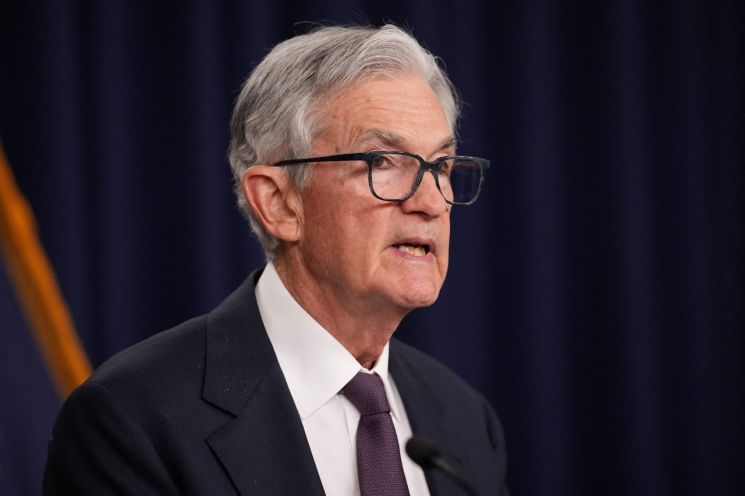
Jerome Powell, Chair of the U.S. Federal Reserve (Fed), kept the benchmark interest rate unchanged for the third consecutive time as expected and warned of increasing economic uncertainty due to trade policy. Despite repeated pressure from President Donald Trump to cut rates, Chair Powell reaffirmed a cautious stance, stating that he would determine the future path of interest rates only after assessing the impact of tariffs on the economy. Both the Fed's statement and Powell's remarks on this day confirmed concerns over tariff-induced stagflation, leading Wall Street to describe the stance as 'hawkish' (favoring monetary tightening) and lowering expectations for further rate cuts.
On May 7 (local time), during a press conference following the regular meeting of the Federal Open Market Committee (FOMC), Chair Powell said regarding President Trump's tariff policy, "There is so much we do not know," and added, "At this point, it is a very clear decision to wait and see." He continued, "Our policy is currently well positioned," and "the cost of waiting and observing the situation further is quite low. There is no need to rush, and we can afford to be patient."
At this meeting, the Fed unanimously decided to keep the federal funds rate unchanged at 4.25-4.5% per annum. After initiating rate cuts in September of last year and lowering the rate by a total of 1 percentage point from 5.25-5.5%, this marks the third consecutive hold following the decisions in January and March this year. As a result, the interest rate gap with South Korea remains at 1.75 percentage points at the upper end.
As concerns over inflation and economic slowdown due to tariff policy have grown, the press conference was dominated by questions regarding the impact of trade policy on the economy.
Chair Powell repeatedly emphasized that the uncertainty surrounding tariff policy is so great that "we need to wait and see." He stated, "If the currently announced tariff increases are sustained, we expect higher inflation, slower economic growth, and rising unemployment." However, regarding which is more at risk?employment or prices?he said, "It is too early to tell." He further explained, "Until we see more data, we cannot know the appropriate response, so it is not a situation where we can act preemptively."
In its policy statement, the Fed also included that "uncertainty regarding the economic outlook has increased." The statement newly added, "We judge that the risks of rising unemployment and inflation have increased." This effectively warns of the possibility of tariff-induced stagflation. Notably, as the U.S. recorded negative economic growth in the first quarter due to a surge in imports, the Fed also included the phrase "fluctuations in net exports affected the data," indicating that tariff policy is impacting the economy.
Through the policy statement, the Fed said, "The Committee's assessment will be based on a wide range of information, including labor market conditions, inflation pressures and inflation expectations, as well as financial and international developments."
The market had been certain of a rate hold ahead of this FOMC meeting. As concerns over stagflation intensified due to the Trump administration's trade policy, the prevailing view was that the Fed would respond only after confirming its impact on the real economy. Above all, in a situation where price increases due to tariff policy are expected, a premature rate cut could stimulate inflation, so it was anticipated that the monetary authorities would remain in a wait-and-see mode for the time being. While there are considerable concerns about an economic slowdown, favorable employment indicators have led to analysis that the Fed has room to maintain a cautious monetary policy stance.
On Wall Street, the FOMC policy statement and Chair Powell's remarks are being described as 'hawkish.' This is because both Powell and the Fed warned of the possibility of stagflation amid uncertainty over tariff policy.
David Kelly, Chief Global Strategist at JP Morgan Asset Management, described the decision as "somewhat hawkish," analyzing that "the Fed's announcement serves as a kind of warning signal to the administration, with the subtext being 'your policy is leading to inflation and rising unemployment.'" He added, "Frankly, the FOMC statement means that there are risks to achieving both parts of our dual mandate, and since we cannot be sure which direction to take, we will not rush to cut rates."
Investors are also lowering their expectations for a rate cut. According to CME FedWatch, the interest rate futures market reduced the probability of the Fed cutting rates by 0.25 percentage points in June from 30.5% the previous day to 19.9% on this day. The probability of resuming rate cuts in July is currently reflected at 58.5%.
This latest rate hold by the Fed came amid open pressure from the Trump administration to cut rates. President Trump has publicly called Chair Powell a "loser" and demanded a rate cut. At one point, he even expressed his intention to dismiss Powell, harshly criticizing him. U.S. Treasury Secretary Scott Besant also pointed out that the yield on the 2-year U.S. Treasury note, which is sensitive to monetary policy, is much lower than the benchmark rate, saying this is a signal that the Fed should cut rates, and urged Powell to do so.
In response to a question from reporters about whether President Trump's pressure to cut rates is influencing monetary policy, Chair Powell replied, "Not at all." He said, "We will use our tools to serve the interests of Americans and to promote maximum employment and price stability," adding, "All we consider are economic indicators, outlook, and the balance of risks."
© The Asia Business Daily(www.asiae.co.kr). All rights reserved.












