Joint Statement Adopted by Urban Rail Operators Nationwide on May 7 Urging National Compensation for PSO Losses
Free Ride Losses Accelerate with Entry into Super-Aged Society... Seoul Metro's Losses Rise by an Average of 10% Annually
President Baekho: "We Urge the Government, National Assembly, and Citizens to Join Forces for Urban Rail Normalization"
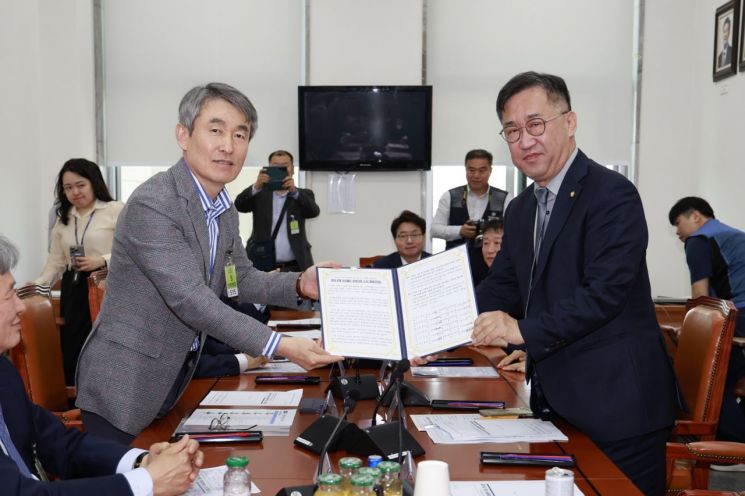 Baekho President of Seoul Metro (left) and Maeng Sungkyu Chairman of the National Assembly Land, Infrastructure and Transport Committee
Seoul Metro (President Baekho) announced on May 7 that, together with six urban rail operators nationwide, it had adopted a joint statement urging the government to provide national funding to compensate for the costs of legally mandated free rides as a public service.
The joint statement was immediately delivered to Maeng Sungkyu, Chairman of the National Assembly Land, Infrastructure and Transport Committee (photo), as well as to relevant government ministries.
Amendments to the Urban Rail Act, Senior Welfare Act, and Disabled Persons Welfare Act, which would enable national funding for legally mandated free rides on urban railways, have been proposed four times in the 22nd National Assembly, but progress has stalled. During the previous 21st National Assembly, amendments to the Urban Rail Act and Senior Welfare Act were proposed five times, but all were discarded after deliberations were postponed in favor of alternative resolutions.
The legally mandated free ride policy for seniors, people with disabilities, and national merit recipients has been implemented as a national transportation welfare policy based on law for over 40 years since 1984. However, there has been no government support for the operating agencies. Over the past five years, Seoul Metro and the other five urban rail operators nationwide have had to shoulder an average annual loss of 558.8 billion won.
Due to the rapid aging of the population, losses from free rides have been increasing every year. Last year, for the first time, the total loss exceeded 700 billion won, with Seoul Metro accounting for 413.5 billion won?more than half of the total, marking the highest share. Over the past five years, Seoul Metro's losses from free rides have consistently increased by an average of 10% annually. If this trend continues, annual losses are projected to exceed 500 billion won by around 2040.
There is also controversy over fairness with Korea Railroad Corporation (KORAIL), which operates some sections of Seoul Subway Line 1, the Suin-Bundang Line, and other metropolitan railways. KORAIL receives annual compensation from the government for free ride losses under the Framework Act on the Development of the Railroad Industry.
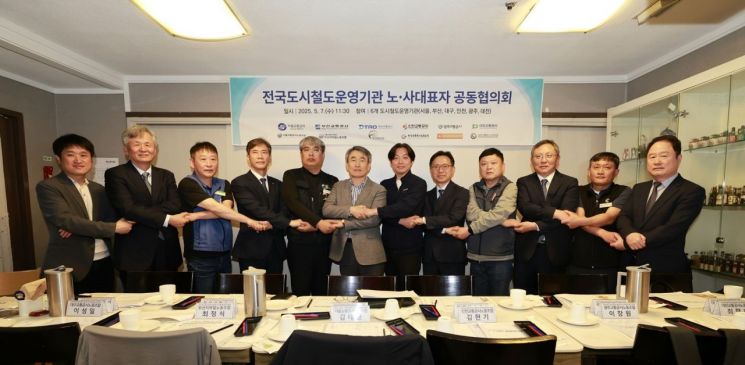
As the financial crisis facing urban railways has reached a critical level, the six operating agencies (Seoul, Busan, Daegu, Incheon, Gwangju, and Daejeon) held a meeting on May 7 to seek alternatives for sustainable urban rail operations in the era of climate crisis and super-aging, and adopted a joint labor-management statement calling for the legalization of national funding support.
Twelve labor and management representatives from the six urban rail operators attended the meeting.
The representatives emphasized, "The government is both the cause and beneficiary of legally mandated free rides, and therefore must bear the public service costs incurred to maintain this nationwide transportation welfare system."
They further stated, "To guarantee the right to mobility for seniors, people with disabilities, and merit recipients, and to ensure the sustainability of the free ride system, national funding support for the public service costs currently borne by urban rail operators is urgently needed."
Until now, the government has maintained the position that free ride losses are a local administrative matter arising from urban rail operations and can be resolved by local governments raising subway fares. In response, urban rail operators have argued that legally mandated free rides are a national matter governed by unified standards nationwide, and that a substantial fare increase sufficient to improve the cost recovery rate is realistically impossible, thus underscoring the necessity and justification for national funding support.
Despite a legislative hearing in 2022, a policy discussion in 2023, and ongoing legislative efforts, national funding support has yet to be realized.
Baekho, President of Seoul Metro, stated, "This joint statement fully reflects the urgent reality faced by the six urban rail agencies," adding, "Starting with this, we aim to raise public awareness of the need for legislative and institutional reforms to resolve the urban rail financial crisis." He continued, "I earnestly ask government ministries, the National Assembly, and all citizens to take a deep interest in and join efforts to normalize urban rail operations."
© The Asia Business Daily(www.asiae.co.kr). All rights reserved.













