At the National Theater of Korea's Haneul Theater on May 17
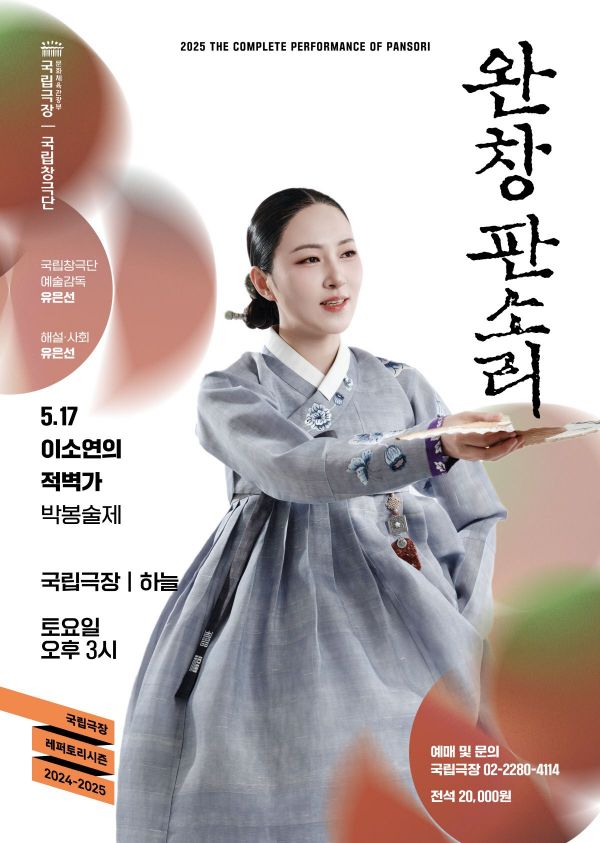
Lee Soyeon, the associate principal singer of the National Changgeuk Company of Korea's Changakbu, will present her first-ever full-length performance on May 17, taking the stage at the National Theater of Korea's Haneul Theater with Park Bong-sul-je "Jeokbyeokga."
Lee Soyeon began studying pansori at the age of 11 under master singer Song Sunseop, a recognized holder of the "Jeokbyeokga" tradition, at the encouragement of her father, who loved traditional singing. She went on to learn "Heungboga," "Sugungga," and "Jeokbyeokga" from Song Sunseop, and studied "Chunhyangga" and "Simcheongga" under Ahn Sookseon and Jeong Hoeseok, respectively, mastering all five major pansori repertoires. In 2004, she was recognized for her talent by winning the top prize in the general division at the Imbangul Gugak Festival, the largest traditional music competition in Korea.
In 2007, she was designated as a successor of the National Intangible Cultural Heritage pansori "Jeokbyeokga," and in the same year, she was selected as a next-generation master singer by the National Changgeuk Company, establishing herself as a leading artist of her generation. Since joining the National Changgeuk Company in 2013, she has played starring roles in the company's representative works, such as Ongnyeo in "Byeongangsoe Jeom Jjigo Ongnyeo," Empress Simcheong in "Simcheongga," and Chunhyang in "Chunhyang." She has also appeared as Okbi in the musical "Arirang" and Songhwa in "Seopyeonje," and gained public recognition by winning the Best New Actress Award at the 2018 Korea Musical Awards.
"Jeokbyeokga" centers on the "Battle of Red Cliffs" from the Chinese novel "Romance of the Three Kingdoms," set during the late Han dynasty and the Three Kingdoms period of Wei, Shu, and Wu, as Cao Cao, Liu Bei, and Sun Quan vie for supremacy. The work features many archaic terms and idioms, and demands a powerful vocal range, making it the most challenging among the five major pansori repertoires. In particular, the singers must perform the voices of generals in a robust and commanding style, requiring solid technique and stamina. The piece also demands the expression of a wide range of emotions, from thrilling scenes like "Jo Ja-ryong Hwal Ssonundae" and "Jeokbyeok Daejeon" to poignant and beautiful passages such as "Saetaryeong" and "Gunsaseolum Taryeong."
The Park Bong-sul-je "Jeokbyeokga" that Lee Soyeon will perform follows the lineage from Song Heung-rok to Song Gwang-rok, Song Man-gap, Park Bong-rae, and Park Bong-sul. It is characterized by a clear yet rough open-throated singing style, with an emphasis on large rhythmic phrases delivered in a straightforward, unembellished manner rather than intricate ornamentation. Lee Soyeon plans to showcase not only her precise vocalization and diction but also her unique, pure, and high-pitched tone, as well as the theatrical expressiveness she has honed as a changgeuk actress, in her debut full-length performance.
Park Geunyoung, a master drummer recognized as the holder of Daejeon Metropolitan City Intangible Cultural Heritage No. 17 for pansori drumming, will accompany her throughout the performance. Yoo Eunseon, artistic director and head of the National Changgeuk Company, will serve as host and commentator to help the audience better understand the performance.
The National Theater of Korea's "Wanchang Pansori" series was first launched in December 1984 to commemorate the 100th anniversary of Shin Jae-hyo's passing, and became a regular event in March of the following year. It has been held continuously for 40 years, boasting the longest and most performances of full-length pansori, and is recognized as a dream stage for the best singers of each era. All seats are priced at 20,000 won.
© The Asia Business Daily(www.asiae.co.kr). All rights reserved.











