Supreme Court: "Second-instance Acquittal Misunderstood Election Law on False Information"
Golf Remarks Related to Kim Moonki and Baekhyeon-dong Comments Ruled Guilty
Case Returned from Seoul High Court to Supreme Court... Lee's Presidential Bid Faces Greater Uncertainty
On May 1, the Supreme Court overturned the second-instance acquittal verdict in the public official election law violation case involving Lee Jaemyung, the presidential candidate of the Democratic Party, and remanded the case with instructions for a guilty verdict. This decision came nine days after the case was referred to the Supreme Court's full bench, and 36 days after the second-instance acquittal. As the Supreme Court has sent the case back to the High Court with a guilty finding, uncertainty has increased over Lee's presidential campaign ahead of the June 3 presidential election.
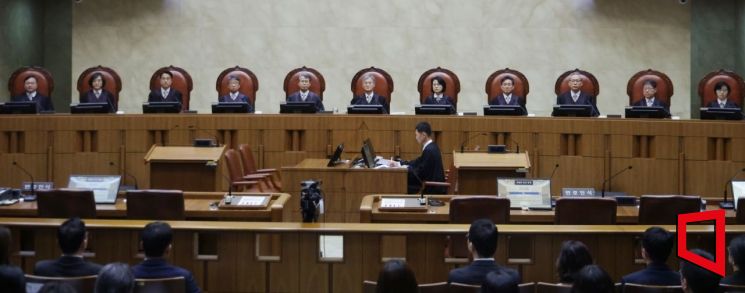 Chief Justice Choi Hee-dae of the Supreme Court, along with other Supreme Court justices, entered the Supreme Court courtroom in Seocho-gu, Seoul, on the afternoon of the 1st to attend the full bench ruling on the public official election law case involving Democratic Party presidential candidate Lee Jae-myung, and took their seats. 2025.05.01 Photo by Joint Press Corps
Since lower courts are required to follow the Supreme Court's rulings, the High Court cannot overturn the full bench's conclusion and acquit Lee. However, in election law cases, the threshold for invalidation of election results and loss of candidacy is a sentence of "a fine of 1 million won or more," meaning that the fate of "politician Lee Jaemyung" will ultimately be determined by the sentence handed down in the Seoul High Court's remand trial. In this case, there is a possibility that the process could extend to another appeal to the Supreme Court, making it virtually impossible for a final decision to be reached before the presidential election. Nonetheless, given the unusually swift judgment by the Supreme Court this time, there is also speculation that a final sentence could be delivered even before the election.
On this day, the Supreme Court's full bench (presiding Justice Park Youngjae) overturned the acquittal verdict and sent the case back to the Seoul High Court. Chief Justice Choi Heedae, who presided over the proceedings, read the verdict for approximately 25 minutes. The Supreme Court stated, "The statements regarding golf with Kim Moonki and the remarks related to Baekhyeon-dong constitute the dissemination of false information under Article 250, Paragraph 1 of the Public Official Election Act," and added, "The second-instance court misunderstood the legal principles concerning the election law." Eleven justices, excluding Supreme Court Justice Noh Taeak, the chairman of the National Election Commission, and Supreme Court Justice Chun Daeyeob, the head of the National Court Administration, participated in the ruling along with Chief Justice Choi Heedae. Ten out of the twelve justices agreed with the majority opinion.
First, the Supreme Court found that Lee's remarks implying that "the photo was fabricated" in relation to suspicions of playing golf with former director Kim constituted the dissemination of false information. Additionally, regarding the remarks about the change of use in Baekhyeon-dong, the Court determined that Lee had made a false statement by claiming that the Ministry of Land, Infrastructure and Transport had threatened to accuse Seongnam City of dereliction of duty, when in fact no such threat had occurred, and thus this constituted the dissemination of specific false facts. The Supreme Court upheld the lower court's acquittal on the rest of the remarks related to Kim, except for the golf-related comments.
The Supreme Court explained, "The act of playing golf together by the defendant and Kim Moonki is an independent fact that can influence voters' judgment regarding the relationship between the defendant and Kim Moonki, and cannot be regarded as merely a supplementary argument regarding perception." In particular, the Court stated, "If the meaning of the golf remarks is determined based on the overall impression given to voters, the statement is interpreted as 'the defendant did not play golf with Kim Moonki during the overseas business trip,' and does not have multiple interpretations as the lower court found." Since Lee, the defendant, did play golf with Kim Moonki during the overseas business trip, the golf statement was deemed a "false fact" regarding the candidate's "conduct."
Regarding the remarks implying "there was a threat from the Ministry of Land, Infrastructure and Transport" in relation to the Baekhyeon-dong change of use, the Supreme Court, contrary to the second-instance court, determined that this constituted the dissemination of "facts," not merely exaggerated expressions or abstract opinions. The Court stated, "The change of use was pursued independently, and there was no pressure from the Ministry of Land, Infrastructure and Transport on Seongnam City during the process, so the 'threat to accuse of dereliction of duty' mentioned by Lee did not exist," and concluded that "the remarks related to Baekhyeon-dong constitute 'false facts' regarding conduct." This means the second-instance court erred in ruling that it was merely an expression of opinion and thus not punishable.
Furthermore, the Supreme Court presented criteria for determining which statements constitute the dissemination of false information under the Public Official Election Act. Regarding the "meaning of the expression," the Court emphasized that "the meaning of the expression should be interpreted from the perspective of ordinary voters, not from the viewpoint of the candidate or the court." On the determination of "false facts," the Court stated, "It must be considered whether the statement is an incidental and minor detail that cannot influence voters' accurate judgment of the candidate's eligibility for public office, or whether it is significant enough to mislead such judgment."
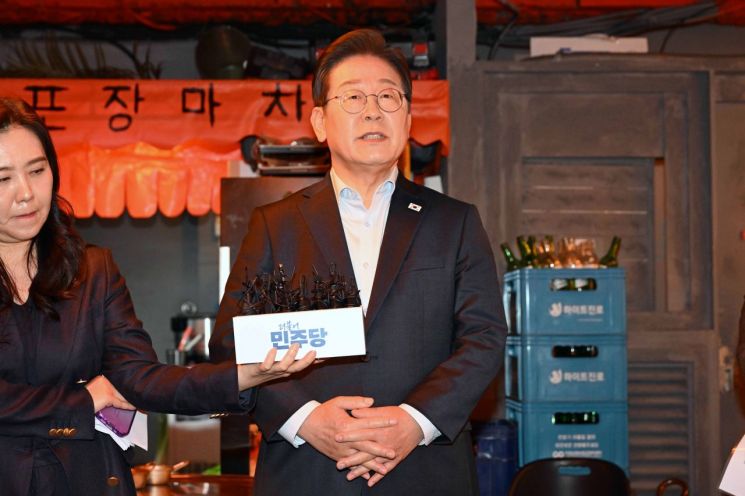
Meanwhile, if the final sentence is not confirmed before the June 3 presidential election, controversy is expected to continue regarding Article 84 of the Constitution, which prohibits 'criminal prosecution while in office.' 'Prosecution' is divided into impeachment and criminal prosecution, but Article 84 addresses only criminal matters. According to the standard Korean dictionary, 'prosecution' means indictment, that is, the filing of charges by the prosecution. If the text of the article is interpreted literally, trials of cases already indicted can continue even after one becomes president. As Article 84 is intended to guarantee stable governance by the president, there is sharp disagreement over whether all trial procedures connected to prosecution should be included, or not.
© The Asia Business Daily(www.asiae.co.kr). All rights reserved.













