From 474 in 2010 to 179 This Year
Discussing Measures Such as Reorganizing Health Institutions and Introducing a Regional Doctor System
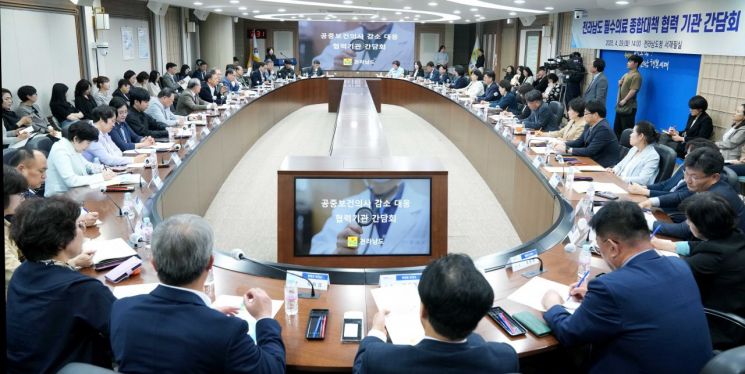 On the 29th, Jeollanam-do held the 'Jeollanam-do Essential Medical Strategy Meeting' in the Seo Jae-pil Room at the provincial government office, attended by local medical professionals and public health medical institution officials. They discussed measures to respond to the decrease in public health doctors and medical personnel, as well as cooperation plans to establish a regional essential medical delivery system. Provided by Jeonnam Province
Jeollanam-do has begun developing countermeasures to address the decrease in the number of public health doctors responsible for primary care in medically underserved areas.
The number of public health doctors assigned to Jeollanam-do has dropped by 62.2% over the past 15 years, from 474 in 2010 to 368 in 2015, 331 in 2020, and 179 in 2025.
The decrease in public health doctors is attributed to several factors. These include an increase in female medical students who are not subject to mandatory military service, the burden of the public health doctor service period (36 months), which is twice as long as that of active-duty soldiers (18 months), and a rise in the number of medical students choosing to complete their active-duty military service while still in medical school.
Since their deployment began in 1979, public health doctors have been responsible for primary care in public health institutions and emergency rooms of hospitals in underserved areas for the past 45 years.
Currently, 18-19% of all public health doctors nationwide are assigned to Jeollanam-do, the highest proportion in the country. As a result, Jeollanam-do is the most affected by the decrease in public health doctors and has taken the initiative to develop countermeasures.
At the meeting, about 50 participants from the local medical community and public health institutions attended, including Lee Minho, representative of Jeollanam-do public health doctors; Choi Unchang, president of the Jeollanam-do Medical Association; Jeon Iyang, chief director of Daeseong Hospital in Wando, representing hospitals in underserved areas; and Choi Youngho, Min Youngdon, and Jeong Giho, directors of local medical centers. They discussed alternative policy tasks in response to the decrease in public health doctors.
The discussion focused on short-term measures such as remote consultations and mobile clinics for unassigned public health institutions (health subcenters), as well as case studies of primary care in underserved areas of Japan, where there is no public health doctor system.
Jeon Iyang stated, "With the declining rural population, it is necessary to consolidate health subcenters at the township level into regional hubs and to allocate public health doctors more efficiently."
Lee Sangsim, Director of Health and Welfare at Jeollanam-do, said, "We plan to organize the various opinions presented at the meeting and propose them as government policy tasks after an expert discussion at the National Assembly. We will do our best to ensure that residents do not face discrimination in medical services due to gaps in regional healthcare."
© The Asia Business Daily(www.asiae.co.kr). All rights reserved.












