KOSME holds meeting with Korean companies in Mexico
Discusses strategies to respond to U.S. tariffs and strengthen local supply chains
The Korea SMEs and Startups Agency (KOSME) announced on the 28th that it had held a meeting in Mexico City with Korean companies operating in Mexico to strengthen their on-site response capabilities to high tariffs imposed by the United States, and that it is working to expand cooperation with local government and economic organizations.
The meeting, held in the afternoon of the 25th local time, was organized to listen to the real voices of Korean SMEs that are considering relocating or expanding their production bases in Mexico due to the spread of protectionism and the strengthening of U.S. trade barriers, and to seek practical support measures.
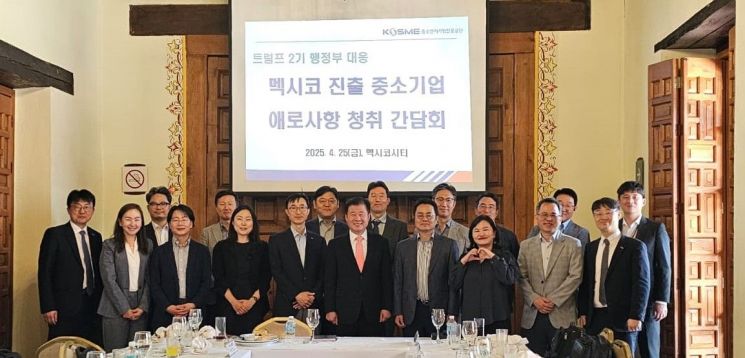 Chairman Seokjin Kang (center front row) is taking a commemorative photo with officials from the Mexico City meeting. Jungjin Corporation
Chairman Kang Seokjin communicated with Korean companies operating in Mexico, reviewing current issues such as responses to U.S. tariffs, requirements for certificates of origin, rising logistics costs, and complex certification procedures, and listened attentively to the difficulties faced by these companies. The CEO of Company A, an auto parts manufacturer who attended the meeting, said, "We are expanding local production in Mexico in response to U.S. tariff measures, but it is essential to increase the local procurement rate of parts to meet the requirements for certificates of origin." He added, "As a result, the burden of manufacturing costs is growing due to the costs of establishing new supply chains, exchange rate volatility when importing raw materials, and rising prices."
Another official from an auto parts company stated, "We experienced operational confusion due to the uncertainty of tariff policies, but if we meet the USMCA (United States-Mexico-Canada Agreement) rules of origin, we can be exempt from tariffs. Therefore, we are closely monitoring external conditions and plan to develop flexible response strategies."
KOSME has also devised specialized support measures to help export-oriented SMEs respond to tariff risks. Through the "Export BArrier zeRO" (BArrier zeRO) program, new voucher services have been introduced to support the discovery of alternative markets, securing alternative supply chains, and resolving tariff disputes. In addition, companies pursuing export diversification due to changes in tariff and trade policies are eligible for new market entry support funds, while companies operating overseas subsidiaries are given priority access to 60 billion KRW in policy funds. KOSME is also taking the lead in supporting companies affected by tariffs by providing preferential support through the Global Business Center (GBC) and offering legal and accounting consulting services.
Chairman Kang also met with Fernando, Director General of Production Development at the Ministry of Economy of Mexico, to convey the difficulties faced by Korean companies in Mexico and to engage in in-depth discussions on several topics: responses to the U.S. high-tariff policy; the impact of global supply chain restructuring on Mexican industry; and ways to collaborate in supporting SMEs in both countries. Furthermore, KOSME signed a business agreement with the Mexican Business Council for Foreign Trade, Investment and Technology (COMCE), the largest private economic organization in Mexico, and agreed to jointly promote business consultations and information exchange events to expand cooperation between the two countries and support SMEs in both nations.
Chairman Kang stated, "As global supply chain uncertainty increases, Mexico will become a strategic base for Korean SMEs to enter the North American market," adding, "We will establish customized policies and support programs to solve issues such as tariffs, certificates of origin, and logistics difficulties, so that Korean companies can stably access the North American market."
© The Asia Business Daily(www.asiae.co.kr). All rights reserved.












