Internal Discussions and Consultations with External Experts in the U.S.
North Korea's Negotiating Power Has Grown Compared to Four Years Ago
Unlikely for the U.S. to Agree to Talks Based on 'Denuclearization' Preconditions
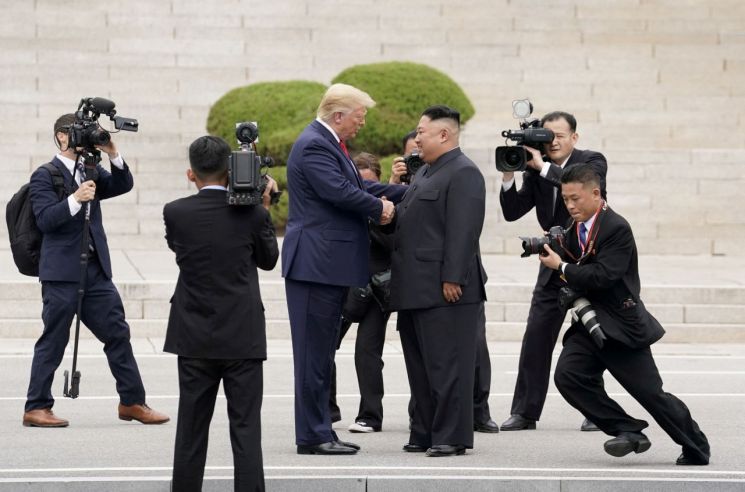 Donald Trump, President of the United States, is shaking hands with Kim Jongun, Chairman of the State Affairs Commission of North Korea, at Panmunjom, the border between South and North Korea, on June 30, 2019, during his first term administration. The American online media Axios reported on the 27th that the second term administration of Trump is preparing behind the scenes to resume talks with North Korea. Photo by Reuters Yonhap News
The American online media outlet Axios reported on the 27th (local time), citing multiple sources, that the second Trump administration in the United States is conducting internal discussions and consulting with external experts in preparation for resuming talks with North Korea. However, given that the U.S. policy goal remains the 'complete denuclearization of North Korea,' it is considered unlikely that Kim Jongun, Chairman of the State Affairs Commission of North Korea, who has gained greater negotiating power compared to the first Trump administration, would accept the same terms previously proposed by the United States.
A senior U.S. official told Axios, "A lot has changed over the past four years. We are convening relevant agencies to understand where North Korea currently stands," adding, "We are assessing and diagnosing the situation, and are discussing potential options, including 'engagement'." Another former senior U.S. official said, "All it takes to capture President Trump's attention is a single 'glamorous letter' from Kim Jongun. Since things could move forward immediately after that, we are working on 'initial planning'.
The Swedish ambassador to North Korea, who acts as the protecting power for U.S. interests, reportedly visited Washington, D.C. last week to consult with U.S. government officials and experts. According to one source, "This was mainly to gauge the atmosphere regarding possible engagement with Pyongyang." A protecting power is a third country that protects or represents the interests of a state with which diplomatic relations have been severed. The United States does not have an ambassador to North Korea.
It has been reported that the U.S. is now considering, at a working level, the designation of an overall coordinator for when U.S.-North Korea talks resume. Officials from the National Security Council (NSC) and the State Department told Axios that they are holding roundtable discussions with external North Korea experts, and that one of the topics discussed was who would be North Korea's counterpart in the event of resumed talks. Andrew Yeo, the Korea Chair at the Brookings Institution, told the outlet, "The ongoing private discussions between current and former U.S. officials and think tank experts indicate that the Trump administration is reviewing various scenarios for a summit between Trump and Kim Jongun."
North Korea is seen as having a stronger negotiating position than four years ago during the first Trump administration. The Trump administration is concerned about several factors: North Korea's nuclear capabilities have advanced compared to the past; North Korea has formed a close military relationship with Russia by supporting the war in Ukraine; and there is the possibility of increased Chinese involvement in North Korean affairs. These factors make it unlikely that President Trump will be able to employ the same pressure-based diplomatic tactics against North Korea in his second term as he did during his first.
More important than these factors is President Trump's own stance on the North Korean nuclear issue. Since entering the White House for a second term in January, President Trump has publicly expressed interest in resuming diplomacy with North Korea. In the process, he referred to North Korea as a 'nuclear-armed state,' raising concerns among allies such as South Korea. On March 31, when asked about plans for contact with North Korea, he described North Korea as a 'massive nuclear state,' leading to ambiguous interpretations, according to Japanese news agency Kyodo and others. At the time, President Trump directly hinted at the possibility of resuming talks with North Korea, saying, "Something will happen soon." Regarding Kim Jongun personally, he has made remarks that seem to showcase their rapport or praise him, such as, "He liked me. I liked him and we got along very well" (January 21), "He is not a religious fanatic. He is a smart man" (January 24), and "I probably know him better than anyone else in the world" (February 10).
A former U.S. official commented, "Past negotiations focused on denuclearization," adding, "Kim Jongun is unlikely to seriously consider this idea now, but if the topic of discussion is arms control that recognizes North Korea as a nuclear-armed state, North Korea would be willing to talk all day." If the United States were to recognize North Korea as a nuclear-armed state, it could open the door to dialogue. On the other hand, Axios pointed out that this could greatly alarm South Korea and Japan, potentially prompting them to pursue their own nuclear weapons development more actively.
© The Asia Business Daily(www.asiae.co.kr). All rights reserved.












