About 50 World Leaders Including Trump and Zelensky Attend
Simple Wooden Coffin Laid to Rest... Interred at Basilica di Santa Maria Maggiore in Rome
The funeral Mass for Pope Francis was held at St. Peter's Square in the Vatican at 10:00 a.m. on April 26 (5:00 p.m. Korean time).
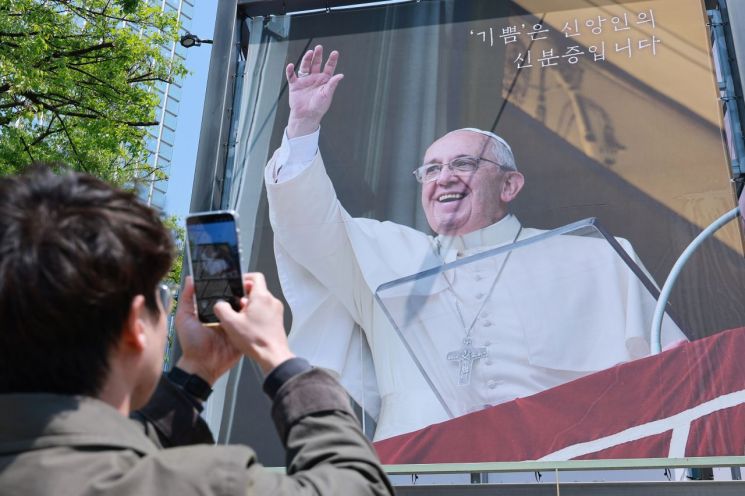 A citizen visiting Myeongdong Cathedral in Jung-gu, Seoul on the 25th is taking a photo of a banner of Pope Francis. Photo by Yonhap News
The funeral Mass was presided over by Cardinal Re and was concelebrated by cardinals, bishops, and priests from around the world. Inside the casket, a pallium (a woolen looped band symbolizing the responsibilities and authority of a high-ranking clergyman), coins and medals minted during the papacy of Pope Francis, and a scroll containing the achievements of his papacy, sealed in a metal cylinder, were placed.
Pope Francis’s burial site was chosen to be the Basilica di Santa Maria Maggiore (the Basilica of Saint Mary Major) near Rome’s Termini Station, a place he often visited, instead of the underground crypt of St. Peter’s Basilica where former popes are interred. It is the first time in 122 years that a pope has been buried outside the Vatican, since Leo XIII was entombed in the Basilica of St. John Lateran in Rome in 1903.
The Pope will be laid to rest in a recessed space inside the basilica wall, which was formerly used to store candlestick bases. At the site where the casket will be placed, only the Latin name 'Franciscus' will be engraved on a white marble slab.
Delegations from about 130 countries, including around 50 heads of state such as U.S. President Donald Trump, Ukrainian President Volodymyr Zelensky, and European Commission President Ursula von der Leyen, as well as about 10 monarchs, visited the Vatican to pay their respects.
The Korean government dispatched a joint public-private condolence delegation led by Minister of Culture, Sports and Tourism Yoo In-chon. Oh Hyunju, Korean Ambassador to the Holy See, and Ahn Jaehong, President of the Catholic Lay Apostolate Council of Korea, accompanied the delegation as members.
The Vatican announced that 200,000 people attended the funeral Mass that day. Prior to the Mass, from April 23 over three days, about 250,000 people visited St. Peter’s Basilica to pay their respects. Unlike his predecessors, whose caskets were placed at waist height, the body of Pope Francis was laid in a low wooden coffin close to the floor to receive mourners.
Beginning with the funeral Mass, daily memorial prayer services will be held at St. Peter’s Square during the nine-day mourning period called 'Novendiali', which will continue until May 4. The Pope’s tomb will be open to the public starting April 27.
The conclave (Conclave, the secret meeting of the College of Cardinals to elect a new pope) will begin sometime between May 5 and May 10. The 135 cardinals under the age of 80 will vote once on the afternoon of the first day, and twice daily from the second day onward. When a candidate receives more than two-thirds of the votes of all electors, white smoke will be released from the chimney of the Sistine Chapel to signal that a new pope has been elected.
Pope Francis passed away from a stroke and heart failure at 7:35 a.m. on April 21. Born in Argentina in 1936, he became the first non-European and the first from the New World to be elected pope in 2013, the first in 1,282 years. He chose the papal name Francis after Saint Francis of Assisi, known as the 'saint of the poor', and lived a life of simplicity. He was regarded as the most progressive pope in history, allowing Catholic priests to bless same-sex couples, among other reforms.
© The Asia Business Daily(www.asiae.co.kr). All rights reserved.